
The end of the earnings season is always a good time to take a step back and see who shined (and who not so much). Let’s take a look at how finance and hr software stocks fared in Q3, starting with BILL (NYSE: BILL).
Organizations are constantly looking to improve organizational efficiencies, whether it is financial planning, tax management or payroll. Finance and HR software benefit from the SaaS-ification of businesses, large and small, who much prefer the flexibility of cloud-based, web-browser delivered software paid for on a subscription basis than the hassle and expense of purchasing and managing on-premise enterprise software.
The 13 finance and HR software stocks we track reported a strong Q3. As a group, revenues beat analysts’ consensus estimates by 3% while next quarter’s revenue guidance was in line.
In light of this news, share prices of the companies have held steady. On average, they are relatively unchanged since the latest earnings results.
BILL (NYSE: BILL)
Transforming the messy back-office financial operations that plague small business owners, BILL (NYSE: BILL) provides a cloud-based platform that automates accounts payable, accounts receivable, and expense management for small and midsize businesses.
BILL reported revenues of $395.7 million, up 10.4% year on year. This print exceeded analysts’ expectations by 1.2%. Overall, it was a strong quarter for the company with an impressive beat of analysts’ EBITDA estimates and full-year EPS guidance beating analysts’ expectations.

Interestingly, the stock is up 15.7% since reporting and currently trades at $51.35.
Is now the time to buy BILL? Access our full analysis of the earnings results here, it’s free for active Edge members.
Best Q3: Marqeta (NASDAQ: MQ)
Powering the cards behind innovative fintech services like Block's Cash App, Marqeta (NASDAQ: MQ) provides a cloud-based platform that allows businesses to create customized payment card programs and process card transactions.
Marqeta reported revenues of $163.3 million, up 27.6% year on year, outperforming analysts’ expectations by 9.7%. The business had an incredible quarter with a solid beat of analysts’ EBITDA and total payment volume estimates.
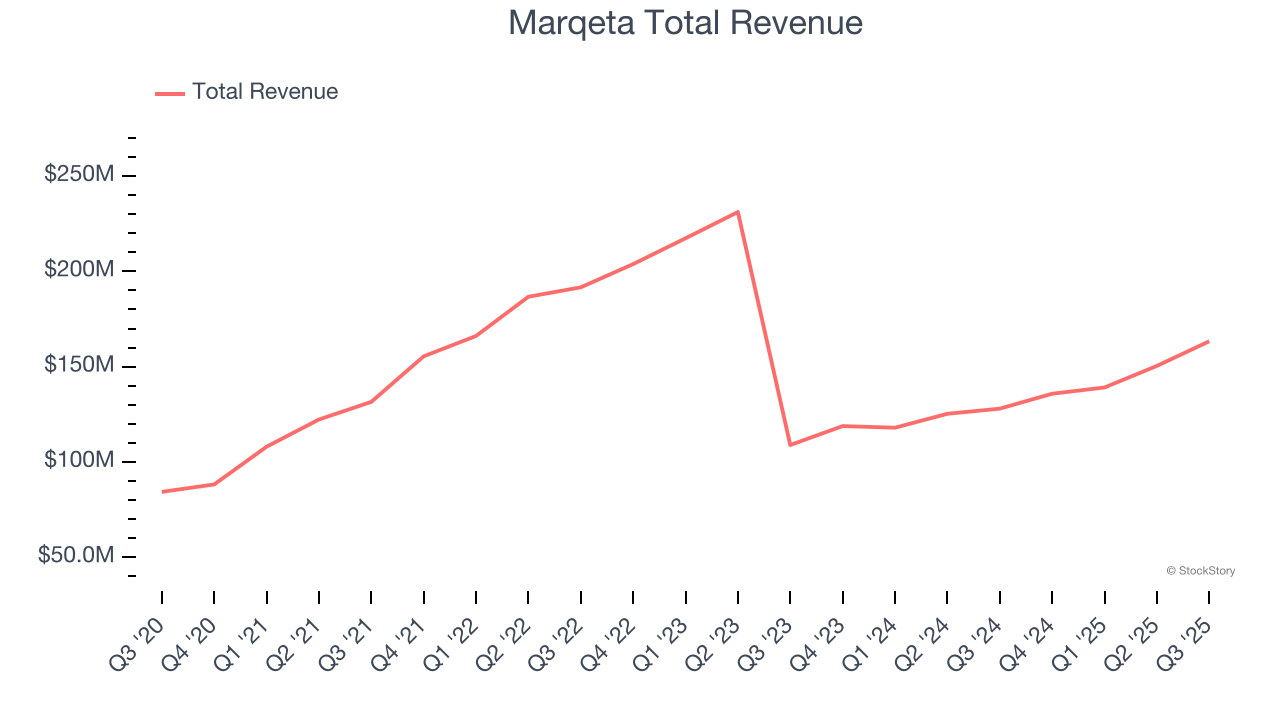
The market seems happy with the results as the stock is up 5.7% since reporting. It currently trades at $4.74.
Is now the time to buy Marqeta? Access our full analysis of the earnings results here, it’s free for active Edge members.
Weakest Q3: BlackLine (NASDAQ: BL)
Born from the vision to eliminate tedious manual spreadsheet work for accountants, BlackLine (NASDAQ: BL) provides cloud-based software that automates and streamlines financial close, intercompany accounting, and invoice-to-cash processes for accounting departments.
BlackLine reported revenues of $178.3 million, up 7.5% year on year, in line with analysts’ expectations. It was a slower quarter as it posted EPS guidance for next quarter missing analysts’ expectations significantly and decelerating customer growth.
BlackLine delivered the slowest revenue growth in the group. The company lost 27 customers and ended up with a total of 4,424. As expected, the stock is down 1.3% since the results and currently trades at $56.10.
Read our full analysis of BlackLine’s results here.
Intuit (NASDAQ: INTU)
Originally named after its founding product "Intuitive for the first-time user," Intuit (NASDAQ: INTU) provides financial management software and services including TurboTax, QuickBooks, Credit Karma, and Mailchimp to help consumers and small businesses manage their finances.
Intuit reported revenues of $3.89 billion, up 18.3% year on year. This result surpassed analysts’ expectations by 3.2%. More broadly, it was a satisfactory quarter as it also logged an impressive beat of analysts’ billings estimates but EPS guidance for next quarter missing analysts’ expectations.
The stock is down 2.7% since reporting and currently trades at $628.85.
Read our full, actionable report on Intuit here, it’s free for active Edge members.
Workday (NASDAQ: WDAY)
Born from the vision of PeopleSoft founders after Oracle's hostile takeover of their previous company, Workday (NASDAQ: WDAY) provides cloud-based software for financial management, human resources, planning, and analytics to help organizations manage their business operations.
Workday reported revenues of $2.43 billion, up 12.6% year on year. This print beat analysts’ expectations by 0.7%. Overall, it was a very strong quarter as it also recorded a solid beat of analysts’ billings estimates and a decent beat of analysts’ EBITDA estimates.
The stock is down 9.1% since reporting and currently trades at $213.67.
Read our full, actionable report on Workday here, it’s free for active Edge members.
Market Update
Thanks to the Fed’s series of rate hikes in 2022 and 2023, inflation has cooled significantly from its post-pandemic highs, drawing closer to the 2% goal. This disinflation has occurred without severely impacting economic growth, suggesting the success of a soft landing. The stock market thrived in 2024, spurred by recent rate cuts (0.5% in September and 0.25% in November), and a notable surge followed Donald Trump’s presidential election win in November, propelling indices to historic highs. Nonetheless, the outlook for 2025 remains clouded by potential trade policy changes and corporate tax discussions, which could impact business confidence and growth. The path forward holds both optimism and caution as new policies take shape.
Want to invest in winners with rock-solid fundamentals? Check out our Top 5 Quality Compounder Stocks and add them to your watchlist. These companies are poised for growth regardless of the political or macroeconomic climate.
StockStory’s analyst team — all seasoned professional investors — uses quantitative analysis and automation to deliver market-beating insights faster and with higher quality.