As of January 20, 2026, a fundamental shift has occurred in the plumbing of global finance. For decades, the "tape"—the real-time feed of stock and bond prices—was the undisputed source of truth for traders. Today, that tape has a rival. Professional desks at major banks and hedge funds are increasingly turning to prediction markets like Kalshi and Polymarket not just to hedge, but for "Information Discovery"—identifying market-moving signals before they hit the Bloomberg terminal.
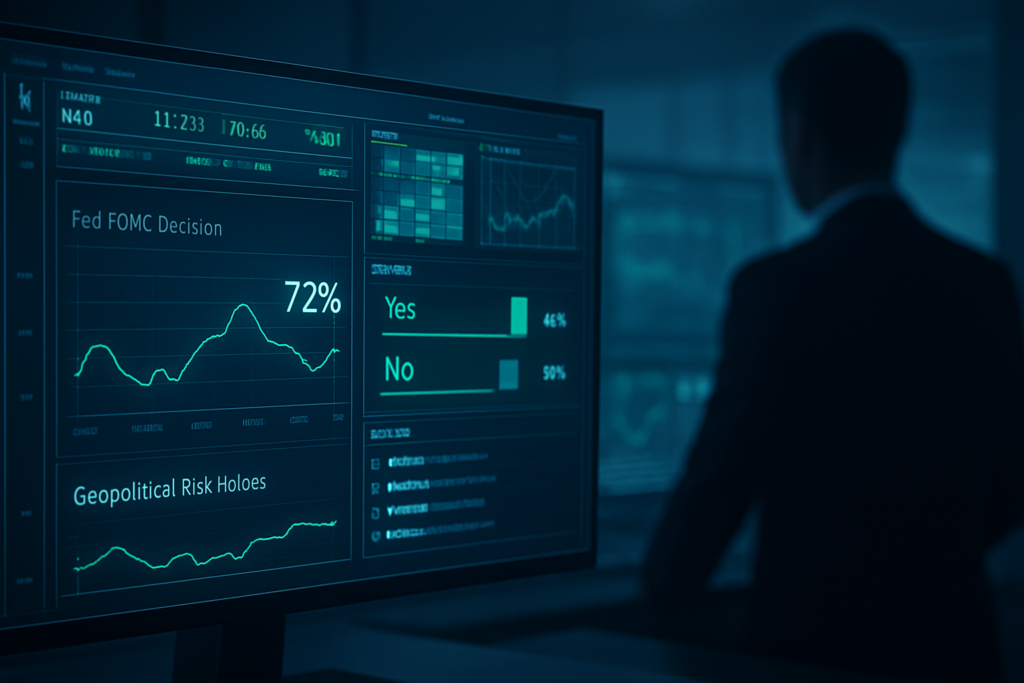
This week, the "Information Discovery" trend reached a fever pitch. While traditional interest rate futures at CME Group (NASDAQ: CME) showed a lingering 16% chance of a rate cut at the upcoming January FOMC meeting, prediction markets had already moved to a 96% "certainty" of a pause. This 12-point "certainty gap" allowed savvy traders to front-run moves in the USD/EUR forex pairs and adjust positions in interest-rate-sensitive stocks before the broader market caught on. With daily trading volumes in the sector hitting a record $701.7 million this month, prediction markets have officially graduated from political novelties to essential financial infrastructure.
The Market: What's Being Predicted
The current landscape of prediction markets is dominated by two primary forces: the regulated U.S. powerhouse Kalshi and the decentralized giant Polymarket, which recently finalized its re-entry into the U.S. via the $112 million acquisition of QCX. These platforms host thousands of "event contracts" ranging from the mundane (monthly CPI prints) to the tectonic (geopolitical regime changes).
Unlike traditional derivatives, which are often tied to the underlying price of an asset, event contracts settle based on the binary outcome of a real-world event. For instance, the "Will the Fed raise rates in January?" contract on Kalshi has seen massive liquidity, with over 2.5 billion contracts traded across integrated platforms like Robinhood Markets, Inc. (NASDAQ: HOOD) in the final quarter of 2025 alone. Current odds on Kalshi show a stagnant 4% probability for a hike, a signal that has remained remarkably stable even as traditional bond yields fluctuated wildly last week.
The speed of resolution is also a key factor. While traditional markets often wait for official government reports or press releases, prediction markets react to "boots on the ground" data in real-time. This has created a high-velocity environment where liquidity and volume have skyrocketed, with the total notional value of the prediction market sector exceeding $13 billion in late 2025.
Why Traders Are Betting
The move toward prediction markets is driven by a simple realization: these markets are often more accurate and faster than professional surveys or analyst consensus. Institutional traders are using these platforms to find "alpha"—the elusive market-beating edge.
A prime example occurred earlier this month on January 3, 2026. Hours before U.S. forces announced the capture of Venezuelan President Nicolás Maduro, specific geopolitical contracts on Polymarket began to swing violently toward a "Yes" outcome. A handful of anonymous traders netted over $400,000 on the move. More importantly, this signal preceded a 10% intraday surge in Chevron (NYSE: CVX) and other Latin American-exposed energy stocks when the NYSE opened the following Monday. Traders who monitored the Polymarket signal were able to position themselves in Chevron before the news was fully digested by traditional equity desks.
Large-scale "whale" activity is also becoming more transparent. Boaz Weinstein of Saba Capital recently highlighted a divergence where prediction markets priced recession risk at 50%, while traditional credit markets implied only a 2% chance. This allowed hedge funds to construct "paired trades"—effectively using the cheap "No Recession" contracts as a hedge while shorting expensive credit instruments. This sophisticated arbitrage is why firms like Susquehanna International Group (SIG) have stepped in as official market makers for Kalshi, and why JPMorgan Chase & Co. (NYSE: JPM) has reportedly integrated real-time prediction market feeds into its internal research dashboards.
Broader Context and Implications
The "Information Discovery" trend is the crown jewel of the "Information Finance" era. It represents a shift from guessing what will happen to pricing what is actually happening in the collective consciousness of the most informed participants. Historically, prediction markets have outperformed pundits and polls in nearly every major election and economic cycle since 2020.
The regulatory environment has finally provided the tailwinds necessary for this institutional adoption. The passage of the Digital Asset Market CLARITY Act of 2025 provided a federal framework that reclassified many event-related assets as commodities, ending years of legal limbo between the SEC and the CFTC. While state-level challenges remain—with New Jersey and Nevada recently issuing cease-and-desist orders against certain sports-related contracts—the federal path for economic and political markets is clearer than ever.
For the broader public, these markets provide a "bullshit detector" for the 24-hour news cycle. When a politician makes a claim or a CEO issues a vague guidance, the market price on a corresponding event contract serves as an immediate, incentivized truth-check.
What to Watch Next
As we move through the first quarter of 2026, the primary focus will be on the "Macro Trifecta": the February CPI print, the Q1 earnings season for "Magnificent Seven" stocks like Microsoft (NASDAQ: MSFT), and the implementation of the CLARITY Act’s secondary market rules.
Traders should specifically watch for discrepancies between the "Earnings Surprise" contracts on ForecastEx—the platform run by Interactive Brokers Group (NASDAQ: IBKR)—and the implied volatility in the options market. If prediction markets begin to signal an earnings beat for big tech 48 hours before the release, we could see significant pre-market moves in the underlying stocks.
Additionally, the battle between state and federal regulators will reach the Supreme Court later this year. The outcome of these cases will determine if prediction markets can expand into more granular, localized events, or if they will remain focused on high-level macro and geopolitical shifts.
Bottom Line
The rise of "Information Discovery" marks the end of the analyst-survey era and the beginning of the market-signal era. As Goldman Sachs Group, Inc. (NYSE: GS) executives noted in their latest earnings call, prediction markets are no longer a "side-show"; they are a fundamental data layer that informs how the world's largest banks price risk.
The key takeaway for any investor is that the "truth" is now priced in real-time, 24/7, by people with skin in the game. Whether you are trading stocks, currencies, or commodities, ignoring the signals from Kalshi and Polymarket is becoming a luxury that professional traders can no longer afford. As liquidity continues to pool in these markets, their ability to predict the future—and move the present—will only grow.
This article is for informational purposes only and does not constitute financial or betting advice. Prediction market participation may be subject to legal restrictions in your jurisdiction.
PredictStreet focuses on covering the latest developments in prediction markets.
Visit the PredictStreet website at https://www.predictstreet.ai/.