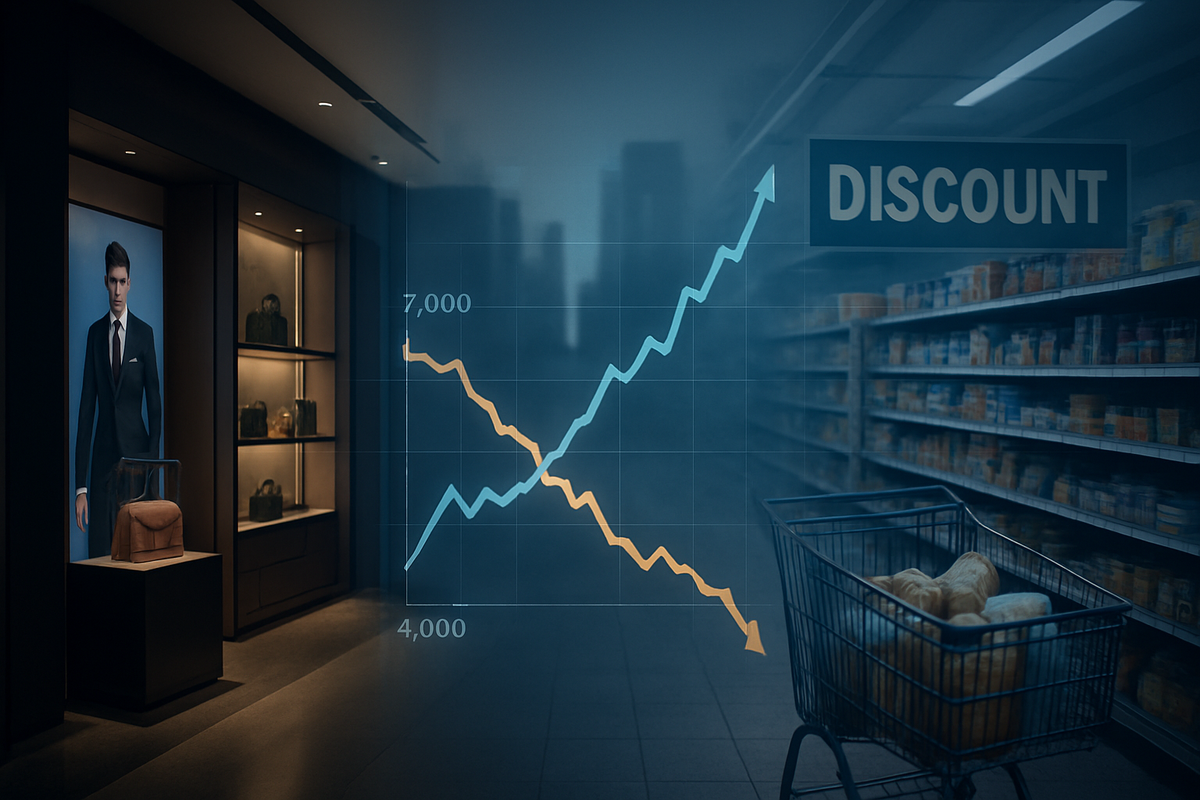
As of March 5, 2026, the American consumer is standing at a critical crossroads. Following a period of historic market highs and cooling inflation, the latest retail indicators for January suggest that while the broader economy remains resilient, the "K-shaped" recovery has deepened. With official government data delayed until tomorrow, private sector benchmarks indicate a marginal rise in spending that masks a growing divide between high-income stability and lower-income exhaustion.
The immediate implications are clear: the consumer discretionary sector is under intense pressure. While the S&P 500 recently shattered records by crossing the 7,000-point threshold, the retailers and brands that rely on non-essential spending are lagging behind. Investors are now grappling with a market where digital growth and luxury services thrive, while big-ticket items and mass-market goods struggle to find footing amidst persistent, though moderating, interest rate pressures.
Resilient Totals Mask Internal Fractures
The retail landscape in January 2026 was defined by a unique set of circumstances, including a federal funding lapse that delayed the official U.S. Census Bureau "Advance Monthly Retail Trade" report. In its absence, the market leaned heavily on the CNBC/NRF Retail Monitor, which reported on February 12 that total retail sales (excluding autos and gas) rose a modest 0.2% month-over-month. On a yearly basis, unadjusted sales grew by 5.72%, a figure that suggests the consumer has not yet "quit," but is certainly being more selective.
This performance follows a robust 2025 holiday season that saw 4.1% year-over-year growth, setting a high bar for the new year. However, the momentum from the holidays appears to have hit a wall in late January. While clothing and accessories surged by 9.39% and digital products climbed 6.45%, these gains were offset by a sharp 6.26% contraction in building and garden supplies. This decline reflects a housing market that remains sluggish despite expectations of upcoming monetary easing.
The timeline leading to this moment has been one of extreme volatility. After a record-setting January where the S&P 500 gained 1.45%, February brought a shift in sentiment. Geopolitical tensions in the Middle East and a "scare trade" regarding artificial intelligence disruption in traditional retail models led to a defensive posture among institutional investors. Initial reactions to the private retail data were neutral-to-bearish, as the modest growth was viewed as "just enough" to keep the Federal Reserve from rushing into aggressive rate cuts.
Winners and Losers in a Divided Market
The divergent paths of individual companies have become the defining story of the 2026 earnings season. Lowe’s Companies, Inc. (NYSE: LOW) surprised analysts with a 13.67% gain in January, largely driven by high-end professional contracts and a resilient upper-income demographic continuing to invest in home maintenance. Similarly, Starbucks Corporation (NASDAQ: SBUX) saw a 13.22% boost early in the year, benefiting from its "affordable luxury" status and a sustained shift in consumer preference toward experiential spending over durable goods.
On the losing side, the consumer discretionary heavyweight Amazon.com, Inc. (NASDAQ: AMZN) sent shockwaves through the sector in early February. After reporting fourth-quarter results that initially seemed strong, the e-commerce giant issued a cautious outlook for Q1 2026, missing operating income guidance and causing its stock to tumble 12% in a single week. This sell-off dragged down the Consumer Discretionary Select Sector SPDR Fund (NYSE Arca:XLY), which currently stands as the only S&P 500 sector reporting a year-over-year earnings decline as of early March.
Furthermore, discount retailers are beginning to report "pockets of stress" among lower-income households. While "Everyday Low Price" leaders like Walmart Inc. (NYSE: WMT) continue to capture market share as consumers "trade down," the broader discretionary space—including furniture and high-end electronics—is suffering. The expiration of the last remaining pandemic-era debt relief measures in late 2025 has left many households "tapped out," forcing a prioritization of essentials over upgrades.
Inflation, Interest Rates, and Historical Precedents
The current retail environment fits into a broader trend of "disinflationary growth." With the Consumer Price Index (CPI) cooling to 2.4% in January—down from 2.7% in December—the macroeconomic backdrop is improving. However, the Federal Reserve has maintained its benchmark interest rate in the 3.5%–3.75% range. For consumers, this means that while prices are no longer skyrocketing, the cost of carrying credit card debt or financing a vehicle remains at a decade-high level, stifling big-ticket discretionary purchases.
Comparisons are already being drawn to the post-2008 recovery and the mid-2010s, where "retail apocalypses" were frequently predicted. The 2026 version of this narrative, however, is driven by the rapid integration of AI and automation. Retailers that failed to pivot to high-efficiency, AI-driven logistics are seeing their margins compressed by rising labor costs and potential tariff-related price hikes. The "scare trade" seen in early March reflects a market that is no longer rewarding mere size; it is rewarding agility and technological integration.
The ripple effects extend beyond US borders. With supply chains increasingly sensitized to Middle Eastern instability, global retailers are facing higher freight costs. This has created a bifurcated policy environment where the Fed is looking for reasons to cut rates to support the slowing consumer, while simultaneously monitoring the inflationary risks of rising energy prices and shipping disruptions.
The Road Ahead: Potential Pivots and Market Scenarios
In the short term, all eyes are on the March 6 release of the official U.S. Census Bureau data. If the government figures confirm the private sector’s lukewarm 0.2% growth, market participants expect the Fed to hold steady through the spring, with a potential rate cut delayed until June. This scenario would likely keep the consumer discretionary sector in a period of consolidation, as companies wait for lower borrowing costs to stimulate demand for larger purchases.
Strategically, the next six months will require retailers to double down on "value engineering." We are likely to see an increase in private-label product launches and aggressive loyalty program expansions. Companies that can bridge the gap between digital convenience and physical experience—a trend often called "phygital" retail—will be better positioned to weather the K-shaped storm. There is also a significant opportunity for mergers and acquisitions; smaller, distressed discretionary brands may become targets for cash-rich tech giants or diversified conglomerates looking to acquire loyal customer bases at a discount.
Longer-term, the market's recovery hinges on the "wealth effect." If equity markets continue their climb and the S&P 500 stabilizes above 7,000, the upper-middle-class consumer may provide enough of a floor to prevent a broader retail recession. However, if geopolitical tensions escalate or if AI-driven job displacement begins to manifest in the employment data, the consumer discretionary sector could face a multi-year restructuring.
Final Assessment for Investors
The January retail data release is a sobering reminder that a record-breaking stock market does not always reflect the reality of the average household. The "K-shaped" consumer behavior observed in early 2026 highlights a significant divergence: high-end services and digital commerce are thriving, while traditional discretionary goods are struggling under the weight of high interest rates and shifting priorities.
Moving forward, investors should watch for three key indicators: the official March 6 Census data, the Fed’s commentary during the late-March meeting, and the Q1 2026 earnings guidance from mass-market retailers. These will provide the ultimate verdict on whether the current slowdown is a temporary "soft patch" or the beginning of a more profound shift in consumer spending habits.
For now, the mantra for the market remains "cautious selectivity." In an era where the S&P 500 can hit 7,000 while its retail components lag, picking winners based on technological resilience and balance sheet strength has never been more vital. The "scare trade" may dominate the headlines today, but the long-term story will be written by those companies that can navigate the increasingly fractured path of the American consumer.
This content is intended for informational purposes only and is not financial advice