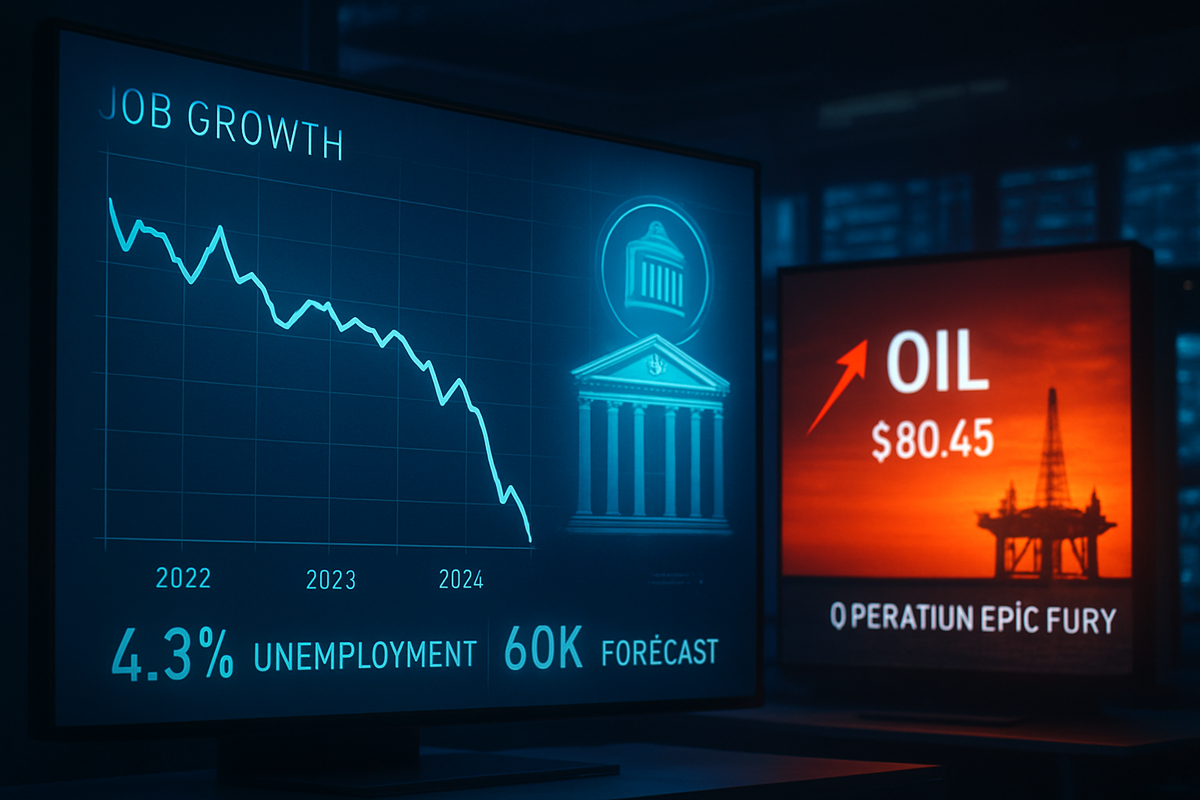
As the sun rises on March 5, 2026, Wall Street is bracing for one of the most consequential economic data points of the year. Tomorrow’s release of the February Nonfarm Payrolls (NFP) report by the Bureau of Labor Statistics comes at a precarious moment for the U.S. economy. Investors are caught between a cooling domestic labor market and a sudden, sharp geopolitical shock—the launch of "Operation Epic Fury"—which has sent energy prices spiraling and complicated the Federal Reserve's path toward a soft landing.
The consensus among economists suggests a significant deceleration in hiring, with a forecast of just 60,000 new jobs, down from a revised 130,000 in January. With the unemployment rate expected to hold steady at 4.3%, the report will serve as a critical barometer for whether the economy is merely downshifting or heading toward a more profound contraction. For the Federal Reserve, the data will be the final major piece of the puzzle before their March 17-18 policy meeting, where the stakes for interest rate stability have never been higher.
A Delicate Balancing Act for the U.S. Economy
The road to this February report has been marked by extreme volatility and conflicting signals. While January’s headline number of 130,000 initially suggested resilience, subsequent benchmark revisions painted a far bleaker picture, revealing that the U.S. economy actually supported nearly 900,000 fewer jobs in 2025 than previously estimated. This backdrop of "low-hire, low-fire" has left the market sensitive to even minor fluctuations. Adding to the complexity is the recent military escalation in the Middle East, which has driven Brent crude into the $80s, threatening to reignite inflation just as the labor market begins to fray.
The timeline leading to tomorrow’s release has been dominated by a series of localized shocks. In February, a major strike by the United Nurses Associations of California (UNAC/UHCP) is expected to have temporarily shaved approximately 31,000 jobs from the headline figure. Furthermore, the ADP Private Payrolls report released yesterday showed a modest gain of 63,000, reinforcing the narrative of a slowing engine. Stakeholders ranging from retail investors to institutional giants like JPMorgan Chase & Co. (NYSE: JPM) are watching the "Average Hourly Earnings" component with particular intensity; a print above the forecasted 0.4% monthly increase could signal that wage-push inflation remains a persistent threat despite the hiring slowdown.
Corporate Winners and Losers in a Shifting Landscape
The cooling labor market has created a stark divide between industries. In the technology sector, the narrative of "AI efficiency" has translated into a fresh wave of job cuts. Block, Inc. (NYSE: SQ) recently made headlines by announcing a 40% reduction in its workforce, a move that sent ripples through the fintech space. While such maneuvers may please shareholders looking for leaner margins, they signal a broader cautiousness among high-growth companies. Similarly, professional staffing firms like Robert Half Inc. (NYSE: RHI) are facing headwinds as permanent placement activity wanes in a "wait-and-see" environment.
Conversely, the healthcare and energy sectors appear to be the current bastions of strength. Healthcare giants like UnitedHealth Group Incorporated (NYSE: UNH) continue to be the primary drivers of job creation, as an aging demographic ensures consistent demand regardless of the broader economic cycle. Meanwhile, the energy sector, led by titans such as Exxon Mobil Corporation (NYSE: XOM), is poised to benefit from the "Epic Fury" geopolitical risk premium. Rising oil prices may hurt the consumer, but they bolster the balance sheets of domestic producers, potentially leading to increased capital expenditure and localized hiring in the Permian Basin.
The Fed's Geopolitical Dilemma and Historical Parallels
The February NFP report is more than just a jobs tally; it is a stress test for the Federal Reserve’s current "pause" strategy. As of today, the CME FedWatch Tool indicates a 98% probability that the FOMC will maintain the target rate at 3.50% - 3.75% later this month. However, the emergence of energy-led inflation—often referred to as a "cost-push" shock—evokes memories of the late 1970s. Historical precedents suggest that the Fed is loath to cut rates when energy prices are surging, for fear of unanchoring inflation expectations, even if the labor market is softening.
This puts Chairman Powell in a difficult position. If tomorrow's report comes in significantly weaker than 60,000, the calls for a rate cut to prevent a recession will grow deafening. Yet, if wage growth remains high, the Fed may be forced to maintain a "higher for longer" stance to combat the stagflationary ghost of the energy shock. This "Goldilocks" search—for a number that is not too hot to fuel inflation but not too cold to signal a hard landing—is the central theme of the current policy cycle.
Looking Ahead: The Path to May and June
In the short term, a "miss" in the NFP data could lead to immediate market volatility, with Treasury yields likely retreating as investors bet on a more dovish Fed in the second half of the year. However, the long-term outlook remains tethered to the resolution of geopolitical tensions. If energy prices remain elevated, corporate America may transition from "efficiency-driven" layoffs to broader cost-cutting measures, which could accelerate the rise in the unemployment rate toward the 4.5% threshold—a level many analysts consider a "danger zone" for consumer spending.
Strategic pivots are already underway. Companies are increasingly prioritizing automation and AI-integration to maintain output with fewer heads, a trend that may permanently alter the structure of the U.S. labor market. Investors should watch for whether the "strike effect" in the February data is quickly reclaimed in March, or if it marks the beginning of a more sustained trend of labor unrest as workers' purchasing power is squeezed by rising fuel and food costs.
Navigating a New Economic Reality
As we await the 8:30 a.m. release tomorrow, the key takeaway is that the labor market is no longer the monolithic engine of growth it was in 2024. The transition to a "low-hire" environment, combined with exogenous shocks in the energy market, has created a complex web for investors to navigate. While a steady unemployment rate of 4.3% offers some comfort, the underlying sector concentration and the impact of large-scale tech layoffs suggest that the surface-level stability may be fragile.
Moving forward, the focus will shift from the sheer quantity of jobs to the quality of earnings and the persistence of wage growth. For investors, the next few months will require a defensive posture, favoring sectors with inelastic demand like healthcare and energy, while remaining cautious on consumer-discretionary and high-multiple tech stocks. The February NFP report will not just be a data point; it will be the starting gun for the market's next major thematic shift.
This content is intended for informational purposes only and is not financial advice