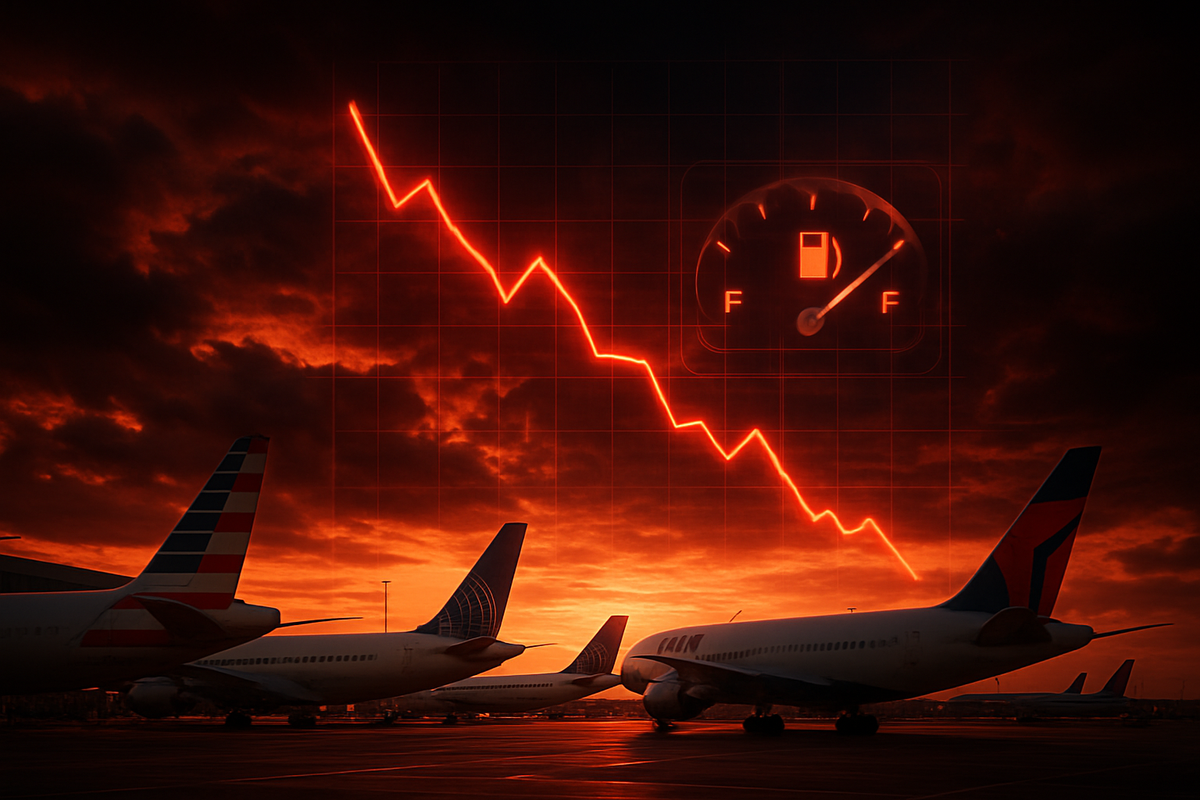
The airline industry faced a grueling session on Thursday, March 5, 2026, as a sudden and dramatic escalation in Middle Eastern geopolitical tensions sent jet fuel prices to multi-year highs. The resulting sell-off erased billions in market capitalization across the sector, casting a long shadow over what was previously predicted to be a record-breaking year for global aviation profits. Investors, spooked by the prospect of a prolonged energy crisis and restricted air corridors, hit the exit button in unison, leading to the steepest single-day decline for major carriers in nearly two years.
By the closing bell, American Airlines (NASDAQ: AAL) led the descent among the "Big Three," tumbling 5.4%. United Airlines (NASDAQ: UAL) followed closely with a 5.0% drop, while Delta Air Lines (NYSE: DAL) proved slightly more resilient but still finished the day down 3.9%. The volatility underscores the fragility of an industry that remains at the mercy of global oil markets and the geopolitical stability of key transit regions.
A Geopolitical Shockwave Hits the Tarmac
The catalyst for the March 5 market rout began in late February 2026, when a series of military strikes involving the U.S., Israel, and Iran led to the effective closure of the Strait of Hormuz. By early March, tanker traffic through this vital waterway—responsible for roughly 20% of the world’s oil and gas supply—had reportedly plummeted by 94%. This supply-side shock sent Brent crude prices surging toward $82 per barrel, but the impact was even more pronounced for refined products. Jet fuel prices in Europe and North America surpassed $1,000 per tonne for the first time in 30 months, driven by a widening "crack spread" as refinery capacity struggled to meet military and commercial demand simultaneously.
The immediate operational fallout was equally severe. On March 2, major airspace corridors over Iran, Iraq, and the UAE were shuttered, forcing carriers to reroute international long-haul flights. These detours added between 90 to 120 minutes of flight time to routes connecting the U.S. and Europe to Asia, significantly increasing fuel burn at the exact moment fuel became most expensive. For United Airlines, which maintains high capacity exposure to the Middle East, the crisis triggered thousands of cancellations at transit hubs like Dubai International (DXB), which saw its operations temporarily paralyzed by the regional instability.
Winners and Losers in a High-Cost Environment
The sell-off highlighted the differing defensive strategies among the major U.S. carriers. American Airlines (NASDAQ: AAL) bore the brunt of the investor exodus due to its unique vulnerability: the company famously does not hedge its fuel costs. With a debt load of approximately $36.5 billion and razor-thin profit margins despite record 2025 revenues, American is viewed by analysts as the most sensitive to energy shocks. Today's 5.4% drop reflects growing fears that any sustained spike in fuel prices could quickly wipe out the company's projected 2026 earnings.
Conversely, Delta Air Lines (NYSE: DAL) managed to outperform its peers during the slide, largely thanks to its strategic ownership of a refinery in Trainer, Pennsylvania. This asset provides Delta with a partial "natural hedge" against rising crack spreads, allowing the carrier to offset some of the increased costs of refined jet fuel. Additionally, Delta’s heavy concentration of premium and business travelers—who are historically less price-sensitive than budget travelers—gives the company more leverage to implement "fuel surcharges" to pass costs onto consumers.
United Airlines (NASDAQ: UAL) occupies a middle ground. While it entered 2026 with strong momentum and record earnings of $10.62 per share in 2025, its vast international network is now a liability. Investors are weighing United’s modern, fuel-efficient fleet against the reality of its heavy Middle Eastern exposure. The 5.0% drop suggests that while the company is financially healthier than it was five years ago, it remains highly exposed to the operational chaos of global conflict.
Wider Significance and Historical Precedents
This energy spike represents a major pivot for an industry that the International Air Transport Association (IATA) had recently forecasted would earn $41 billion in net profits in 2026. Those projections are now being recalibrated as the industry faces a "perfect storm" of high fuel costs and capacity constraints. Supply chain issues at Boeing and Airbus have already limited the number of new, more efficient aircraft available to airlines, leaving them with older, thirstier fleets to navigate this crisis.
Historically, the March 5 sell-off draws comparisons to the energy shocks of 2022. However, the current situation is complicated by record-high load factors. With planes already flying at 85% capacity, there is little room for airlines to consolidate flights to save fuel without leaving thousands of passengers stranded. This lack of a "buffer" means the financial impact of every cancelled flight or rerouted journey is amplified compared to previous decades.
Navigating the Flight Path Ahead
In the short term, travelers should prepare for a significant rise in ticket prices as airlines move to implement emergency fuel surcharges. Market analysts at Rothschild Redburn have already begun downgrading the sector, suggesting that if Brent crude hits the $100 mark, even the most efficient carriers will struggle to maintain profitability. The next several weeks will be critical as carriers report their first-quarter earnings and provide updated guidance on how they plan to manage the escalating costs.
Strategic pivots may include a further reduction in secondary long-haul routes and an increased focus on domestic "trunk" routes where fuel burn is more predictable. For the manufacturers, the crisis may accelerate the demand for Next-Gen aircraft and Sustainable Aviation Fuel (SAF), though these solutions remain years away from being able to provide immediate relief to the current supply-side crunch in the Middle East.
The Bottom Line for Investors
The events of March 5, 2026, serve as a stark reminder that the airline industry remains one of the most volatile sectors in the global market. While travel demand has remained resilient following the post-pandemic boom, the industry's structural dependence on the Strait of Hormuz and stable energy prices remains its "Achilles' heel." The key takeaway for the market is a shift from growth-oriented optimism to a defensive "wait-and-see" approach.
As the industry moves forward, investors should keep a close eye on "crack spreads" and geopolitical developments in the Middle East. The ability of carriers like Delta to leverage their internal supply chains, versus the exposure of unhedged carriers like American, will likely define the sector's performance for the remainder of the year. For now, the "clear skies" forecast for 2026 has been replaced by heavy fog and significant turbulence.
This content is intended for informational purposes only and is not financial advice.