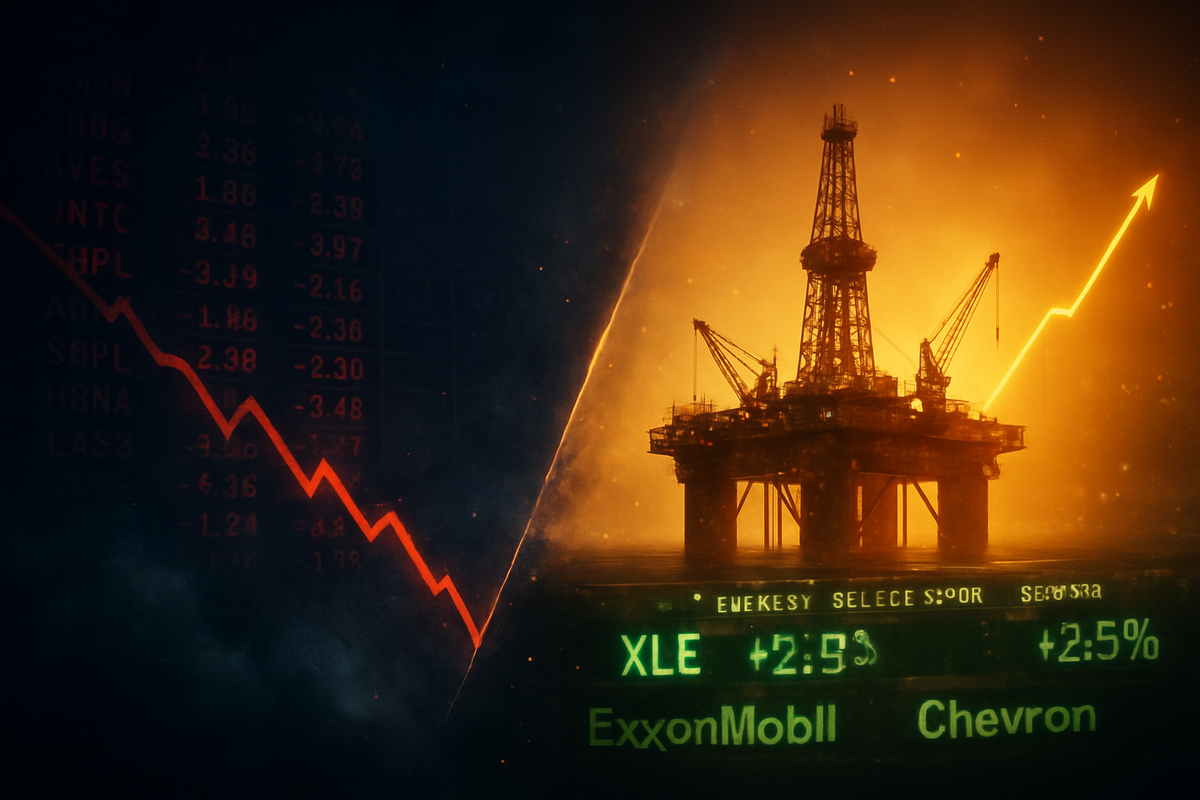
The financial landscape fractured on Friday, March 13, 2026, as a "black swan" event in the energy markets sent the broader indices into a tailspin. While the S&P 500 and Nasdaq Composite plummeted under the weight of surging inflation fears and a deteriorating geopolitical situation in the Middle East, the Energy Select Sector SPDR (NYSEARCA:XLE) emerged as the sole beacon of green on traders' screens. The exchange-traded fund, which tracks the heavyweight champions of the American oil and gas industry, climbed 2.5% in a single session, fueled by a historic spike in crude oil prices that breached the $115 per barrel mark.
This decoupling of energy stocks from the wider market marks a pivotal shift in investor sentiment for 2026. As the "AI-driven" bull market of the previous two years shows signs of exhaustion under the pressure of "higher-for-longer" interest rates, capital is aggressively rotating back into the "old economy." The immediate implications are stark: while tech-heavy portfolios are bleeding, energy-weighted strategies are reaping the rewards of a tightening global supply chain and a re-emerging "war premium" in the commodities market.
Oil's Surge Amidst a Broad Market Retreat
The dramatic divergence witnessed on March 13 was the culmination of a tense week that began with reports of targeted strikes on critical energy infrastructure in the Persian Gulf. By early Friday morning, rumors of a temporary blockade in the Strait of Hormuz—a chokepoint responsible for 20% of the world's daily oil transit—were confirmed by regional maritime authorities. This triggered an immediate "panic-buy" in Brent and West Texas Intermediate (WTI) futures, which surged over 6% before the opening bell in New York. While the broader market indices like the S&P 500 shed 3.2% in its worst day of the year, the XLE marched steadily higher, closing at levels not seen since the post-pandemic supply shocks of 2022.
The timeline leading to this divergence has been brewing for months. Throughout early 2026, global oil inventories had been trending lower as OPEC+ maintained its strict production quotas despite rising demand from a recovering Chinese economy. When the military escalation between regional powers in the Middle East finally reached a boiling point this week, the market was already "short" on physical supply. The Energy Select Sector SPDR, heavily concentrated in upstream producers, captured the full upside of this supply-side shock. Key stakeholders, including institutional hedge funds and retail "safety-seekers," piled into the sector, viewing energy as a primary hedge against the very inflation that was currently gutting the technology and retail sectors.
Initial market reactions were characterized by a "flight to quality" within the energy space. Traders bypassed speculative renewables in favor of cash-flow-rich majors. By the time the closing bell rang, the volume in XLE was nearly double its 30-day average, signaling a profound shift in market leadership. The event has fundamentally altered the 2026 outlook, as the narrative of "disinflation" has been replaced overnight by fears of a stagflationary spiral driven by uncontrollable energy costs.
Winners and Losers in the Triple-Digit Crude Era
The primary beneficiaries of this market fracture are the integrated oil giants that dominate the XLE index. ExxonMobil (NYSE: XOM) and Chevron (NYSE: CVX), which together represent over 40% of the fund’s weighting, saw their shares rise 2.8% and 2.4%, respectively. Both companies entered 2026 with fortress balance sheets and record-low production costs in the Permian Basin, meaning that every dollar oil stays above $100 translates directly into massive free cash flow and potential special dividends. Other winners included ConocoPhillips (NYSE: COP) and SLB (NYSE: SLB), formerly Schlumberger, as the demand for increased domestic drilling and oilfield services spiked in anticipation of a prolonged international supply disruption.
Conversely, the "losers" of the March 13 crash were companies whose business models are most sensitive to fuel costs and consumer discretionary spending. The airline sector was decimated, with United Airlines (NASDAQ: UAL) and Delta Air Lines (NYSE: DAL) falling 7% and 6.5% respectively, as investors priced in a catastrophic rise in jet fuel expenses. Similarly, logistics giants like FedEx (NYSE: FDX) saw their margins threatened by soaring diesel prices, forcing them to announce immediate fuel surcharge hikes that will likely further dampen consumer demand.
The technology sector, particularly companies with massive energy footprints like Amazon (NASDAQ: AMZN), also felt the burn. Amazon’s vast delivery network and energy-hungry data center operations face rising operational hurdles at $115 oil. Furthermore, the broader tech sector, which has been the darling of the market for years, is now facing a valuation crunch as the high energy prices force the Federal Reserve to reconsider interest rate cuts, making the future cash flows of growth stocks less attractive to investors.
The Geopolitical and Macroeconomic Ripple Effects
The outperformance of the XLE is not just a statistical anomaly; it is a signal that the global economy has entered a "high-friction" era. This event fits into a broader trend of "resource nationalism" and the weaponization of energy supplies that has defined the mid-2020s. The 2.5% gain in XLE while the market crashed is reminiscent of the 1970s oil shocks, where energy stocks remained the only viable inflation hedge in a decade of stagnant growth. This historical precedent suggests that we may be entering a multi-year cycle where "physical" assets outperform "digital" assets.
The ripple effects extend beyond the stock tickers. Competitors in the green energy space, such as NextEra Energy (NYSE: NEE), found themselves in a difficult position; while high oil prices theoretically make renewables more competitive, the broader market crash and rising interest rates have increased the cost of capital for new wind and solar projects. This creates a "paradox of the transition," where high fossil fuel prices actually slow down the shift to clean energy by making the necessary infrastructure more expensive to finance.
From a policy perspective, the events of March 13 are likely to trigger emergency interventions. There is already talk in Washington of another release from the Strategic Petroleum Reserve (SPR) to combat the $5.00-per-gallon national average at the pump that appears imminent. However, with the SPR already at historically low levels, the government’s ability to manipulate prices is far more limited than in previous decades. This regulatory helplessness only adds to the bullish case for the energy companies that currently control the "molecules."
The Road Ahead: Navigating the New Energy Paradigm
Looking forward, the market faces two distinct paths. In the short term, the energy sector is expected to remain highly volatile as the geopolitical situation in the Middle East remains unresolved. If the Strait of Hormuz remains contested, analysts at major banks are already modeling scenarios where oil could reach $150 per barrel, which would likely push the XLE to record highs while potentially forcing the S&P 500 into a formal bear market. Strategic pivots are already occurring; many institutional funds are now increasing their "energy weight" from underweight to overweight for the first time in a generation.
Long-term, this event may force a radical adaptation in corporate America. Companies that have ignored energy efficiency in favor of rapid growth will be forced to restructure. We may see a "reshoring 2.0," where manufacturing moves closer to the point of consumption to minimize transportation costs. For the energy companies themselves, the challenge will be managing this windfall. Investors will be watching closely to see if Exxon and Chevron use their record profits to double down on fossil fuel production or if they pivot more aggressively into carbon capture and hydrogen to mitigate future regulatory risks.
The market opportunities that emerge from this crisis will likely favor "energy-efficient" technology and domestic energy infrastructure. While the broader market remains in a state of shock, the "energy-first" investment thesis has been validated. Investors should expect a period of "sectoral rotation" where traditional valuation metrics—like price-to-earnings and free cash flow—become far more important than the speculative "hype" that fueled the previous market cycle.
Closing the Books: Lessons from March 13, 2026
The market action of March 13, 2026, serves as a stark reminder that the global economy still runs on oil. Despite the rapid advancement of artificial intelligence and the push for a green transition, the "old economy" retains the power to dictate market outcomes. The key takeaway for investors is the importance of diversification into non-correlated assets; the XLE’s 2.5% gain was not just a profit opportunity, but a vital portfolio insurance policy during a systemic market failure.
Moving forward, the market is likely to remain on edge. The "energy tax" on the global consumer is now a reality, and the looming threat of stagflation will weigh on every Federal Reserve decision in the coming months. The significance of this day lies in the final realization that the period of cheap energy and cheap money is officially over.
Investors should watch for the upcoming quarterly earnings calls from the "Big Oil" majors for guidance on capital expenditure and production targets. Additionally, keep a close eye on the U.S. dollar and the 10-year Treasury yield, as their movements in relation to crude prices will determine whether the broader market can find a bottom or if March 13 was merely the first leg of a deeper correction. In this new paradigm, energy is no longer just a sector; it is the fundamental currency of the market.
This content is intended for informational purposes only and is not financial advice