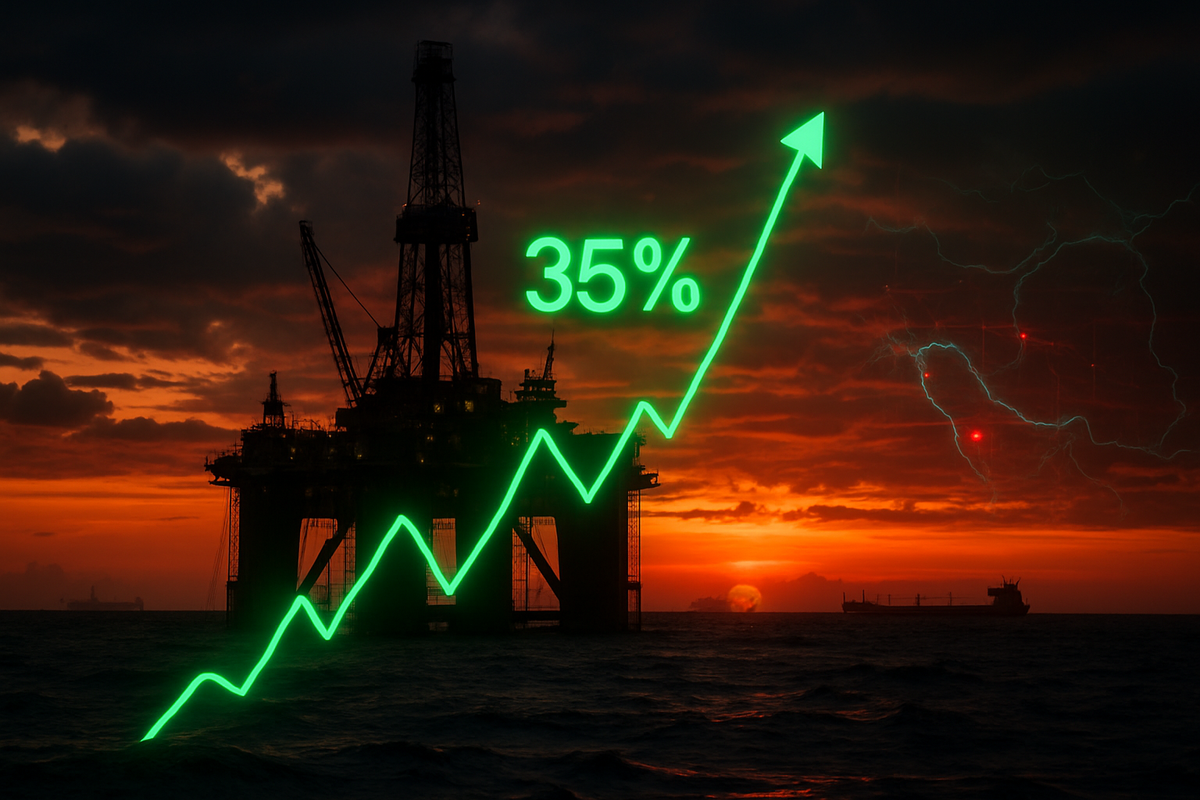
The energy sector has emerged as the undisputed leader in the global markets this week, fueled by an unprecedented 35% surge in West Texas Intermediate (WTI) crude oil prices. This historic rally, the largest weekly percentage gain in the history of oil futures trading, has fundamentally rewritten the earnings outlook for the world’s largest oil and gas producers. As of March 12, 2026, the energy industry is basking in a windfall that only weeks ago seemed improbable, while the broader market grapples with the inflationary shockwaves of a renewed global energy crisis.
The immediate implications of this price spike are twofold: a massive upward revision in free cash flow projections for industry titans and a simultaneous "Black Monday" style rout for fuel-sensitive sectors like aviation and logistics. With WTI briefly touching an intraday high of $119.48 per barrel on March 9 before stabilizing in the $85–$92 range today, analysts are scrambling to adjust price targets for a "higher-for-longer" energy environment that could define the remainder of the 2026 fiscal year.
The Geopolitical Trigger
The catalyst for this extraordinary market volatility was a rapid escalation of hostilities in the Middle East. On February 28, 2026, a coordinated series of airstrikes by the United States and Israel against Iranian military and nuclear infrastructure sent shockwaves through global capitals. Iran’s subsequent declaration of a "state of war" and its move to blockade the Strait of Hormuz—the world’s most critical energy chokepoint—effectively removed nearly 20% of global oil flows from the market within 48 hours. By the first week of March, tanker traffic through the Strait had plummeted to less than 10% of normal levels, forcing major Gulf producers to shut in over 10 million barrels per day (bpd) as regional storage capacity reached its limits.
The market reaction was instantaneous and visceral. WTI crude, which had been trading in a comfortable $67–$70 range in late February, exploded upward. The timeline intensified on March 1, when an emergency OPEC+ meeting resulted in a decision to pause all previously planned production increases for the spring, a move that traders interpreted as a signal that the group would not—or could not—offset the Iranian disruption. By March 9, the "war premium" was fully baked into the price, leading to the historic 35% weekly gain that has defined the current market landscape.
Initial industry reactions have been characterized by extreme caution mixed with opportunistic buying in the energy equity space. While the International Energy Agency (IEA) has authorized a record-breaking release of 400 million barrels from strategic reserves to provide a "physical floor" for supply, the psychological impact of the Hormuz closure has maintained a high floor under prices. As of today, March 12, the market is seeing a slight cooling as rumors of a potential diplomatic de-escalation surface, but the fundamental supply-demand balance remains tilted toward a severe deficit.
Winners and Losers in the Market
The primary beneficiaries of this price surge are the U.S. "Big Three" oil majors, who are now poised to generate record levels of cash. ExxonMobil (NYSE: XOM) has seen its earnings outlook transformed, with JPMorgan analysts raising their 2026 EPS estimate to $6.73, up from a previous $6.39. Bank of America has also slapped a $151 price target on the stock, citing a projected $52 billion in cash flow for the 2025-2026 period. Similarly, Chevron (NYSE: CVX) is now viewed as a "conviction buy" by many on Wall Street, with EBITDA forecasts for 2026 climbing to $44.3 billion on the back of strong margins in the Permian Basin and its operations in Kazakhstan. ConocoPhillips (NYSE: COP) has also seen a dramatic reversal of fortune; after a sluggish fourth quarter in 2025, the March spike has led to a consensus revision of its full-year EPS to $8.16, with Goldman Sachs adding the firm to its "Conviction List."
Conversely, the transportation and logistics sectors are bearing the brunt of the cost spike. United Airlines (NASDAQ: UAL) saw its stock crater by over 8% on March 9 alone, as investors fretted over the impact of $120 oil on jet fuel expenses. The airline is particularly vulnerable due to its heavy exposure to spot fuel prices and long-haul international routes. Delta Air Lines (NYSE: DAL) has fared slightly better, thanks to a partial structural hedge provided by its Monroe Energy refinery, yet its shares remain down 7% year-to-date. In the logistics space, United Parcel Service (NYSE: UPS) suffered a brutal seven-day losing streak, losing approximately $14 billion in market capitalization by March 10 as fuel costs threatened to devour its already thin 8.87% operating margins.
Broader Significance and Historical Echoes
The broader significance of this event lies in its disruption of the "fragile surplus" narrative that dominated 2025. Many analysts had predicted an oil glut in 2026 due to slowing Chinese demand and rising production from non-OPEC+ nations like Brazil and Guyana. The current crisis has shattered that complacency, proving that geopolitical risk still carries the ultimate veto power over market fundamentals. This event echoes the 1973 oil embargo and the 2022 energy shock following the invasion of Ukraine, reminding investors that the global economy's transition away from fossil fuels is not yet far enough along to insulate it from Middle Eastern volatility.
Furthermore, the spike has significant regulatory and policy implications. In the United States, the national average for regular gasoline hit $3.58 per gallon on March 11, a nearly 20% jump in two weeks. This "energy tax" is already weighing on consumer sentiment, which plummeted to mid-50s levels in the University of Michigan’s latest index. Economists at JPMorgan warn that this could push monthly inflation to 1% for March, the highest in four years, potentially forcing the Federal Reserve to reconsider its interest rate path to combat a "stagflationary" slump. The crisis is also likely to accelerate legislative efforts to secure domestic energy supply chains and expedite renewable energy permits, though such measures offer little relief in the immediate term.
The Road Ahead: Scenarios for the Second Quarter
Looking ahead, the market is entering a phase of extreme uncertainty as it balances "peace talk" rumors against the reality of a closed Strait of Hormuz. In the short term, the market will be hyper-focused on the IEA’s 400-million-barrel reserve release and whether it can successfully bridge the gap until Middle Eastern supplies return. If the blockade continues through the end of the month, even more aggressive strategic releases may be required, and the "war premium" could push prices back toward the $110 level.
Over the long term, major energy companies may be forced into a strategic pivot. While the current windfall is immense, the volatility may embolden politicians to pursue more aggressive windfall taxes or "green" mandates to reduce oil dependency. For companies like ExxonMobil and Chevron, the challenge will be to balance the distribution of these surprise profits to shareholders via buybacks with the need to reinvest in diversified energy sources to mitigate future geopolitical risks. Market participants should also watch for a potential "demand destruction" scenario, where sustained $100+ oil prices lead to a global economic slowdown that ultimately crashes demand later in 2026.
Market Wrap-Up and Investor Outlook
The events of early March 2026 serve as a stark reminder of the energy sector's enduring power to dictate market direction. The 35% weekly gain in WTI crude has not only provided a massive boost to the earnings outlook for companies like ExxonMobil (NYSE: XOM) and ConocoPhillips (NYSE: COP) but has also introduced a significant headwind for the global economic recovery. While oil prices have retreated from their $119 peak as of March 12, the underlying tensions in the Middle East suggest that the "war premium" will remain a central fixture of the market for the foreseeable future.
For investors, the coming months will require a watchful eye on two fronts: the progress of diplomatic efforts to reopen the Strait of Hormuz and the impact of rising fuel costs on broader consumer spending. If the conflict de-escalates quickly, the energy sector may see a rapid "give-back" of recent gains; however, if the disruption persists, the outperformance of oil and gas stocks could be the defining trade of 2026. For now, the energy sector remains the only safe harbor in a market suddenly tossed by the winds of geopolitical instability.
This content is intended for informational purposes only and is not financial advice.