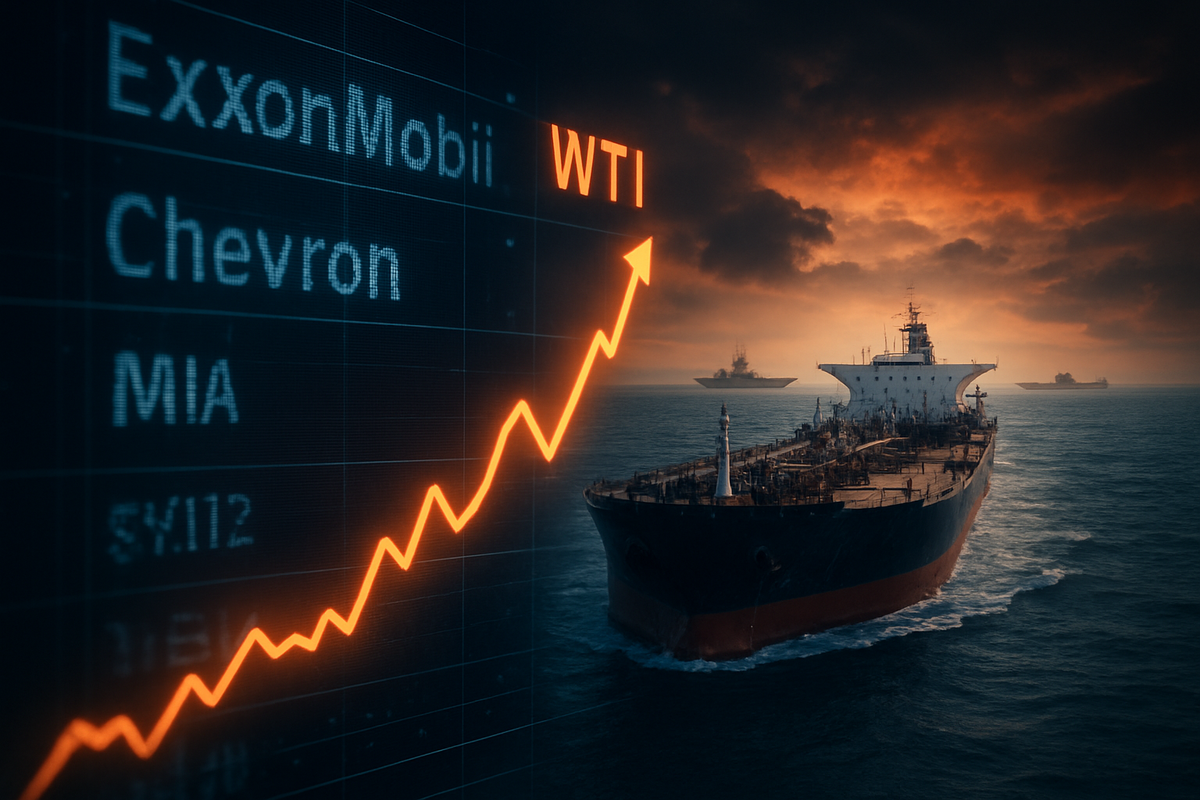
Energy markets are reeling as West Texas Intermediate (WTI) crude oil futures surged to a four-month high this week, breaching the $67 per barrel mark for the first time since late 2025. This sudden spike, which saw prices climb nearly 8% in February alone, is being driven by a volatile cocktail of escalating military threats in the Middle East and a calculated production freeze by global oil powers. As the United States and Iran stand on the precipice of a direct military confrontation, the "geopolitical risk premium" has returned to the forefront of global finance, overshadowing domestic inventory data and sending shockwaves through the energy sector.
The immediate implications for the market are stark. Investors are pivoting toward "inflation-hedge" assets and domestic energy producers as the threat of a closure of the Strait of Hormuz—a chokepoint through which 20% of the world’s oil passes—becomes a tangible reality. While U.S. crude inventories recently showed a massive jump of 16 million barrels, the fear of a sudden supply shock in the Persian Gulf has rendered bearish supply data irrelevant. For the average consumer, this surge signals a likely uptick in gasoline prices heading into the spring, while for Wall Street, it marks a renewed era of energy-driven volatility.
The Path to Escalation: A Timeline of Tension
The current crisis is the culmination of a "maximum pressure" campaign that intensified throughout late 2025. Following a period of relative stalemate, the geopolitical landscape shifted dramatically in September 2025 when the United Kingdom, France, and Germany triggered the UN "snapback" mechanism, effectively reinstating international sanctions on Iran’s nuclear and missile programs. This diplomatic maneuver set the stage for a more aggressive stance from Washington, which throughout December 2025 and January 2026 began systematically targeting Iran’s "shadow fleet" of tankers used to export oil to Asian markets.
By early February 2026, the rhetoric turned from economic to military. During his State of the Union address, President Trump issued a "zero enrichment" demand to Tehran, setting a strict 15-day deadline for Iran to dismantle its nuclear infrastructure or face "grave consequences." This ultimatum was met with defiance from the Iranian Revolutionary Guard (IRGC), which launched live-fire naval drills in the Strait of Hormuz on February 16, 2026, intermittently blocking commercial traffic and further tightening the global supply outlook.
The situation reached a fever pitch on February 23, 2026, when WTI futures peaked at $67.28. This followed reports of a massive U.S. naval buildup in the Arabian Sea, featuring two carrier strike groups—the USS Gerald Ford and the USS Abraham Lincoln. Market participants are now pricing in a "war premium," as the shot fired by U.S. forces to down an Iranian drone earlier this month serves as a grim reminder of how quickly localized skirmishes can escalate into a broader regional conflict.
Winners and Losers in the Energy Sector
The surge in crude prices has been a windfall for major integrated energy companies, particularly those with significant domestic production capabilities. ExxonMobil (NYSE: XOM) has emerged as a clear leader in the current environment; its stock has surged over 17% since the start of the year, trading near all-time highs as the company benefits from both higher commodity prices and favorable U.S. diplomatic backing for its expansion into Iraq and Libya. Similarly, Chevron (NYSE: CVX) has seen its shares track upward as investors reward its capital discipline and its strategic pivot toward North African production hubs.
Upstream producers are also feeling the boost. Marathon Oil (NYSE: MRO) has seen its shares climb toward the $30 mark, a 52-week high, as the valuation of its U.S. shale assets increases in lockstep with WTI futures. The company’s focus on high-margin domestic plays makes it a preferred vehicle for investors looking to capitalize on geopolitical instability without the direct risk of Middle Eastern asset seizures. Meanwhile, its downstream counterpart, Marathon Petroleum (NYSE: MPC), recently posted a 15% weekly jump, as refining margins—often squeezed by high crude costs—are currently being buoyed by a frantic scramble for refined products ahead of potential supply disruptions.
Conversely, the losers in this scenario are the energy-intensive sectors and companies reliant on stable transportation costs. Airlines and logistics firms are facing a sudden spike in fuel expenses that could eat into Q1 earnings. Furthermore, smaller independent refiners that lack the integrated supply chains of "Big Oil" may struggle to pass on the rapidly rising costs of WTI to consumers, potentially leading to margin compression if the price of crude stays above $65 for an extended period.
A New Paradigm for Global Energy Policy
This event marks a significant departure from the market trends of 2024, where concerns over a global economic slowdown and oversupply dominated the narrative. The current spike fits into a broader trend of "energy nationalism," where nations are increasingly using oil production as a geopolitical lever. The role of OPEC+ cannot be understated; in November 2025, the alliance led by Saudi Arabia and Russia chose to freeze planned production increases for the first quarter of 2026. This "strategic pause" effectively removed the safety net for global supply, ensuring that any geopolitical disruption would have a magnified impact on prices.
The regulatory environment is also shifting. With the U.S. administration actively supporting domestic drilling and pipeline projects as a matter of "national security," the traditional friction between environmental policy and energy production has taken a backseat to the immediate need for energy independence. This historical precedent mirrors the oil shocks of the 1970s and early 2000s, where geopolitical flashpoints forced a rapid acceleration of domestic energy infrastructure.
The ripple effects are reaching beyond the U.S. and Iran. Competitors in the Permian Basin and other shale plays are dusting off expansion plans that were sidelined during the $50-per-barrel days of 2024. However, the shadow of regulatory shifts looms; should the tensions subside, a sudden flood of new production could lead to a price collapse similar to the 2014-2015 "shale bust," leaving over-leveraged companies vulnerable.
What Comes Next: Scenarios for the Spring
In the short term, the market's eyes are fixed on the 15-day deadline set by the U.S. administration. If a diplomatic "off-ramp" is found, we could see a rapid $5 to $10 "cool-down" in WTI prices as the geopolitical premium evaporates. However, many analysts believe the most likely scenario involves targeted "surgical" strikes on Iranian infrastructure, which would likely push oil toward the $80 range as insurance costs for tankers in the Persian Gulf skyrocket.
Longer-term, the industry may see a permanent strategic pivot toward U.S. and South American assets (like Guyana) that are perceived as "safe harbors." Major players will likely continue to prioritize dividend increases and stock buybacks over massive new exploration projects to keep shareholders happy, even as they enjoy the benefits of higher crude prices. The challenge for 2026 will be balancing the immediate profits from high oil prices with the long-term threat of an accelerated transition to renewable energy, which often gains political momentum during periods of high fossil fuel costs.
Final Assessment: Investors on High Alert
The surge in WTI crude to four-month highs is more than just a fluctuation on a chart; it is a manifestation of a world where the intersection of energy and geopolitics has become more volatile than at any point in the last two decades. For investors, the takeaway is clear: the era of "quiet" energy markets is over. The dominance of geopolitical risk over fundamental supply-and-demand data suggests that volatility will remain high through the remainder of 2026.
As we move forward, the key indicators to watch will be the U.S. Navy’s posture in the Strait of Hormuz and any signals from the upcoming OPEC+ ministerial meeting in March. While companies like ExxonMobil and Marathon Oil are currently riding the wave of high prices, the sustainability of this rally depends entirely on whether the current "cold war" in the Middle East turns hot. In this environment, caution and diversification remain the most valuable tools for any market participant.
This content is intended for informational purposes only and is not financial advice.