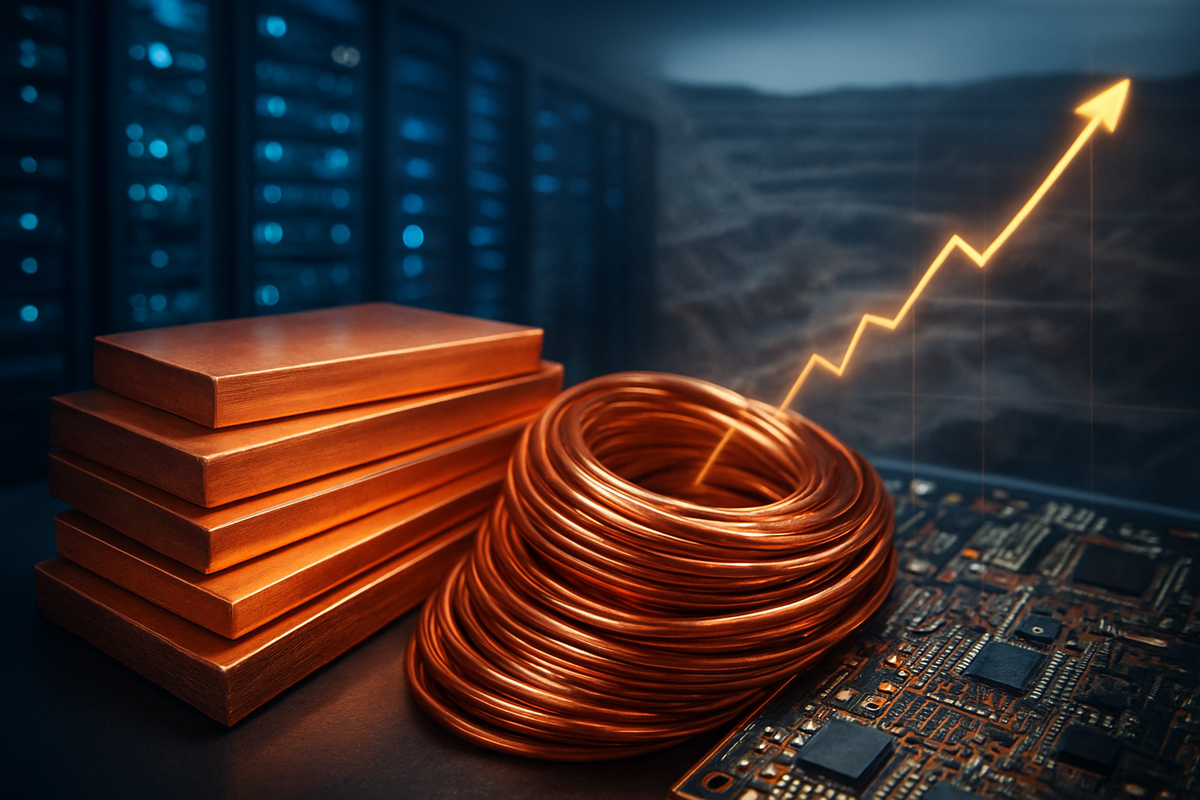
The global commodities market reached a historic milestone this week as copper prices surged to an all-time high, shattering previous records and sending a jolt through the industrial sector. On the London Metal Exchange (LME), the "red metal" climbed to a staggering $14,527 per metric ton in late January 2026, maintaining a steady altitude above the $13,000 mark as of February 25, 2026. This unprecedented rally is more than just a price spike; it is a fundamental revaluation of the world’s most critical industrial metal, driven by a "perfect storm" of insatiable demand from the artificial intelligence (AI) boom and a crumbling global supply chain.
The immediate implications are profound. For manufacturers of everything from electric vehicles to high-end semiconductors, the cost of raw materials is skyrocketing, threatening to reignite inflationary pressures just as global central banks were finding their footing. Conversely, the rally provides a massive windfall for mining giants and resource-rich nations, while simultaneously sounding an alarm for the "Dr. Copper" indicator. Traditionally, rising copper prices signal robust economic health, but this current surge—labeled a "structural bull era"—suggests a world scrambling to rewire itself for a carbon-neutral, AI-driven future at any cost.
The Path to $14,000: A Timeline of the Copper Crunch
The journey to these record highs began in earnest in mid-2024, when copper first broke past the $11,000 per metric ton barrier. While that initial rally was fueled by speculative short-covering and early signs of a supply deficit, 2025 saw the market transition into a state of chronic shortage. Throughout the past year, prices hovered near $12,000 as the market realized that the "green transition" was moving faster than the mining industry could dig. The situation reached a breaking point in late 2025 following a series of catastrophic operational failures at the world’s largest mines.
Key players in this drama include the Grasberg mine in Indonesia, operated by Freeport-McMoRan (NYSE: FCX), which suffered a devastating mudrush in September 2025. The disaster paralyzed the Grasberg Block Cave, responsible for a significant portion of global output, resulting in an estimated loss of 313,000 tons of copper for the 2026 calendar year. Simultaneously, the Escondida mine in Chile—the world’s largest copper producer, co-owned by BHP Group (NYSE: BHP) and Rio Tinto (NYSE: RIO)—faced a double blow of declining ore grades and aggressive labor strikes. Workers, emboldened by record-high prices, have shut down operations multiple times in early 2026 to demand higher profit-sharing, further tightening the global supply.
Initial market reactions have been a mix of euphoria and dread. Commodity traders have flocked to copper as a hedge against a "hard-asset" future, while industrial buyers have engaged in panic-stocking. In North America, the implementation of new trade tariffs in late 2025 also prompted a massive inventory pull-forward, as firms sought to secure domestic supplies before costs climbed even higher. The result is a market currently operating in a deficit of roughly 400,000 tons, leaving no margin for further error.
Winners and Losers: The Corporate Fallout of the Copper Surge
In this high-priced environment, the winners are clearly defined by their access to "heavy" copper assets. Freeport-McMoRan (NYSE: FCX), despite its Indonesian setbacks, remains a primary beneficiary as its other global operations reap the rewards of $14,000 copper. Southern Copper Corporation (NYSE: SCCO) has seen its stock price soar to new heights, buoyed by its low-cost production profile and massive reserves in Peru and Mexico. Additionally, Ivanhoe Mines (TSX: IVN), which operates the Kamoa-Kakula project in the Democratic Republic of Congo, has become a darling of the market; despite localized flooding in 2025, it remains one of the few producers capable of bringing new, high-grade supply to the market in the near term.
However, the "losers" list is growing, particularly among sectors with thin margins and high copper intensity. Electric vehicle (EV) manufacturers like Rivian Automotive (NASDAQ: RIVN) and Lucid Group (NASDAQ: LCID) are facing significant headwinds as the cost of the 83kg of copper required for a single EV battery and drivetrain has nearly doubled in two years. Similarly, renewable energy developers—such as Orsted (OTC: DNNGY)—are seeing the capital expenditure for offshore wind farms balloon, as the subsea cables and transformers required for these projects are almost entirely copper-dependent.
The tech sector, while cash-rich, is also feeling the pinch. Hyperscale data center operators like Meta Platforms (NASDAQ: META) and Alphabet (NASDAQ: GOOGL) are finding that the copper needed for power distribution and cooling in their new AI-focused facilities is becoming a significant line item. A single large-scale AI data center can consume up to 50,000 tons of copper—the equivalent of the annual production of a medium-sized mine. For these firms, the copper rally isn't just a cost issue; it's a bottleneck for the very deployment of the AI infrastructure they are betting their futures on.
Beyond the Chart: Dr. Copper and the New Global Reality
The current rally is fundamentally altering the "Dr. Copper" narrative. Historically, copper was viewed as a barometer for global GDP growth—when prices rose, it meant construction and manufacturing were booming. Today, the signal is more complex. While the price hike indicates strong demand, much of that demand is "inelastic," meaning it is driven by government mandates for the energy transition and the strategic necessity of the AI race. This suggests that the global economy is entering a phase where "energy security" and "digital sovereignty" take precedence over traditional cost-efficiency.
This trend fits into a broader industrial pivot toward "electrification of everything." For decades, the global energy system was built on oil and gas. In 2026, the backbone of the economy is shifting to the electrical grid. This has massive regulatory and policy implications. We are seeing a return to resource nationalism, as countries like Chile, Indonesia, and the DRC look to capture a larger share of the "copper rent" through higher taxes and domestic processing requirements. The U.S. and EU are also responding with aggressive subsidies for domestic copper recycling and "friend-shoring" initiatives to secure supply chains outside of Chinese influence.
Historical precedents for this moment are rare. One might look to the oil shocks of the 1970s, which forced a total rethink of fuel efficiency and energy sourcing. The copper spike of 2026 may be the "first metal shock" of the 21st century. It is forcing engineers to look for substitutes, such as aluminum for high-voltage lines, though copper’s superior conductivity and durability make substitution difficult in high-performance applications like AI chips and EV motors.
The Road Ahead: Short-Term Pain for Long-Term Gain?
Looking forward, the market expects copper prices to remain volatile but structurally elevated. In the short term, the primary focus will be on whether the Grasberg mine can return to full capacity by 2027 and whether labor peace can be achieved in South America. However, even if current mines return to peak performance, the long-term outlook remains tight. It takes an average of 17 to 29 years to move a copper project from discovery to production, meaning the "supply gap" predicted for the late 2020s is effectively locked in.
Investors should expect a strategic pivot toward "urban mining" and advanced recycling technologies. Companies specializing in copper recovery from electronic waste are likely to see increased venture capital and public interest. Furthermore, we may see a wave of consolidation in the mining sector as cash-flush giants look to acquire smaller juniors with "shovel-ready" projects. The challenge for the market will be managing the inflationary impact; if copper remains at $14,000, the cost of the global energy transition could increase by trillions of dollars, potentially slowing the pace of decarbonization.
Market Wrap-Up: What to Watch
The copper rally of early 2026 marks a turning point in the global industrial landscape. The key takeaway for investors is that the metal has decoupled from the traditional business cycle and is now tethered to the multi-decade structural shifts of AI and electrification. While high prices may eventually lead to some demand destruction in low-value sectors like basic construction, the high-tech and energy-transition sectors are likely to keep the floor under prices for years to come.
Moving forward, the market will be hyper-focused on quarterly production reports from the "Big Three"—Freeport-McMoRan, BHP, and Rio Tinto. Any further operational hiccups or political instability in the "copper belt" of Africa or the Andes could send prices toward the $16,000 mark. Investors should also watch for advancements in aluminum substitution and the success of new "leaching" technologies that promise to extract more copper from old waste piles. For now, Dr. Copper is shouting that the world is in the midst of a massive, expensive, and high-voltage transformation.
This content is intended for informational purposes only and is not financial advice.