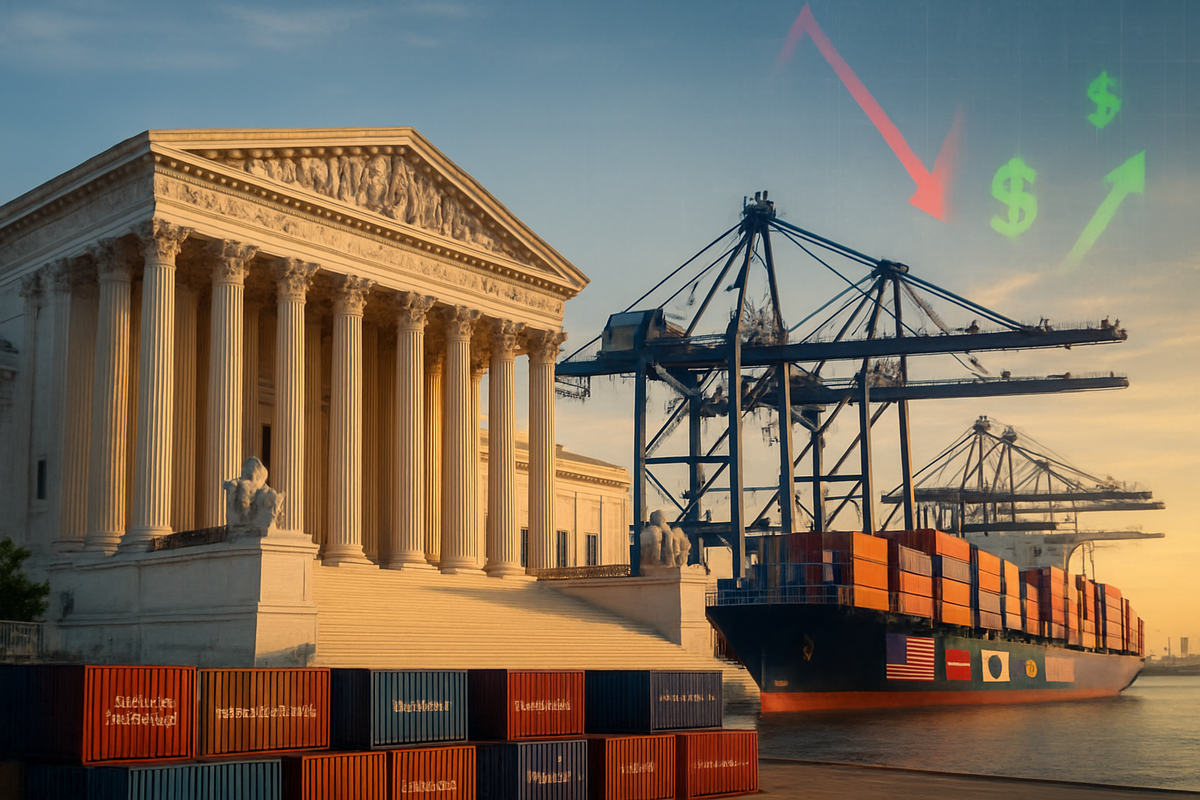
In a seismic shift for global trade and constitutional law, the Supreme Court of the United States ruled on February 20, 2026, that the executive branch lacks the authority to unilaterally impose broad-based tariffs under the International Emergency Economic Powers Act (IEEPA). The 6–3 decision in the consolidated cases of Learning Resources, Inc. v. Trump and Trump v. V.O.S. Selections, Inc. has effectively dismantled a high-tariff regime that had defined U.S. trade policy since early 2025. The ruling not only forces an immediate reduction in duties for major exporting nations like China, Brazil, and India but also opens the door for an estimated $200 billion in rebates for U.S.-based importers.
The immediate implications are profound for both the economy and the markets. Effective immediately, punitive tariffs that had reached as high as 50% for some goods have collapsed to a temporary 15% surcharge, as the administration pivots to alternative legal authorities. For thousands of American businesses that have been grappling with skyrocketing import costs and margin compression, the ruling represents a massive liquidity event and a restoration of the long-standing principle that the "power of the purse"—specifically the power to tax and levy duties—resides exclusively with Congress under Article I of the Constitution.
The End of Executive Trade Overreach: A Timeline
The legal battle reached its climax last Friday when Chief Justice John Roberts delivered the majority opinion, asserting that IEEPA was never intended to be a "blank check" for the President to regulate the economy through taxation. The case originated with a challenge by Learning Resources, Inc., a Chicago-based educational toy manufacturer, and V.O.S. Selections, Inc., a family-owned wine importer. These companies argued that the administration’s use of IEEPA to impose "reciprocal" and "fentanyl-related" tariffs—which saw rates on Chinese imports climb from 25% to an effective 50% or more—was an unconstitutional delegation of legislative power.
The timeline of this trade conflict began in early 2025, when the White House declared a national emergency regarding the fentanyl crisis and trade imbalances, using IEEPA to bypass the more traditional, time-consuming Section 301 or Section 232 investigations. By mid-2025, targeted nations including Brazil and India were hit with 50% punitive duties on various sectors, ranging from steel and timber to pharmaceuticals and electronics. The Supreme Court's ruling specifically invoked the "Major Questions Doctrine," stating that a policy of such "vast economic and political significance" requires clear and explicit authorization from Congress, which IEEPA does not provide for the purpose of levying duties.
In the hours following the ruling, the administration issued an emergency Executive Order to cease IEEPA-based collections. To prevent a total "tariff vacuum," the President invoked Section 122 of the Trade Act of 1974, which allows for a temporary 15% global import surcharge for a period of 150 days. This has resulted in a dramatic drop for major partners: China’s effective rates fell from 50% to 15%, while Brazil and India saw their punitive 50% levies slashed to the same 15% baseline.
Corporate Winners and Losers in the $200 Billion Refund Pool
The financial markets have reacted sharply to the prospect of a $200 billion refund pool. Leading the pack of beneficiaries is Apple Inc. (NASDAQ: AAPL), which analysts estimate could be owed upwards of $3 billion for duties paid on Chinese-assembled components and finished goods like the Apple Watch and Mac peripherals. While Apple still faces the new 15% surcharge, the net reduction from previous peak rates is expected to provide a significant boost to its hardware margins in the second half of 2026.
Retail giants are also poised for a massive cash infusion. Walmart Inc. (NYSE: WMT) and Target Corp. (NYSE: TGT) were among the largest filers of administrative protests during the IEEPA era. Walmart is estimated to be eligible for over $2 billion in refunds, a sum that analysts suggest could be used for aggressive price cuts or stock buybacks. Similarly, Home Depot (NYSE: HD) and Lowe's Companies, Inc. (NYSE: LOW) are expected to recover hundreds of millions of dollars paid on construction materials imported from Brazil and China, such as timber and flooring, which were heavily hit by the 2025 surcharges.
However, the ruling has created distinct "losers" among domestic producers who had enjoyed the protection of the high IEEPA walls. U.S. Steel (NYSE: X) and Nucor Corporation (NYSE: NUE) saw their share prices tumble as the market priced in increased competition from Brazilian and Indian semi-finished steel, which is now significantly cheaper to import. Additionally, while the ruling is a win for importers, the broader bond market has reacted with trepidation. The need for the U.S. Treasury to fund a $200 billion refund payout has pushed 10-year Treasury yields toward 4.25%, as investors weigh the impact on an already strained federal deficit.
A Constitutional Correction and its Global Ripple Effects
Beyond the immediate balance sheet impacts, the SCOTUS ruling marks a pivotal turn in U.S. trade policy and constitutional law. By reclaiming the authority to set tariffs for Congress, the Court has signaled the end of the "emergency-style" trade wars that have characterized the last several years. This shifts the focus back to multilateral negotiations and legislative action, likely making trade policy more predictable, albeit slower to change.
The ripple effects are being felt most acutely in New Delhi and Brasília. India, a major supplier of generic pharmaceuticals, is a standout winner. Because the new 15% Section 122 surcharge contains exemptions for essential medicines, Indian pharmaceutical giants and their U.S. partners, such as Viatris Inc. (NASDAQ: VTRS) and Amneal Pharmaceuticals, Inc. (NYSE: AMRX), will see the IEEPA "fentanyl" surcharges vanish without being replaced by the new 15% floor. This is expected to lower healthcare costs for U.S. consumers and restore profitability to the generic drug sector.
Conversely, the ruling has inadvertently penalized some U.S. allies. Nations like the United Kingdom and Australia, which had previously negotiated "carve-outs" or 10% preferential rates under the old IEEPA regime, are now subject to the uniform 15% Section 122 surcharge. This has led to immediate diplomatic friction, with trade ministers from London and Canberra calling for a return to the negotiating table to restore their previous advantages.
The Road Ahead: Refunds and Strategic Pivots
The coming months will be defined by the "reliquidation" process. The U.S. Court of International Trade (CIT) is expected to issue a series of orders directing U.S. Customs and Border Protection to process refunds. For companies like FedEx Corp. (NYSE: FDX) and Amazon.com, Inc. (NASDAQ: AMZN), this will involve massive administrative undertakings to verify years of import records. Investors should expect to see "one-time gains" appearing on corporate earnings reports throughout the third and fourth quarters of 2026 as these checks are issued.
In the short term, the 150-day clock on the Section 122 surcharge is ticking. Unless Congress acts to codify new trade authorities or the administration finds a different legal path, the U.S. could see a total expiration of these temporary duties by July 2026. This creates a window of opportunity for retailers to restock inventory at the lowest tariff rates seen in years, though many remain cautious about a potential legislative "snapback" if Congress decides to assert its power by passing new, industry-specific tariffs.
Strategically, the ruling may slow the "de-risking" trend of moving supply chains out of China. With the effective duty rate dropping from 50% to 15%, the economic urgency to relocate manufacturing to higher-cost regions may diminish. Companies that had paused investments in Chinese manufacturing, such as Nvidia Corp. (NASDAQ: NVDA) for certain consumer-grade components, may now reconsider their near-term logistics strategies.
Final Assessment: A Landmark Shift for Investors
The Supreme Court’s decision is a watershed moment that restores the constitutional balance of trade power while providing a massive, if chaotic, stimulus to the U.S. private sector. The immediate transition from 50% IEEPA tariffs to a 15% surcharge represents a significant easing of inflationary pressure on imported goods, which could provide the Federal Reserve more breathing room in its ongoing battle with price stability.
For investors, the key takeaways are twofold: first, look for the "liquidity winners"—large-cap retailers and tech companies with high import volumes that will receive the lion's share of the $200 billion refund pool. Second, watch the domestic manufacturing sector for signs of distress as international competition intensifies. The market over the next six months will be a story of "margin restoration" for importers and "strategic adaptation" for the rest of the world.
As we move toward the summer of 2026, the focus will shift from the courtroom to the halls of Congress. Whether the legislative branch will use its reclaimed power to build new trade barriers or embrace the newly lowered rates will determine the long-term trajectory of the American economy and its role in the global market.
This content is intended for informational purposes only and is not financial advice.