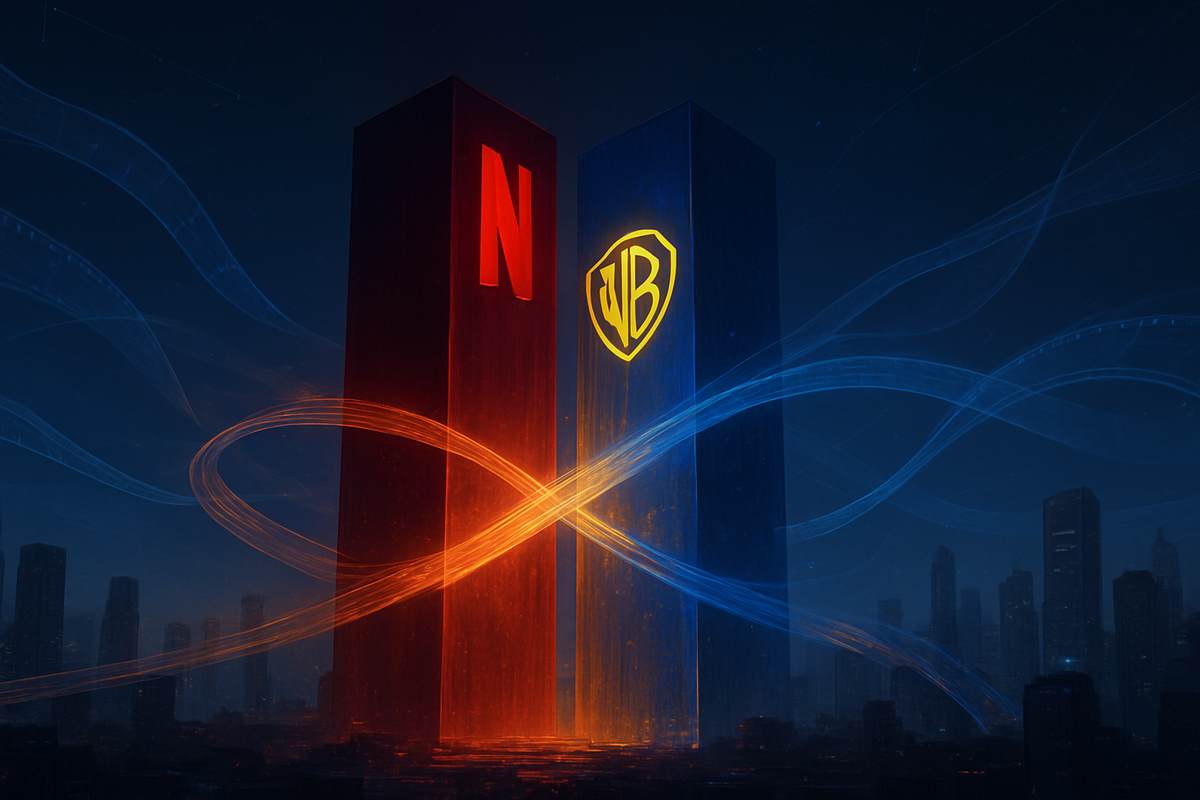
The media landscape reached a fever pitch this week as Netflix (NASDAQ: NFLX) and Warner Bros. Discovery (NASDAQ: WBD) finalized terms for a massive $82.7 billion merger, a deal poised to redefine the "streaming wars" by consolidating Hollywood’s most storied assets under a single digital roof. As of February 2, 2026, the agreement signifies the most aggressive move by Netflix to date, pivoting from its historical focus on organic content creation to a strategy of heavy-duty acquisition to secure long-term market dominance.
The transaction, which values Warner Bros. Discovery’s core studio and premium streaming assets at approximately $27.75 per share, comes at a time of immense pressure for the entertainment sector. By acquiring the "crown jewels" of the WBD portfolio—including the DC Universe, the Harry Potter franchise, and the HBO library—Netflix is positioning itself as an unassailable titan in global entertainment. However, the deal’s immediate implication is a bifurcated market reaction: while WBD shareholders cheer a massive valuation recovery, Netflix investors are grappling with the reality of an $83 billion price tag and the significant debt burden required to fund the all-cash offer.
A Targeted Acquisition: The Studio over the Screen
The specifics of the deal, which followed months of speculation and a rival hostile bid from Paramount Global (NASDAQ: PARA) and Skydance, reveal a surgical approach to consolidation. Netflix is not acquiring the entirety of Warner Bros. Discovery. Instead, the deal is structured around a corporate spin-off: WBD will separate its declining linear cable networks—including CNN, TNT Sports, HGTV, and the Food Network—into a new independent entity dubbed "Discovery Global." Netflix will then acquire the remaining core film and television studios, the Max streaming service, and the vast HBO content library.
This "clean exit" strategy was designed to insulate Netflix from the accelerating "linear decay" of traditional cable television. The timeline of the deal accelerated in late 2025 after WBD announced it was exploring strategic alternatives to unlock shareholder value. By January 20, 2026, Netflix sweetened its proposal to an all-cash offer of $27.75 per share, successfully fending off a $108.4 billion all-stock bid from Paramount Skydance that would have forced WBD to keep its debt-laden cable networks intact. Key players in the negotiation included Netflix Co-CEOs Ted Sarandos and Greg Peters, and WBD CEO David Zaslav, who is expected to oversee the transition before the deal’s projected close in Q3 2026.
Winners and Losers: A Tale of Two Tickers
In the immediate wake of the announcement, Warner Bros. Discovery (NASDAQ: WBD) has emerged as the clear winner in terms of stock performance. The company’s shares have "melted up" by over 100% since the merger rumors began in late 2025, finally reaching the $27.75 floor established by the Netflix bid. For WBD investors, the deal provides a lucrative exit from a stock that had struggled under the weight of nearly $40 billion in debt since the 2022 Discovery-WarnerMedia merger. The spin-off of Discovery Global allows these shareholders to retain a stake in the legacy cable business while pocketing a premium for the high-growth studio assets.
Conversely, Netflix (NASDAQ: NFLX) has seen its stock price face significant headwinds, falling nearly 9% in the first month of 2026. Investors are wary of the $52 billion in new debt the company must take on to finance the all-cash acquisition. While the strategic rationale is clear, the financial strain of integrating a massive studio system and maintaining a 34x P/E multiple is causing jitters among the more conservative tiers of Wall Street. Meanwhile, the biggest "loser" may be Paramount Global, which now finds itself marginalized in a market dominated by a "Big Three" of Netflix, Disney (NYSE: DIS), and Amazon (NASDAQ: AMZN). Employees within WBD’s linear networks also face an uncertain future, as the new Discovery Global entity will likely be forced into aggressive cost-cutting measures to survive without the support of the studio’s blockbuster hits.
The Regulatory Gauntlet: Antitrust in the New Era
The broader significance of this merger lies in its potential to trigger a final wave of consolidation across the media sector. By controlling roughly 30.7% of the U.S. streaming market, a combined Netflix-Warner entity would possess unprecedented leverage over creators and advertisers. This concentration of power is already drawing intense scrutiny from the U.S. Department of Justice (DOJ) and the Federal Trade Commission (FTC). Under the 2026 regulatory environment, led by Andrew Ferguson at the FTC and Gail Slater at the DOJ, the agencies have moved away from "novel" antitrust theories but remain deeply concerned about horizontal consolidation that could suppress wages for writers and actors.
The DOJ issued a "Second Request" for information in January 2026, signaling a deep-dive investigation that could last most of the year. Unlike previous administrations that might have blocked the deal outright, current regulators have signaled a renewed openness to divestiture remedies. Historically, the 2019 Disney-Fox merger serves as the closest precedent, where Disney was forced to sell off regional sports networks to gain approval. Similarly, Netflix may be required to license out certain HBO franchises or divest parts of the Warner Bros. film library to competitors to ensure the theatrical and streaming markets remain competitive.
Looking Ahead: The Integration Challenge
The short-term path for Netflix involves a grueling integration process. The company must figure out how to fold Max’s premium library into the Netflix interface without alienating Max’s existing subscriber base. Strategically, the most important pivot will be the integration of Max’s advertising inventory into Netflix’s existing ad-tech stack. If successful, Netflix could become the primary destination for global brand advertising, rivaling YouTube and even traditional broadcast networks in scale.
In the long term, the success of the $82 billion gamble will depend on the "Discovery Global" spin-off’s ability to remain solvent. If the legacy cable networks collapse too quickly, it could drag down the valuation of the remaining Netflix-Warner assets. Investors should also watch for a "domino effect" among remaining mid-sized players. With Netflix having secured its "IP factory," competitors like Disney or Amazon may feel compelled to make their own moves for assets like Sony Pictures or the remnants of Paramount Global.
Final Assessment: A New Streaming Hegemony
The Netflix-Warner Bros. Discovery merger represents the definitive end of the "Peak TV" era, transitioning the industry into an age of corporate efficiency and massive scale. The takeaway for the market is clear: content is no longer just king; it is the currency of survival. For Netflix, the deal marks its transformation from a tech disruptor into a legacy-bridging media conglomerate. For Warner Bros. Discovery, it is a pragmatic, if somewhat painful, admission that its legacy cable business could no longer support the weight of its prestigious studio ambitions.
Moving forward, the market will be defined by how well these two distinct corporate cultures—Silicon Valley’s data-driven approach and Hollywood’s talent-centric model—can coexist. Investors should keep a close eye on the WBD shareholder vote scheduled for April 2026 and any further guidance from the DOJ regarding potential divestitures. While the merger creates a streaming powerhouse of unparalleled depth, the sheer scale of the deal means that any stumble in integration or a shift in regulatory winds could have ripple effects across the entire S&P 500 for years to come.
This content is intended for informational purposes only and is not financial advice.