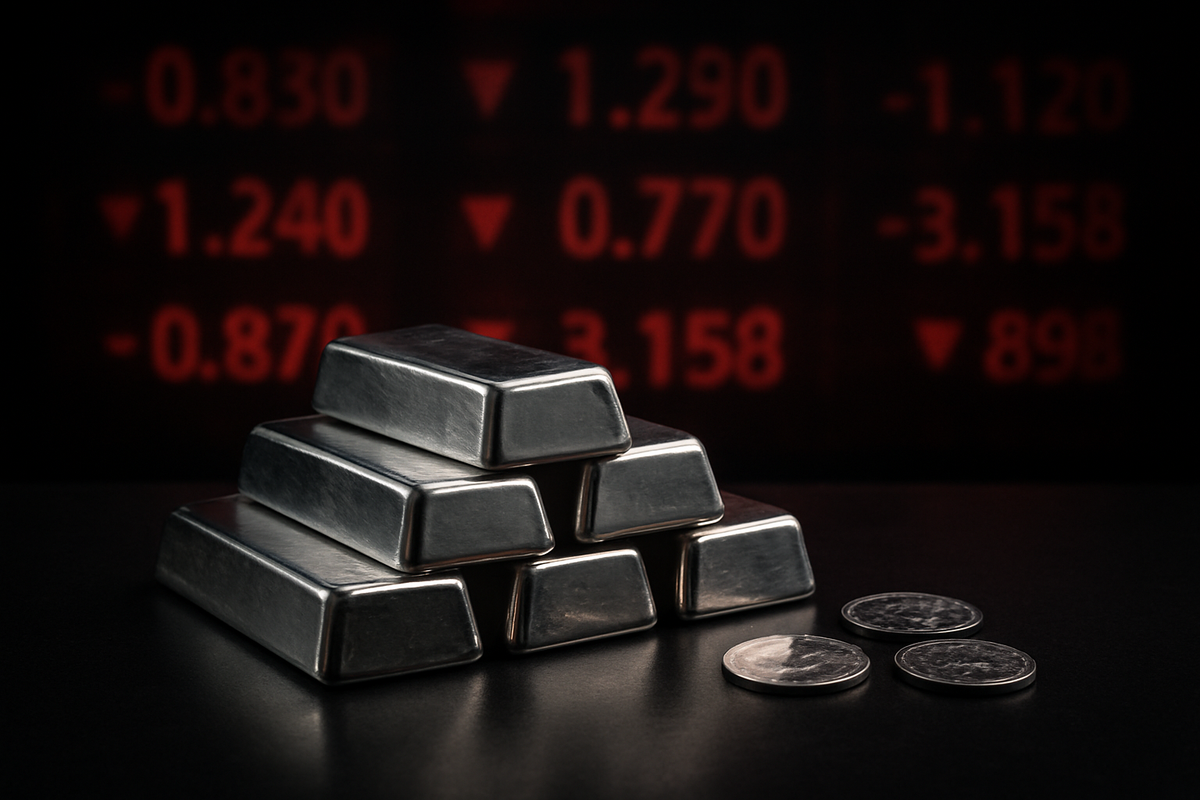
January 8, 2026 — The silver market experienced a jarring reality check on Thursday as spot prices plummeted 5%, dragging major mining stocks down in a wave of technical selling. After a historic 2025 that saw the "poor man’s gold" gain over 150%, spot silver retreated to approximately $74.14 per ounce. The decline was catalyzed not by a shift in industrial demand, but by the mechanical gears of Wall Street: the annual rebalancing of major commodity indices, which forced billions of dollars in passive sell orders onto the market.
The sudden price drop has sent ripples through the equities market, with pure-play silver producers bearing the brunt of the volatility. As the Bloomberg Commodity Index (BCOM) and the S&P GSCI began their scheduled weight adjustments, the sheer volume of silver futures being offloaded created a liquidity vacuum. For investors who had grown accustomed to silver’s relentless climb toward the $100 mark, today’s correction serves as a stark reminder of the technical hurdles that often accompany record-breaking rallies.
The Mechanics of the $5 Billion Sell-Off
The primary driver behind today's 5% slide was the scheduled annual rebalancing of the Bloomberg Commodity Index and the S&P GSCI. Following silver’s explosive performance in 2025, its relative weight in these indices had surged to nearly 9%, far exceeding the 2026 target of approximately 3.9%. To maintain their mandated weightings, passive investment funds were required to offload an estimated $5 billion to $7 billion in silver futures. Analysts from J.P. Morgan (NYSE: JPM), led by Gregory Shearer, had warned of this "paper" sell-off earlier in the week, noting that the concentration of sell orders over a five-day window would likely overwhelm immediate buying interest.
Adding fuel to the fire, the CME Group (NASDAQ: CME) implemented a series of margin hikes for silver contracts, increasing requirements by roughly 47%. This forced highly leveraged retail and institutional traders to liquidate their positions simultaneously, exacerbating the intraday "flash crash." The price of $74.14 represents a significant retreat from the multi-decade peak of $83.60 seen just weeks ago in late December 2025. While the decline is sharp, market historians note that the current price remains more than double the $28 levels seen at the start of 2025, suggesting this is a technical correction within a broader bull cycle.
The timeline of today's events began during the Asian trading session, where uncertainty surrounding China's new silver export licenses—effective January 1, 2026—initially kept prices stable. However, as the London and New York markets opened, the weight of the index rebalancing became apparent. By mid-morning in New York, spot silver had broken through key support levels at $78 and $76, eventually finding a temporary floor near $74.14.
Winners and Losers: Miners Retrench While Industrial Giants Breathe
The immediate "losers" of this price action are the major silver mining companies, whose stock prices often act as a leveraged play on the underlying metal. First Majestic Silver (NYSE: AG) saw its shares drop 4.2%, falling from a 52-week high as profit-taking intensified. Hecla Mining (NYSE: HL) followed suit, declining over 5% to trade near $21.37. Even the industry’s heavyweights were not immune; Pan American Silver (NYSE: PAAS) retreated 3.6%, while the world’s largest silver streamer, Wheaton Precious Metals (NYSE: WPM), showed slightly more resilience but still closed down 2.0%.
In international markets, the impact was even more pronounced. Hindustan Zinc (NSE:HINDZINC) plunged 6% in Mumbai, marking its steepest intraday loss in six months, as silver now contributes over 40% of the company's earnings before interest and taxes (EBIT). Smaller producers like Avino Silver & Gold (NYSE American:ASM) faced a "washout" of sentiment, with some analysts downgrading the stock from "Buy" to "Hold" as the metal’s volatility raised concerns about short-term cash flow consistency.
Conversely, the price dip was welcomed by industrial consumers in the green energy sector. Solar module manufacturers like JinkoSolar (NYSE: JKS) and First Solar (NASDAQ: FSLR) saw their margins improve overnight. In 2026, silver paste accounts for an estimated 14% of total solar module production costs; thus, a $10-per-ounce drop provides significant relief for utility-scale projects. Similarly, electric vehicle (EV) leader Tesla (NASDAQ: TSLA) and electronics giant Samsung Electronics (KOSPI:005930) benefited from the retreat, as silver remains a critical component in high-conductivity AI hardware and battery management systems.
Wider Significance: The Energy Transition Supercycle
The current volatility in silver is a microcosm of the broader "energy transition supercycle." Unlike previous silver rallies driven largely by monetary hedging, the 2025–2026 bull market is rooted in a structural supply deficit. The silver market has faced consecutive years of production shortfalls, exacerbated by the increasing silver intensity of N-type solar cells and the global push for electrification. This event highlights the tension between "paper" market dynamics—like index rebalancing—and the "physical" reality of scarce industrial supply.
Furthermore, the price drop has exposed underlying stresses in the banking sector. Reports suggest that several major bullion banks, including HSBC (NYSE: HSBC) and Bank of America (NYSE: BAC), have been holding substantial short positions to hedge their physical holdings or on behalf of clients. The rapid rise to $80+ in late 2025 reportedly forced some institutions to tap the Federal Reserve’s Standing Repo Facility for liquidity. Today's correction to $74.14 may provide these institutions with a much-needed window to cover or adjust those positions without triggering a systemic liquidity event.
Historically, this event draws comparisons to the 2011 silver correction, though the fundamentals differ significantly. In 2011, the rally was driven by retail speculation and a hunt for inflation hedges; in 2026, the demand is anchored by the global decarbonization mandate. This fundamental shift is why many institutional desks, including those at Goldman Sachs (NYSE: GS) and UBS (NYSE: UBS), are characterizing today's drop as a "healthy correction" rather than the end of the bull market.
What Comes Next: The Road to $100
In the short term, the silver market is likely to remain volatile as the index rebalancing window continues through January 15. Investors should expect continued "see-saw" price action as passive selling is met by opportunistic buying from industrial end-users and sovereign wealth funds. The $72.00 to $74.00 range is now being eyed by technical analysts as a critical support zone; a failure to hold these levels could see a deeper retracement toward $68.00.
However, the long-term outlook remains overwhelmingly bullish. Goldman Sachs has maintained its price target of $100 per ounce for late 2026, citing the "unstoppable" demand from the photovoltaic sector and the lack of new major silver mines coming online. Mining companies may use this period of stock price weakness to engage in share buybacks or accelerate M&A activity, as the valuation of their in-ground reserves remains high despite the temporary dip in spot prices.
Strategic pivots are also expected from industrial players. Companies like LONGi Green Energy are already exploring "silver-lite" technologies to reduce their exposure to price spikes. For investors, the coming months will be a test of patience, as the market balances the technical "noise" of January's rebalancing against the fundamental "signal" of a world that is running out of affordable silver.
Market Wrap-Up and Investor Outlook
Today’s 5% decline in silver to $74.14 is a classic example of how technical market structures can temporarily decouple a commodity from its fundamental value. While the slump in miners like First Majestic and Hecla is painful for shareholders in the immediate term, the correction has flushed out excessive leverage and "weak hands" that had entered the market during the December surge. The role of commodity index rebalancing was the primary catalyst, but the underlying story remains one of scarcity and high industrial utility.
Moving forward, the market will likely consolidate as it digests the $5 billion in passive selling. Investors should closely watch the $74.00 support level and monitor the CME Group for any further changes in margin requirements, which could signal more volatility ahead. The "energy transition supercycle" continues to provide a powerful tailwind, and for those with a long-term horizon, this dip may eventually be viewed as a strategic entry point before the next leg of the rally.
As we move further into 2026, the focus will shift back to physical supply. With China tightening export controls and solar demand showing no signs of slowing, the "paper" selling of early January may soon be eclipsed by the "physical" buying of a world hungry for silver.
This content is intended for informational purposes only and is not financial advice