On January 6, 2026, the financial markets opened the new year with a familiar sight: Nvidia (NASDAQ: NVDA) single-handedly lifting the technology sector. As the Consumer Electronics Show (CES) 2026 kicked off in Las Vegas, Nvidia’s stock surged behind a series of blockbuster announcements regarding its next-generation "Rubin" architecture. While the broader market experienced a complex "Great Rotation" into energy and financials, the tech-heavy Nasdaq Composite (NASDAQ: .IXIC) remained buoyed by the sheer gravity of the world’s most valuable semiconductor company, which now commands a market capitalization hovering near the $5 trillion mark.
The immediate implications of today’s rally are clear: the artificial intelligence trade is not cooling down; it is merely evolving. Investors who feared a "post-training" slump in chip demand have been met with a new reality—the era of "Agentic AI" and "Physical AI." As Nvidia accelerates its production timelines, it continues to serve as the primary engine for the Nasdaq 100, ensuring that even as traditional software and defensive sectors take a breather, the index remains at or near record highs.
The Rubin Breakthrough and the Shift to Autonomous Agency
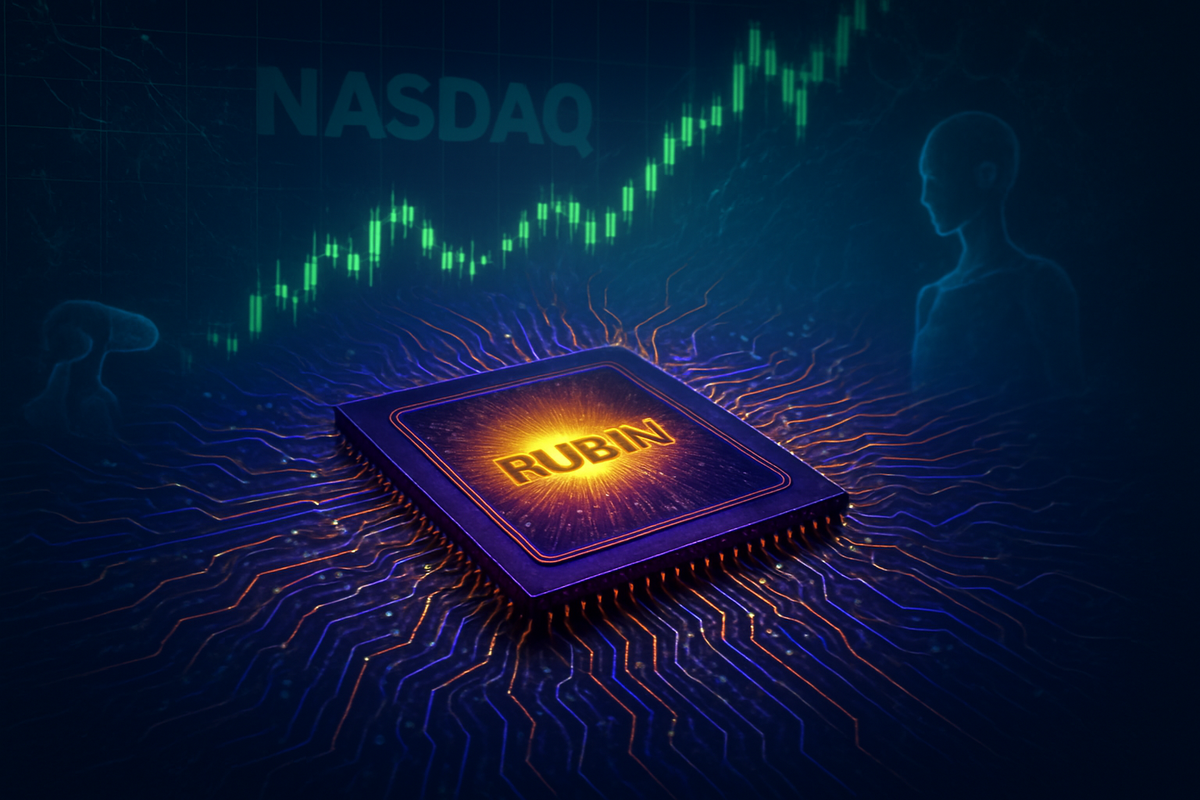
The primary catalyst for today’s market action was a high-stakes keynote delivered by Nvidia CEO Jensen Huang at CES 2026. In a move that caught many analysts off guard, Huang announced that the "Rubin" GPU architecture—the successor to the highly successful Blackwell platform—has entered full production in the first quarter of 2026, nearly two quarters ahead of the industry's original expectations. The Rubin platform, featuring the new Vera CPU and integrated NVLink 6 switches, is designed specifically for the transition from generative AI to "Agentic AI," where models do not just generate text but autonomously execute complex workflows.
The technical specifications of the Rubin architecture have sent shockwaves through the industry. Utilizing HBM4 memory with a staggering 22 TB/s of bandwidth, the Rubin GPU promises a tenfold reduction in inference costs for large-scale "mixture-of-experts" models. This shift is critical as the market moves from the "training phase"—where companies spent billions building models—to the "deployment phase," where these models must reason and act in real-time. The timeline acceleration suggests that Nvidia is widening its competitive moat, leaving rivals struggling to match its rapid-fire release cycle of new architectures every 12 to 18 months.
Initial market reactions were swift. Nvidia shares climbed to $189.31 in mid-day trading, a move that masked underlying volatility in other tech sub-sectors. While the Nasdaq Composite rose approximately 0.69%, much of that gain was concentrated in the semiconductor space. The broader market sentiment remains anchored by Nvidia’s massive weighting; institutional investors are increasingly viewing the company not just as a chipmaker, but as the foundational infrastructure provider for the "sovereign AI" and "physical AI" movements that are defining the mid-2020s.
Winners and Losers in the Wake of the AI Evolution
The ripple effects of Nvidia’s Rubin announcement have created a distinct set of winners within the semiconductor ecosystem. Micron Technology (NASDAQ: MU) and SK Hynix have seen significant gains as the demand for HBM4 memory—a core component of the Rubin architecture—reaches a fever pitch. Similarly, Taiwan Semiconductor Manufacturing Company (NYSE: TSM), the primary foundry for Nvidia’s advanced nodes, continues to see record utilization rates. On the application side, companies like Salesforce (NYSE: CRM) and Meta Platforms (NASDAQ: META) are being viewed as winners as they successfully integrate Nvidia's "Agentic" capabilities into their software stacks, allowing for autonomous AI agents to manage corporate supply chains and customer service.
Conversely, the "losers" in today’s session are those caught in the "Great Rotation." Legacy software companies that have failed to pivot from basic generative tools to autonomous agents are seeing their valuations compressed. Additionally, defensive sectors like Utilities and Consumer Staples are being sold off as capital flows toward the high-growth "Physical AI" sector. Even within the Magnificent Seven, a divergence is appearing; companies like Apple (NASDAQ: AAPL) that are perceived to be slower in their autonomous hardware integration are lagging behind the Nvidia-led charge.
In a surprising twist, the Energy sector, led by giants like Chevron Corporation (NYSE: CVX), has also rallied today, but for geopolitical reasons rather than AI demand. Recent developments in South America, including a significant shift in Venezuelan leadership, have sparked a rally in oil stocks. This has created a bifurcated market where Nvidia drives the Nasdaq, while energy and financials drive the Dow Jones Industrial Average, leaving traditional mid-cap growth and defensive "safety" stocks in the lurch.
The Broader Significance: From Content to Execution
Nvidia’s dominance on January 6, 2026, fits into a much broader industry trend: the transition of AI from a digital curiosity to a physical and operational necessity. This "Agentic AI" era represents a fundamental shift in how computing power is utilized. Unlike the 2000 dot-com bubble, to which this era is often compared, the current rally is supported by unprecedented free cash flow. Nvidia is not just selling a promise; it is selling the literal tools required for companies to remain competitive in an automated global economy.
Furthermore, the "Physical AI" trend—highlighted by Nvidia’s Alpamayo L4 autonomous driving model—marks the moment when AI moves from the data center to the factory floor and the open road. The partnership between Nvidia and Mercedes-Benz, which saw the launch of full-stack autonomous vehicles this quarter, serves as a historical precedent for how semiconductor companies are becoming the new "Tier 1" suppliers for the automotive and robotics industries. This shift has regulatory implications as well, with governments now viewing AI chip production as a matter of national security and industrial policy, further cementing Nvidia's role as a geopolitical actor.
Historically, few companies have maintained this level of market influence for such a sustained period. Nvidia’s ability to dictate the direction of the Nasdaq through multiple product cycles (Hopper, Blackwell, and now Rubin) mirrors the influence Intel once held in the 1990s, but on a much larger scale. The "halo effect" Nvidia provides for the entire tech sector is currently the only force powerful enough to offset the "extreme overbought" technical readings that would otherwise signal a market correction.
What Comes Next: The Road to H2 2026
Looking ahead, the short-term focus will remain on the ramp-up of Rubin production. If Nvidia can maintain its accelerated schedule, the second half of 2026 could see a massive wave of hardware upgrades across global data centers. However, this pace requires a strategic pivot for Nvidia’s partners and customers, who must now adapt their software environments to take advantage of the 22 TB/s bandwidth and HBM4 capabilities. The challenge for the market will be the "digestion period"—can the enterprise world implement these autonomous agents as fast as Nvidia can build the chips?
In the long term, the primary risk remains a potential "AI Capex" fatigue among the hyperscalers like Microsoft (NASDAQ: MSFT) and Alphabet (NASDAQ: GOOGL). While they are currently projected to grow capital expenditures by 50-60% in 2026, any sign of slowing demand for AI services could lead to a sharp pullback. Investors should also watch for potential regulatory hurdles or trade tariffs that could disrupt the complex global supply chain required to produce the Rubin architecture.
Final Assessment and Investor Takeaways
As we navigate the first week of 2026, the key takeaway is that Nvidia remains the undisputed heartbeat of the modern market. Its ability to pull the Nasdaq higher, even when other sectors are rotating or "taking a breather," is a testament to its central role in the global economy. The transition to Rubin and Agentic AI marks a new chapter in the technological revolution, one that moves beyond simple chatbots to autonomous, reasoning systems.
Moving forward, investors should watch for the "halo effect" to spread to smaller semiconductor players and AI service providers that can capitalize on Nvidia's infrastructure. While the broader market may see volatility due to interest rate shifts or geopolitical events in South America, the "AI-led rally" appears to have found its second wind. The months ahead will be defined by one question: how quickly can the rest of the world keep up with the pace of innovation set by Nvidia?
This content is intended for informational purposes only and is not financial advice.