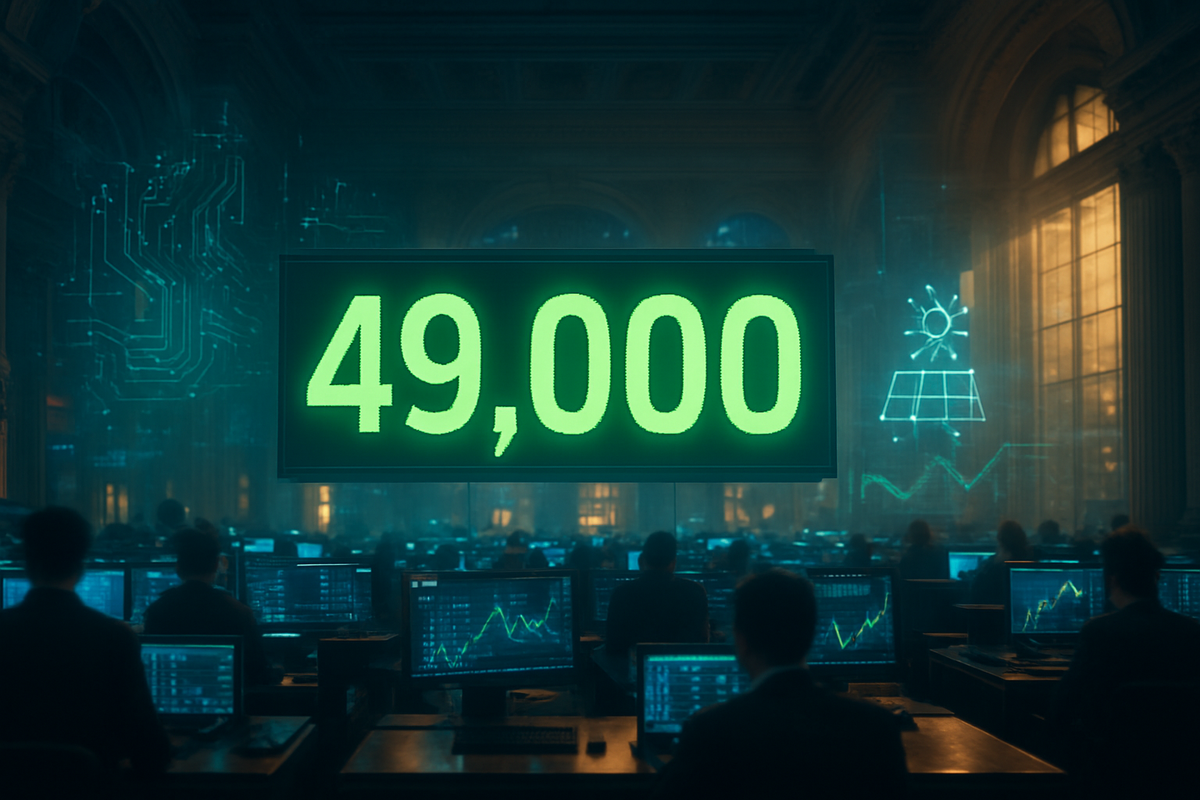
The Dow Jones Industrial Average crossed the historic 49,000 threshold during midday trading on January 6, 2026, marking a monumental milestone for the storied index and signaling a robust start to the new year. This breakthrough comes on the heels of a resilient 2025, where the market successfully navigated a 43-day government shutdown and significant shifts in trade policy. The crossing of 49,000 is more than just a psychological victory; it represents a fundamental shift in investor sentiment as the market rally "broadens" beyond high-growth technology into the bedrock of the American industrial and financial sectors.
The implications for the 2026 market are profound. As the index inches closer to the elusive 50,000 mark, the momentum suggests that the "soft landing" long sought by economists may finally be manifesting as a sustained period of "sturdy" growth. While the tech-heavy benchmarks dominated the previous two years, the Dow’s current ascent highlights a renewed faith in traditional blue-chip earnings, driven by the practical integration of artificial intelligence and a stabilizing interest rate environment.
The Path to 49,000: Resilience Amidst Policy Shifts
The journey to 49,000 was characterized by a series of high-stakes hurdles throughout late 2025. Following a volatile autumn where new tariff announcements and a prolonged government shutdown threatened to derail the economy, the Dow Jones Industrial Average (DJIA) showed remarkable tenacity. The index began its concerted push toward this milestone in December 2025, buoyed by a 25-basis-point interest rate cut from the Federal Reserve and a "Santa Claus rally" that extended well into the first week of 2026.
The specific catalyst for today’s breakout was a combination of stronger-than-expected manufacturing data and a series of upbeat earnings pre-announcements from major industrial players. As the opening bell rang on January 6, the index surged 320 points within the first hour of trading, slicing through the 48,900 resistance level that had held firm since the previous November. Traders on the floor of the New York Stock Exchange (NYSE) noted that the volume was exceptionally high, indicating that institutional "dry powder" from the end of the 2025 fiscal year is being aggressively deployed into the market.
Key stakeholders, including major institutional asset managers and retail investors, have pivoted their strategies to account for "sticky" but manageable inflation. With core Personal Consumption Expenditures (PCE) holding near 2.7%, the market has seemingly accepted that the era of 2% inflation may be on pause, opting instead to focus on productivity gains. The initial reaction from Wall Street has been overwhelmingly positive, with analysts from Goldman Sachs (NYSE: GS) and JPMorgan Chase (NYSE: JPM) raising their mid-year targets for the index to 51,000 and beyond.
Winners and Losers in the 49,000 Era
The ascent to 49,000 has created a clear divergence between sectors. The primary winners in this environment are the "AI Adopters"—companies that have successfully integrated generative AI to expand margins. Microsoft (NASDAQ: MSFT) and Salesforce (NYSE: CRM) have seen their Dow-weighted influence grow as they move from the "hype" phase of AI into material revenue generation. Similarly, the financial sector has seen a massive resurgence. Goldman Sachs (NYSE: GS) has benefited from a rejuvenated M&A and IPO market, which had been largely dormant during the high-rate environment of 2023-2024.
Energy and utility companies have also emerged as surprise leaders in this rally. NextEra Energy (NYSE: NEE) has seen significant gains as the demand for "round-the-clock" power for AI data centers reaches a fever pitch. As the digital economy's energy requirements spike, these traditional "defensive" stocks are being re-rated as growth engines. The steepening of the yield curve has also provided a tailwind for JPMorgan Chase (NYSE: JPM), allowing for improved net interest margins as the Federal Reserve maintains a "measured pause" in its rate-cutting cycle.
Conversely, the "losers" in this current climate are companies heavily exposed to the 2025 tariff updates and those with high debt-to-equity ratios. Retail giants like Walmart (NYSE: WMT) and Target (NYSE: TGT) are facing margin pressures as the "tariff bump" in early 2026 hits supply chains. While these companies remain Dow staples, their performance has lagged behind the broader index as they struggle to pass on increased costs to a consumer base that is increasingly price-sensitive. Additionally, small-cap companies that lack the scale to invest in AI productivity tools are finding themselves left behind in this "K-shaped" corporate recovery.
The Significance of the "Broadening" Rally
The Dow’s milestone is a signal that the market is no longer solely dependent on the "Magnificent Seven" for growth. This "broadening" of the rally into industrials, financials, and energy suggests a more durable economic foundation. Historically, when the Dow leads or keeps pace with the Nasdaq, it indicates that investors are betting on the health of the broader economy rather than just a few high-growth outliers. This shift mirrors the market dynamics of the late 1990s, though with a more significant focus on actual earnings rather than speculative potential.
Furthermore, the 49,000 mark comes at a critical juncture for U.S. monetary policy. With Federal Reserve Chair Jerome Powell’s term set to expire in May 2026, the market is currently in a "wait-and-see" mode regarding his successor. The Dow’s strength suggests that investors believe the current "data-dependent" framework will persist regardless of who takes the helm. This stability is crucial as the market digests the long-term implications of 2025’s fiscal policies, including tax cuts and deregulation, which have historically favored the large-cap industrial stocks that comprise the Dow.
Regulatory shifts are also playing a role. The current administration's lean toward a friendlier merger environment has sparked a wave of consolidation in the banking and healthcare sectors. This has allowed Dow components like UnitedHealth Group (NYSE: UNH) to expand their footprints, further driving the index higher. The historical precedent for such a move often points to a "melt-up" phase, where the fear of missing out (FOMO) drives the index toward even more significant psychological barriers, such as 50,000.
What Lies Ahead: The Road to 50,000
In the short term, the market will likely face a period of consolidation as it absorbs the gains from the first week of 2026. Technical analysts expect a "test" of the 49,000 level as support. If the index can hold this ground through the upcoming Q4 2025 earnings season, the path to 50,000 could be cleared by the end of the first quarter. However, the "Powell Transition" in May remains the largest looming shadow on the horizon, potentially introducing volatility if the nominated successor is perceived as either too hawkish or too politically aligned.
Strategic pivots will be required for investors who have been overweight in pure-play tech. The 2026 market favors a "barbell" strategy: maintaining exposure to AI infrastructure through companies like Apple (NASDAQ: AAPL) while increasing weight in "old economy" stocks that are leveraging that technology to reduce costs. The potential for a "tariff-driven" volatility spike in mid-2026 also means that diversification into energy and materials—sectors that can serve as an inflation hedge—will be paramount.
Potential scenarios for the remainder of 2026 range from a "Goldilocks" continuation, where the Dow hits 53,000 by year-end, to a more stagnant "range-bound" scenario if inflation remains stickier than expected. The most likely outcome, according to current futures pricing, is a steady climb characterized by sector rotation rather than a uniform market surge. This would see the Dow continue to outperform more speculative indices as investors prioritize cash flow and dividend stability in an uncertain geopolitical landscape.
Wrap-Up: A New Benchmark for a New Era
The Dow Jones Industrial Average crossing 49,000 is a testament to the resilience of the American corporate sector in the face of significant macro-economic and political shifts. It marks the transition of the market from a tech-led recovery into a broader, more diversified expansion. Key takeaways from this milestone include the successful "soft landing" of the economy, the tangible ROI of AI investments in traditional sectors, and the market's ability to look past short-term policy volatility.
Moving forward, the market appears poised for further gains, though the "easy money" of the initial recovery phase has likely been made. Investors should watch closely for the Federal Reserve's leadership transition in May and the persistence of the "tariff bump" in consumer prices. The focus for the coming months will be on earnings quality and the ability of blue-chip companies to maintain margins in a higher-cost environment.
As we look toward the 50,000 horizon, the 49,000 mark will be remembered as the moment the 2026 rally proved it had the legs to carry the entire economy forward. For the savvy investor, the message is clear: the rally has broadened, and the "old guard" of the Dow is leading the charge into the future.
This content is intended for informational purposes only and is not financial advice.