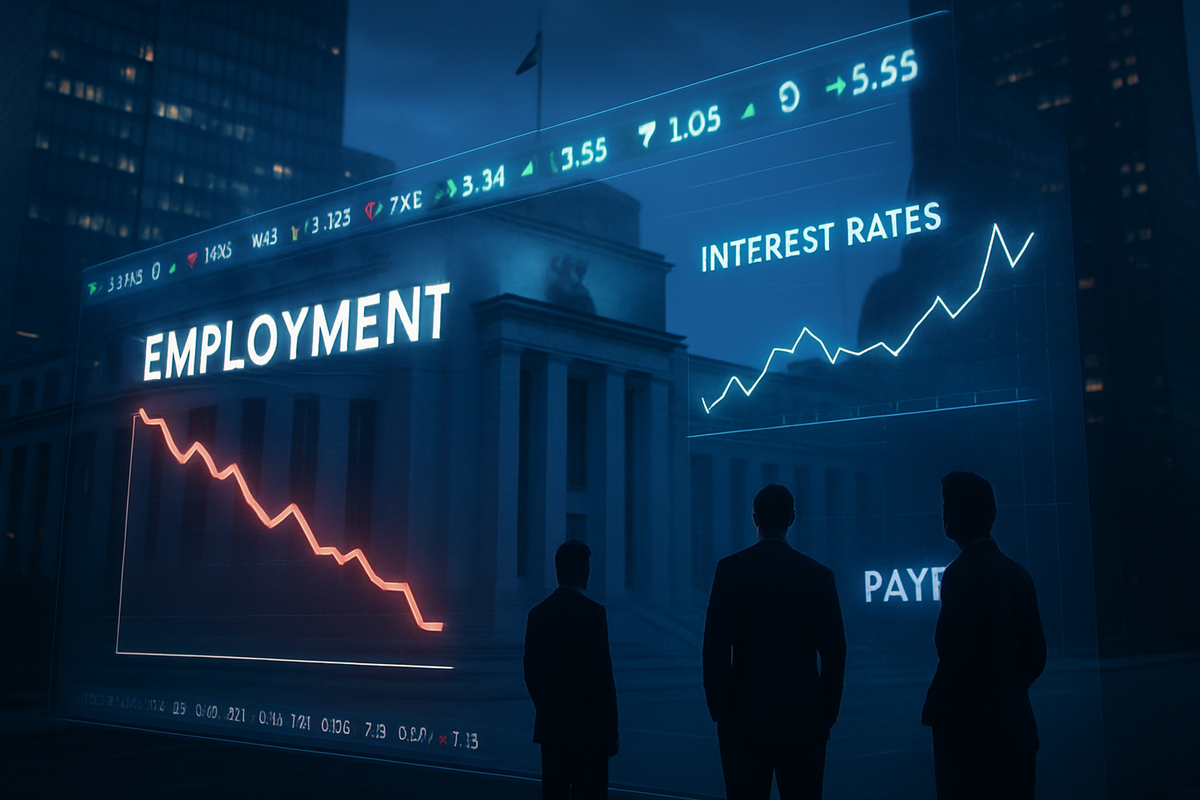
As the Federal Reserve convenes this week for its January 27–28 policy meeting, the financial world is looking past the central bank’s expected "hold" decision toward a critical data point: the February nonfarm payrolls report. Scheduled for release on February 6, 2026, this report is anticipated to reveal a labor market in the throes of a significant structural slowdown. With consensus estimates hovering at a meager 50,000 to 60,000 new jobs, investors are grappling with a "new normal" where the frenetic hiring of the post-pandemic era has been replaced by a cautious, stagnant equilibrium.
The implications for Federal Reserve policy are profound. While the Fed, led by Chair Jerome Powell in the waning months of his term, has already signaled a pause in its rate-cutting cycle, a particularly weak jobs print could reignite the debate over whether the current benchmark rate of 3.50%–3.75% is overly restrictive. Conversely, persistent inflation—fueled by 2025’s aggressive fiscal policies and new trade tariffs—leaves the central bank with little room to maneuver, creating a high-stakes environment where the labor market’s health is the ultimate arbiter of the "soft landing" narrative.
A Stagnant Pulse: Navigating the January Labor Data
The upcoming February report, which covers data from January 2026, arrives at a time of extreme statistical "noise." Much of this turbulence stems from the lingering effects of the 43-day federal government shutdown that paralyzed Washington in late 2025. Economists at LPL Financial Holdings Inc. (NASDAQ: LPLA) have noted that the Bureau of Labor Statistics (BLS) is still relying on "carry-forward" imputations to fill gaps left by the shutdown, making this February release one of the most unpredictable in recent memory. Despite these hurdles, the trend is clear: hiring has slowed to a crawl, with monthly averages for 2026 expected to settle at a fraction of the 150,000+ levels seen just two years ago.
The timeline leading to this moment is defined by a series of aggressive fiscal maneuvers. Following the passage of the "One Big Beautiful Bill Act" (OBBBA) in July 2025, the U.S. economy received a massive injection of liquidity through tax refunds and business expensing. While this spurred GDP growth toward the 2.5% mark, it also created a "labor hoarding" effect where companies are maintaining existing staff but are hesitant to expand. The unemployment rate has remained relatively stable at 4.5%, but this is increasingly seen as a reflection of a shrinking labor supply—partially due to stricter immigration policies—rather than a sign of robust demand.
Market participants are currently focused on the Federal Reserve’s reaction function. Internal consensus from major institutions like JPMorgan Chase & Co. (NYSE: JPM) suggests that the FOMC is likely to maintain its current interest rate corridor through the first half of 2026. The central bank is caught between a rock and a hard place: the labor market is slowing, which typically necessitates cuts, but core inflation remains stubbornly high at 2.76%, bolstered by a 17% effective tariff rate on imported goods. This "stagflation-lite" environment has kept bond yields volatile and investors on edge.
Sector Winners and Losers in a Low-Growth Era
In this environment of low job growth and steady interest rates, the banking sector remains a primary beneficiary. Firms like Bank of America Corporation (NYSE: BAC) and JPMorgan Chase & Co. (NYSE: JPM) continue to benefit from elevated net interest margins, as the Fed’s reluctance to cut rates further prevents the erosion of lending profits. However, these gains are tempered by the reality of slowing loan growth, as both businesses and consumers pull back on credit in the face of economic uncertainty and a cooling employment landscape.
On the other side of the ledger, the high-growth technology sector faces a more difficult path. Giants such as Apple Inc. (NASDAQ: AAPL) and NVIDIA Corporation (NASDAQ: NVDA) are highly sensitive to the "cost of capital" narrative. Any sign in the February payrolls report that suggests the Fed will keep rates at 3.5% or higher for the remainder of 2026 could put downward pressure on the rich valuations of these tech leaders. While AI-driven productivity remains a long-term tailwind, the short-term reality of "higher for longer" rates continues to act as a gravity-like force on growth stocks.
The industrial and construction sectors present a more nuanced picture. Companies like Caterpillar Inc. (NYSE: CAT) are seeing strong demand driven by the infrastructure and business expensing provisions of the OBBBA. Yet, these firms are also the most vulnerable to the rising costs of raw materials due to tariffs. If the February jobs report shows a decline in construction or manufacturing employment, it could signal that the initial boost from the 2025 fiscal stimulus is beginning to fade, potentially leading to a sell-off in cyclical stocks that had previously anticipated a multi-year boom.
The Broader Significance: Policy Collisions and Historical Shifts
The current economic landscape represents a departure from the historical precedents of the last decade. Unlike the "Goldilocks" economy of the late 2010s, early 2026 is defined by a collision of contradictory forces: massive fiscal stimulus (OBBBA) meeting aggressive protectionist trade policy (tariffs). This policy mix has complicated the Federal Reserve's traditional toolkit. Historically, a jobs report as weak as 50,000 would have triggered an immediate "dovish" pivot from the Fed. Today, however, the fear that cutting rates will only fan the flames of tariff-induced inflation has paralyzed the central bank.
Furthermore, the transition of leadership at the Federal Reserve adds a layer of political and regulatory uncertainty. With Jerome Powell’s term as Chair expiring in May 2026, the February jobs report will be one of the final major data points released under his full stewardship. Speculation regarding his successor—with names like Kevin Warsh and Kevin Hassett frequently mentioned—has already begun to influence market behavior. Investors are watching for any subtle shift in the FOMC’s rhetoric that might suggest a pivot toward a more politically aligned or "hawkish" stance in the transition period.
The ripple effects of the U.S. labor slowdown are also being felt globally. As the U.S. consumer—long the engine of global growth—slows down amid a stagnant job market, international partners are feeling the pinch. Retailers like Amazon.com, Inc. (NASDAQ: AMZN) are closely monitoring domestic discretionary spending, which is inextricably linked to job security and wage growth. If the February report confirms a sustained downturn in hiring, the pressure on the global supply chain and international exporters will intensify, potentially leading to a synchronized global slowdown.
What Comes Next: Strategic Pivots and Scenarios
In the short term, the primary focus remains on the March FOMC meeting. While the January meeting is expected to result in a "hold," the February payrolls report will serve as the most significant "swing" factor for the March decision. If the report significantly misses the 50,000-job mark—perhaps even showing a contraction—the Fed may be forced to consider an "insurance cut" to prevent a harder economic landing. Conversely, if the numbers surprise to the upside, the Fed’s "hold" could extend well into the summer of 2026.
Long-term, corporations and investors are preparing for a strategic pivot. The era of "cheap labor" and "cheap money" appears firmly in the rearview mirror. Companies are increasingly looking toward automation and AI to mitigate the effects of a shrinking labor supply and high wage floors. For investors, the challenge will be identifying firms that can maintain margins through productivity gains rather than headcount expansion. We expect a shift in market leadership toward "quality" stocks—those with strong balance sheets and the ability to pass on costs to consumers in an inflationary environment.
Potential scenarios for the next six months range from a "stagnation success," where inflation slowly returns to target while the labor market avoids a collapse, to a "policy error" scenario where the Fed stays too tight for too long, triggering a recession. The data released on February 6 will provide the first clear evidence of which path the U.S. economy is taking. Markets are currently pricing in a 65% chance of a "hold" through May, but those odds are written in pencil, not ink.
Summary: A Market in Transition
The upcoming February nonfarm payrolls report is more than just a monthly statistic; it is a vital sign for an economy at a crossroads. With estimates suggesting a tepid 50,000 jobs were added in January, the narrative of a cooling labor market is reaching a fever pitch. This slowdown, combined with the Fed’s current "hold" stance and the looming expiration of Chair Powell’s term, creates a complex tapestry for investors to navigate. Key takeaways include the structural decline in the job growth "run rate" and the counterintuitive pressure of tariff-driven inflation that prevents the Fed from providing the relief the labor market might seem to need.
Moving forward, the market will remain hyper-sensitive to every nuance of the Fed’s communication. The transition from the 2025 fiscal boom to the 2026 structural reality will likely be characterized by heightened volatility and a sector-by-sector divergence in performance. Investors should maintain a defensive posture, prioritizing sectors with resilient earnings power and watching closely for any signs of a deeper cracks in the labor market.
The coming months will be a test of the Fed’s resolve and the economy’s underlying strength. While the "One Big Beautiful Bill" provided a temporary cushion, the true foundation of the U.S. economy—the American worker—is showing signs of fatigue. Whether the Fed can engineer a soft landing amidst this fatigue and the "noise" of late-2025 data disruptions will be the defining story of the first half of 2026.
This content is intended for informational purposes only and is not financial advice.