WASHINGTON D.C. — In a dramatic escalation of his "America First" foreign policy, President Donald Trump has moved beyond mere interest to a formal demand for the acquisition of Greenland, threatening a wave of crippling tariffs against any nation—including long-standing NATO allies—that opposes the bid. As of January 16, 2026, the administration has transitioned from diplomatic persuasion to economic coercion, signaling a new era where trade policy is directly leveraged to redraw the geopolitical map. The move has sent shockwaves through global markets, pitting the defense and mining sectors against the pharmaceutical and shipping industries in a high-stakes battle over Arctic sovereignty.
The immediate implications are staggering: a proposed 25% tariff on Danish goods and potential retaliatory measures from the European Union have placed billions of dollars in transatlantic trade at risk. For President Trump, the acquisition is a cornerstone of his "Golden Dome" initiative, a $175 billion missile defense project designed to shield the United States from emerging high-altitude threats. However, for Denmark and its European neighbors, the demand is viewed as an existential threat to international law and the integrity of the NATO alliance, leading to a military standoff in the North Atlantic that many fear could spiral out of control.
A Timeline of Escalation: From "Real Estate" to National Security
The current crisis began in early January 2026, when the Trump administration officially categorized the acquisition of Greenland as an "absolute national security necessity." Following his re-election in 2024, Trump tasked Secretary of State Marco Rubio and Vice President JD Vance with drafting a formal proposal to the Kingdom of Denmark, reportedly offering between $500 billion and $700 billion for the territory. When Danish Prime Minister Mette Frederiksen dismissed the offer as "absurd," the administration shifted tactics, threatening to impose 25% tariffs on all Danish exports—ranging from life-saving medicines to wind turbine components.
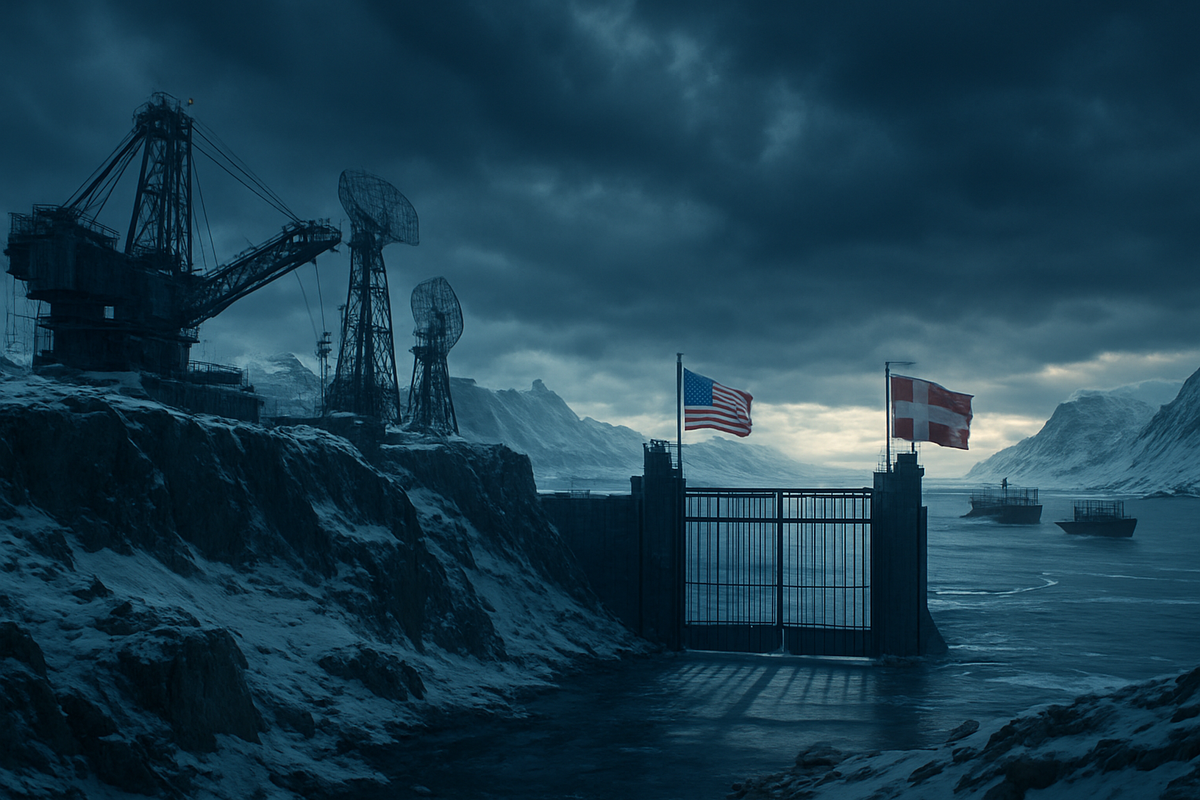
The rationale provided by the White House is two-fold: security and resources. The administration argues that Greenland is the essential geographic anchor for the "Golden Dome" missile defense system. Furthermore, the White House has highlighted Greenland’s vast, untapped reserves of rare earth minerals as vital for U.S. energy independence and high-tech manufacturing. On January 16, 2026, during a White House roundtable, Trump explicitly warned that the U.S. would secure the territory "the easy way or the hard way," a statement that has been interpreted as a threat of unilateral action or forced annexation.
The international response was swift and unprecedented. By mid-January, France, Germany, and Norway deployed a joint "Arctic Sentry" mission to Greenland as a physical deterrent against U.S. intervention. Domestic opposition has also flared, with a bipartisan group of lawmakers introducing the "NATO Unity Protection Act" to block the use of federal funds for any forced seizure of the territory. Despite this, the President has reportedly ordered the Joint Special Operations Command to prepare contingency plans, famously telling reporters, "I don't need international law" when questioned about the legality of the move.
Market Fault Lines: Winners and Losers in the Arctic Proxy War
The threat of a Greenland-centric trade war has created a stark divide in the financial markets. The primary beneficiaries have been U.S. defense contractors and mining firms positioned to exploit the Arctic’s potential. Lockheed Martin (NYSE: LMT) saw its stock rise by over 7% in early January as investors anticipated a massive surge in Arctic-capable aircraft and missile defense contracts. Similarly, RTX Corporation (NYSE: RTX) and Northrop Grumman (NYSE: NOC) have gained significantly, buoyed by their roles in operating the Pituffik Space Base (formerly Thule) and advanced surveillance drone programs.
In the mining sector, Critical Metals Corp (NASDAQ: CRML) has emerged as a "meme stock" favorite, with shares skyrocketing 160% following reports of potential U.S. government backing for its Tanbreez rare earth project. Speculation has also lifted MP Materials (NYSE: MP), which is seen as the primary hub for processing Arctic minerals. Even the local Grønlandsbanken (CPH: GRLA) has experienced a 34% surge, as speculators bet on a massive influx of American infrastructure capital should the acquisition proceed.
Conversely, the losers are high-profile European multinationals. Novo Nordisk (NYSE: NVO) is perhaps the most vulnerable, with nearly $16 billion in U.S. sales at risk of being caught in the crossfire of a 25% tariff on Danish pharmaceuticals. Logistics giant A.P. Moller - Maersk (CPH: MAERSK-B) has faced a "risk premium" on its shares as the threat of trade barriers looms over transatlantic shipping lanes. Other Danish stalwarts like Ørsted (CPH: ORSTED) and the privately-held Lego Group are bracing for economic defense strategies as their products face the prospect of being priced out of the American market.
Geopolitical Shifts and the Return of Resource-Driven Trade
This event marks a significant departure from traditional trade disputes, fitting into a broader trend of "Trade War 2.0" where economic tools are used to achieve specific territorial objectives. It mirrors historical precedents like the 19th-century "Manifest Destiny" or the Gadsden Purchase, but with the modern twist of global supply chain weaponization. By linking Greenland to the "Golden Dome" project, the administration is effectively securitizing trade, suggesting that allies who do not assist in U.S. defense goals forfeit their right to favorable trade terms.
The ripple effects are being felt across the NATO alliance. The "Arctic Sentry" mission marks the first time EU allies have deployed troops to deter a potential U.S. action, signaling a profound breakdown in trust. Furthermore, the focus on rare earth minerals is a direct challenge to China’s dominance in the sector, suggesting that the Greenland bid is as much about the Great Power competition with Beijing as it is about Danish relations. Regulatory implications are also surfacing, as the EU considers retaliatory tariffs that could target U.S. tech giants, turning a regional dispute into a global economic conflict.
The Road Ahead: Diplomatic Standoff or Economic Siege?
In the short term, the market will likely remain in a state of high volatility as the "NATO Unity Protection Act" moves through Congress and the tariff implementation dates approach. The primary challenge for multinational corporations will be navigating the uncertainty of a fractured NATO. If the Trump administration follows through on its 25% tariff threat, we may see a massive "de-risking" of Danish companies from the U.S. market, leading to a permanent shift in trade patterns.
Long-term possibilities include a potential "strategic pivot" where Denmark allows for expanded U.S. military and mining rights in exchange for the removal of tariff threats—a middle-ground solution that preserves Danish sovereignty while satisfying U.S. security concerns. However, if the administration persists with a "purchase or annex" ultimatum, the likelihood of a total U.S. withdrawal from NATO becomes a credible tail risk. Investors should watch for the results of the upcoming "Arctic Summit" and any signs of cracks in the European coalition.
Closing Thoughts: A New Frontier of Economic Coercion
The Greenland crisis of 2026 represents a watershed moment in international relations. It demonstrates that the current administration is willing to treat geopolitical bids not as diplomatic negotiations, but as real estate transactions backed by the full weight of the U.S. Treasury’s tariff powers. The summary of the situation is clear: the "Golden Dome" project has made Greenland a non-negotiable asset in the eyes of the White House, and the economic costs of this stance are being borne by some of the world's most successful multinational corporations.
As the market moves forward, the "Greenland Risk" will be a standard metric for any company with significant exposure to transatlantic trade. Investors should closely monitor tariff implementation dates and any potential shifts in the "Arctic Sentry" mission's posture. While the defense and mining sectors may continue to find opportunities in the chaos, the broader market remains vulnerable to a trade war that could redefine the global order for decades to come.
This content is intended for informational purposes only and is not financial advice.