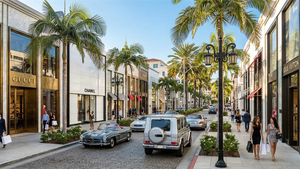
As of mid-January 2026, the American consumer has defied nearly two years of recessionary warnings, but the engine of this resilience has undergone a profound shift. The U.S. economy is currently operating under a powerful "wealth effect," where record-high valuations in real estate and the stock market are fueling a spending spree among high-income households. While the broader population grapples with "inflation fatigue" and record-high credit card debt, the top 10% of earners—who now account for nearly 50% of all U.S. consumption—are driving a robust, albeit uneven, economic expansion.
This divergence has created a "K-shaped" consumer landscape that is fundamentally altering the retail and luxury sectors. Households bolstered by the "AI Gold Rush" of 2025 have seen their net worth skyrocket, providing a psychological and financial cushion that keeps high-end restaurants full, premium travel booked, and luxury showrooms busy. However, beneath the surface of these glittering retail numbers lies a more complex reality of rising delinquencies and a vanishing middle-market, as the wealth gap reaches levels not seen in decades.
The Tale of Two Consumers: From the AI Bull Market to the Debt Ceiling
The economic data released in early January 2026 tells a story of extraordinary asset concentration. Following the massive tech rally of 2025, U.S. household net worth hit a staggering $181.6 trillion in late 2025. This was largely propelled by corporate equity gains, with NVIDIA Corp. (NASDAQ: NVDA) leading a semiconductor surge that added trillions to retail portfolios. At the same time, the housing market remained stubbornly resilient. Despite mortgage rates hovering around 6.5%, a chronic lack of inventory pushed total real estate values to over $49 trillion, with homeowners sitting on $35.8 trillion in equity.
The timeline leading to this moment began in late 2024, when the Federal Reserve’s "soft landing" narrative took hold. Throughout 2025, as AI transitioned from hype to infrastructure deployment, equity markets saw a historic run-up. High-income families, who are disproportionately invested in these assets, felt a "wealth dividend" that translated directly into discretionary spending. Conversely, the bottom 80% of the population faced a different reality. By January 2026, national household debt exceeded $18 trillion, with credit card balances hitting a record $1.2 trillion as lower-income groups used credit to bridge the gap between stagnant wages and the cumulative cost of living.
Initial market reactions to this divergence have been mixed. While the S&P 500 remains near all-time highs, there is growing concern among economists about the sustainability of an economy so heavily reliant on the top quintile of earners. The Michigan Consumer Sentiment Index for January 2026 reflected this "guarded resilience," rising slightly to 54.0—better than the lows of 2024, but still far below the exuberant levels seen in previous decades.
Winners and Losers in the Age of High-Net-Worth Dominance
The beneficiaries of this wealth-driven economy are those companies that cater to the affluent or offer essential value to the squeezed middle class. Apple Inc. (NASDAQ: AAPL) has emerged as a major winner, capturing the high-income upgrade cycle with its latest premium hardware and expanding Services ecosystem. Similarly, American Express (NYSE: AXP) has reported sustained 9% year-over-year revenue growth, driven by record spending on travel and entertainment by its tech-savvy, affluent cardholder base.
In the luxury and high-end retail space, the divide is even more pronounced. Hermès (OTC: HESAY) and LVMH (OTC: LVMUY) continue to showcase extreme pricing power, with Hermès reporting 17% growth in early 2026. Domestic high-end brands like Ralph Lauren (NYSE: RL) and the upscale home furnishings giant RH (NYSE: RH) are also thriving as their core demographics remain insulated from inflationary pressures. Even in the travel sector, Delta Air Lines (NYSE: DAL) and Host Hotels & Resorts (NASDAQ: HST) have outperformed by focusing on premium cabins and luxury urban locations, catering to a "revenge travel 2.0" trend among the wealthy.
Conversely, the "losers" in this environment are traditional middle-market retailers that lack a clear value or luxury proposition. Department stores and mid-tier apparel brands are finding themselves in a "middle trap," unable to attract the ultra-wealthy while being too expensive for the budget-conscious. On the value end, Walmart Inc. (NYSE: WMT) has become a "value fortress," successfully capturing the "trade-down" effect from families earning over $100,000 who are increasingly using AI-driven tools to manage their grocery budgets in the face of persistent food inflation.
Wider Significance: The K-Shaped Trend and Policy Risks
The current state of the US consumer represents more than just a temporary fluctuation; it is the crystallization of a decade-long trend toward asset-driven growth. This reliance on the "wealth effect" creates a significant ripple effect across the economy, as consumer-facing industries pivot their business models to focus exclusively on the high-end. This shift could lead to a reduction in services and products available to the median earner, further entrenching the economic divide.
From a regulatory and policy perspective, this divergence presents a headache for the Federal Reserve. Traditional interest rate hikes, intended to cool the economy, have a delayed and uneven impact when the primary spenders are sitting on large cash reserves and fixed-low-rate mortgages from the early 2020s. This "monetary policy lag" means that while lower-income consumers are feeling the pain of higher rates on their credit cards, the wealthy are actually benefiting from higher yields on their savings and money market accounts, potentially fueling more inflation in the luxury services sector.
Historical precedents, such as the period following the 2008 financial crisis, showed a similar but less extreme wealth divergence. However, the speed of the 2025 AI-driven wealth creation has no modern parallel. The risk remains that a sudden correction in tech valuations could "unwind" the wealth effect overnight, leaving the economy without its primary engine of growth at a time when the lower-income cohorts are already financially exhausted.
The Road Ahead: Short-Term Booms and Long-Term Vulnerabilities
In the short term, the US consumer is likely to remain resilient as long as asset prices hold steady. We expect to see continued strategic pivots from companies looking to capture high-margin affluent spending. Expect more "premiumization" across sectors ranging from fast food to automotive. However, the long-term sustainability of this model depends on two factors: the continued return on investment for AI technologies and the ability of real wages to eventually catch up to the cost of living for the broader population.
Market opportunities will emerge in "efficiency-driven" retail and financial services that help the bottom 80% manage their debt. Meanwhile, luxury brands may face a "saturation risk" if they push pricing power too far, even for the wealthy. If the tech sector faces a significant valuation reset in mid-2026, we could see a rapid "consumption chill" that forces the Federal Reserve to pivot aggressively toward rate cuts to prevent a broader downturn.
Final Assessment: What Investors Should Watch
The US consumer in 2026 is a study in contrasts. The economy is currently supported by a "wealth floor" of nearly $182 trillion, but that floor is unevenly distributed. Investors should focus on companies with high exposure to the top 10% of earners, while keeping a close eye on credit delinquency rates among regional lenders, which serve as the "canary in the coal mine" for the broader economy.
In the coming months, watch for the Q1 2026 earnings reports from major retailers and the next update to the Federal Reserve’s Survey of Consumer Finances. The key question remains: can the "wealth dividend" from the 2025 bull market bridge the gap until inflation is fully tamed, or is the US economy building a house of cards on the backs of its wealthiest citizens? For now, the resilience is real, but its foundation is narrower than ever.
This content is intended for informational purposes only and is not financial advice.