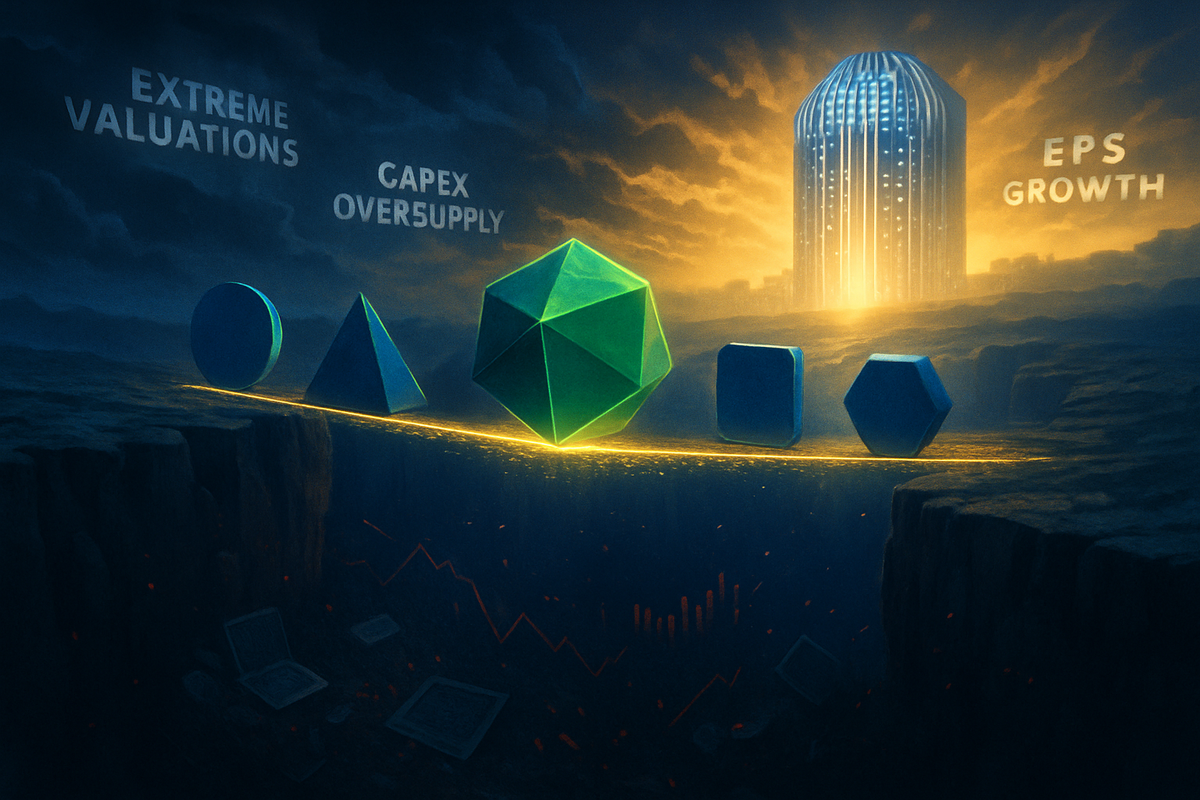
As of mid-January 2026, the global financial markets find themselves in a state of precarious euphoria. The S&P 500 Information Technology Index is hovering near an all-time high of 5,688 points, buoyed by a sector-wide earnings-per-share (EPS) growth rate that continues to exceed 20%. Yet, beneath this veneer of unprecedented prosperity, a growing chorus of analysts and institutional investors is sounding the alarm on an "AI narrative collapse"—a tipping point where the astronomical capital expenditures (Capex) required to fuel the generative AI revolution may finally fail to justify their valuations.
The immediate implications are a market defined by extreme concentration and volatility. While the technology sector has posted a staggering one-year return of roughly 26%, the forward price-to-earnings (P/E) ratio has ballooned to nearly 39x—more than double its 20-year historical average. Investors are currently engaged in a high-stakes gamble, betting that the productivity gains from artificial intelligence will materialize fast enough to prevent a valuation correction that some fear could mirror the 2000 dot-com crash.
The Disconnect Between Record Profits and "Stretched" Valuations
The current market environment is a "split reality" where record-breaking fundamentals meet historically expensive prices. Leading into 2026, the technology sector has been supported by a "stair-step" acceleration in earnings. The "Magnificent Seven" companies—led by titans like NVIDIA (NASDAQ: NVDA), Microsoft (NASDAQ: MSFT), and Alphabet (NASDAQ: GOOGL)—are projected to deliver consistent EPS growth of 20% to 25% throughout the 2026 fiscal year. FactSet forecasts suggest this momentum is accelerating, with year-over-year growth expected to hit 24.5% by the third quarter of 2026.
This surge follows a volatile 2025, which saw a "mini-crash" in January triggered by the rise of international AI competitors like DeepSeek, followed by a massive recovery as the "AI arms race" intensified. The concentration of the market has reached levels not seen in over half a century; according to Apollo Global Management (NYSE: APO), the top five tech companies now represent the highest percentage of the total S&P 500 market capitalization in history. Nearly 15 cents of every dollar flowing into passive S&P 500 funds are now directed into just two stocks: Microsoft and NVIDIA.
However, the "narrative collapse" fear is driven by a perceived lack of Return on Investment (ROI). While tech giants are spending hundreds of billions on data centers and H100/B200 chips, the tangible revenue from these investments is still largely concentrated in "selling the picks and shovels" rather than transformative consumer or enterprise applications. This tension was highlighted in late 2025 when Microsoft's credit default swap (CDS) spreads doubled, signaling rising anxiety over the company’s massive debt-fueled AI infrastructure build-out.
Winners, Losers, and the High Stakes of the "Depreciation Game"
In the current landscape, NVIDIA remains the undisputed "AI poster child," with its market capitalization fluctuating between $4.5 trillion and $5.1 trillion. The company is projecting a massive 60.4% EPS growth for 2026, but its dominance is being challenged from within its own customer base. Hyperscalers like Alphabet and Amazon (NASDAQ: AMZN) are aggressively scaling their own proprietary silicon. Alphabet, which crossed the $4 trillion market cap threshold in early January 2026, has seen its Gemini 3 model and TPU (Tensor Processing Unit) chips emerge as credible, cost-effective rivals to NVIDIA’s hardware.
Conversely, the potential "losers" in this cycle are the companies that have over-extended their balance sheets to keep pace with the AI trend without a clear path to monetization. Analysts have begun pointing to a "Depreciation Game" in accounting filings, where major tech firms are extending the "useful life" of their AI servers from four years to six. Critics argue this is a tactical maneuver to artificially inflate earnings by lowering reported depreciation expenses, masking the true, recurring costs of maintaining a cutting-edge AI ecosystem.
Furthermore, private entities like OpenAI are facing a "funding linchpin" scenario. With projected obligations exceeding $200 billion by 2030, any shortfall in private funding could trigger a liquidity crisis that ripples through its major backers, most notably Microsoft. On the other hand, the "S&P 493"—the stocks outside the tech elite—are finally showing signs of life. For the first time in years, these companies are expected to see double-digit profit growth in 2026, potentially offering a "safety net" for investors looking to rotate out of an over-extended tech sector.
Historical Echoes and the Global Economic Ripple Effect
The current AI boom is increasingly being compared to the infrastructure build-out of the late 1990s. Capital Economics has gone as far as predicting a full-scale AI bubble burst in 2026. Their analysts warn that while AI drives genuine productivity, the resulting inflation and "higher-for-longer" interest rate environment will eventually force a precipitous valuation correction. Michael Burry of "The Big Short" fame has reportedly placed bets exceeding $1 billion against the AI sector, specifically shorting NVIDIA and Palantir (NYSE: PLTR), citing a "Capex-to-GDP" spike that historically precedes market peaks.
From a regulatory standpoint, the stakes have never been higher. Governments in the U.S. and EU are closely monitoring the monopolistic tendencies of the "Big Three" cloud providers. Any antitrust action aimed at unbundling AI services from cloud infrastructure could be the catalyst for the very narrative collapse the market fears. Furthermore, the reliance on a handful of companies for the vast majority of index returns has created a systemic risk: if one pillar falls, the entire market architecture could crumble.
The broader industry trend is shifting from "AI experimentation" to "AI efficiency." In 2024 and 2025, companies were rewarded for simply mentioning AI in earnings calls. In 2026, the market is demanding proof of margin expansion. The "narrative" is no longer about the potential of the technology, but about the fiscal discipline of the companies deploying it. This shift mirrors the transition from the early internet era (1995–1998) to the "dot-com" peak (1999–2000), where the focus abruptly moved from "clicks" to "cash flow."
The Road Ahead: Short-Term Pivots and Long-Term Realities
In the short term, the market is likely to remain "data-dependent" on the quarterly Capex reports of the Magnificent Seven. If companies like Meta (NASDAQ: META) or Apple (NASDAQ: AAPL) signal a slowdown in AI spending, it could trigger a massive sell-off in the semiconductor space, specifically impacting Broadcom (NASDAQ: AVGO) and NVIDIA. However, a strategic pivot is already underway: many firms are moving away from massive, generalized LLMs toward smaller, specialized "Edge AI" models that require less compute power and offer clearer ROI for enterprise clients.
The most likely scenario for the remainder of 2026 is a "Great Broadening." As tech valuations remain stretched, capital is expected to flow into undervalued sectors like healthcare, energy, and mid-cap industrials that are just beginning to integrate AI-driven efficiencies into their operations. This rotation could preserve the level of the S&P 500 even if the Information Technology Index undergoes a 15-20% "healthy correction."
Market participants should also watch for potential "M&A desperation." If the bubble starts to deflate, expect the cash-rich tech giants to go on a buying spree, acquiring smaller AI startups at a fraction of their previous valuations to bolster their patent portfolios and talent pools. This consolidation could mark the beginning of the "utility phase" of AI, where the technology becomes a standard, integrated component of the global economy rather than a speculative engine of growth.
A Precarious Balance for the Modern Investor
As we move through 2026, the central question remains: Is the AI revolution a genuine industrial shift or a speculative fever dream? While the 20% plus EPS growth is a testament to the technology’s power, the 39x P/E ratio is a testament to the market's impatience. The "narrative collapse" is not a question of if the technology works, but whether it can work fast enough to pay back the trillions of dollars currently being poured into its foundation.
Investors should remain vigilant, focusing on companies with "fortress balance sheets" and those that can prove AI is actually driving down their cost of goods sold. Moving forward, the market will likely reward "AI implementers" over "AI dreamers." The era of "blind faith" in the AI narrative is ending; the era of "AI accountability" has begun.
The coming months will be a test of nerves. With Deutsche Bank (NYSE: DB) reporting that 57% of institutional investors view an "AI Narrative Collapse" as the top tail risk for 2026, the margin for error has never been thinner. Watch for shifts in depreciation accounting, updates on OpenAI's funding status, and the quarterly Capex guidance of the hyperscalers as the primary indicators of where this $5 trillion tightrope walk will lead.
This content is intended for informational purposes only and is not financial advice.