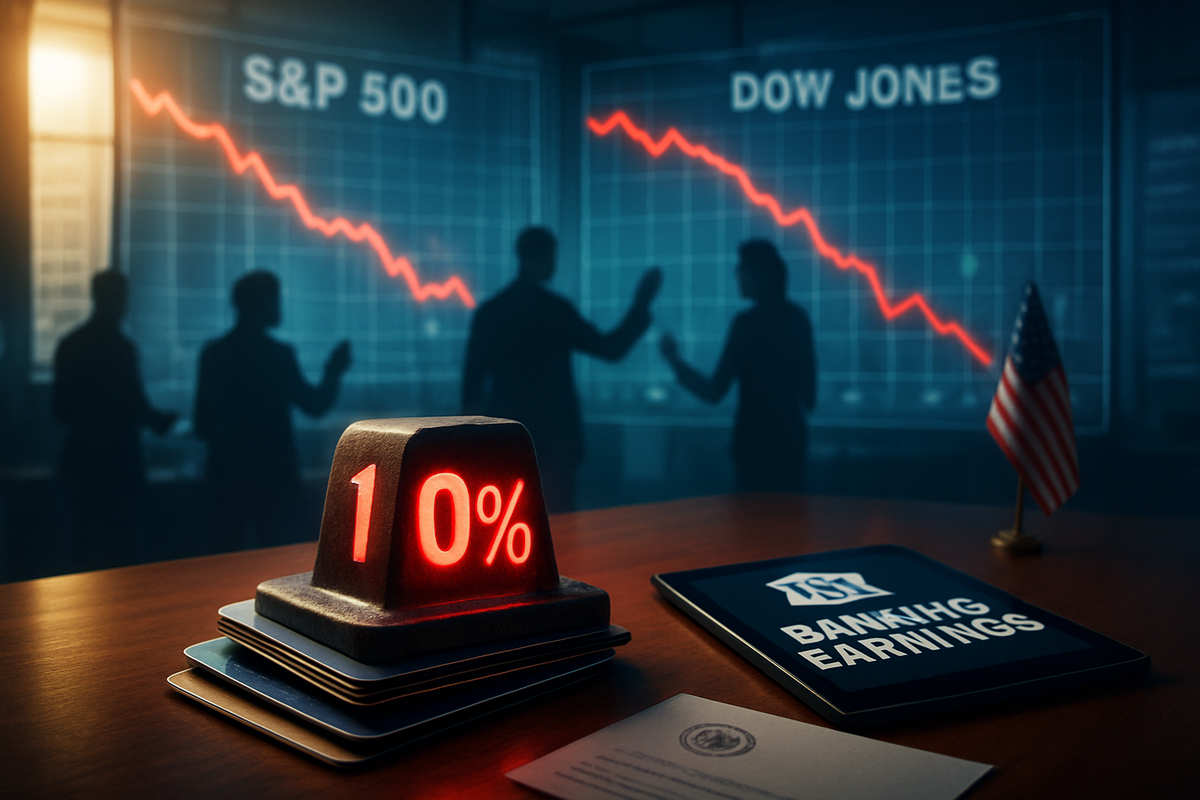
Wall Street’s record-breaking momentum hit a significant speed bump on Tuesday, January 13, 2026, as both the S&P 500 and the Dow Jones Industrial Average pulled back from all-time highs. The retreat marks a sharp transition from the "January effect" optimism that characterized the start of the year, driven by a volatile cocktail of underwhelming financial sector performance and aggressive new policy proposals from the Trump administration.
The market's cooling comes as investors weigh the resilience of corporate America against a shifting regulatory landscape. While the underlying economy remains stable, the sudden introduction of price controls on consumer credit and a dramatic escalation in trade policy have introduced a level of uncertainty that hasn't been seen since the mid-2024 election cycle. The S&P 500 (INDEXSP:.INX) slipped approximately 0.4% to close near 6,963, while the Dow Jones Industrial Average (INDEXDJI:.DJI) shed nearly 250 points, ending the session around the 49,300 mark.
Earnings Miss and Policy Shifts Spark Volatility
The day began with a focus on the banking sector, as JPMorgan Chase & Co. (NYSE: JPM) kicked off the fourth-quarter earnings season. Although the bank reported an adjusted earnings per share of $5.23—beating the analyst consensus of $5.01—the stock tumbled as much as 3.8%. The primary drag on sentiment was a $2.2 billion reserve tied to the bank’s recent takeover of the Apple Card portfolio from Goldman Sachs Group Inc. (NYSE: GS). Investors expressed concern over rising provisions for loan losses and a notable year-over-year decline in investment banking fees, suggesting that the "higher-for-longer" interest rate environment may finally be biting into the margins of even the largest financial institutions.
The downward pressure intensified midday when President Donald Trump announced a proposal for a one-year cap on credit card interest rates at 10%, set to take effect on January 20, 2026. This move, framed as a populist measure to provide "debt relief for the forgotten man," sent shares of major lenders into a tailspin. The proposal was followed shortly by a new executive order imposing a 25% tariff on all goods from countries doing business with Iran, a move that immediately spiked energy prices and raised fears of renewed supply chain disruptions.
The timeline of today’s volatility was also marked by a lingering tension between the White House and the Federal Reserve. A Department of Justice probe into Federal Reserve Chair Jerome Powell, ostensibly regarding building renovations, has been widely interpreted by market analysts as a "pretextual" move to influence monetary policy. This perceived challenge to Fed independence has pushed Gold (XAU/USD) prices toward a staggering $4,630 per ounce, as investors seek a hedge against institutional instability and a volatile U.S. dollar.
Winners and Losers in the New Policy Landscape
The clear losers of Tuesday's session were the financial and payment processing giants. Capital One Financial Corp. (NYSE: COF) saw its stock price crater by nearly 7%, as its business model is heavily dependent on credit card interest income. Similarly, payment titans Visa Inc. (NYSE: V) and Mastercard Inc. (NYSE: MA) experienced sharp declines as the market began pricing in a massive contraction in consumer credit availability and bank profitability. The broader financial sector, which had been a leader in the recent rally, was the worst-performing S&P 500 industry group on the day.
Conversely, the energy sector and precious metals miners emerged as relative winners. The new "Iran-business" tariffs pushed WTI Crude oil toward $61 per barrel, providing a lift to companies like Exxon Mobil Corp. (NYSE: XOM) and Chevron Corp. (NYSE: CVX). Gold mining companies also saw a surge in volume as the yellow metal touched new heights. Additionally, some defensive sectors like healthcare and utilities saw modest inflows as traders rotated out of growth and financial stocks into "safe haven" assets amid the intraday turbulence.
Tech giant Apple Inc. (NASDAQ: AAPL) remained relatively resilient, though it faced scrutiny regarding its transition of the Apple Card to JPMorgan. Analysts suggest that while the financial terms of the transition may be complex, the company’s massive cash reserves and hardware ecosystem provide a buffer against the immediate shocks of the proposed interest rate caps.
A Wider Significance: Policy Populism vs. Market Independence
The events of January 13, 2026, highlight a burgeoning conflict between populist policy goals and the traditional market-driven economy. The 10% credit card interest rate cap represents one of the most interventionist consumer finance proposals in decades, drawing historical comparisons to the price controls of the 1970s. Economists warn that while such a cap might provide short-term relief for some consumers, it could lead to a massive credit crunch, where banks simply stop lending to all but the most creditworthy borrowers.
Furthermore, the escalation of trade tariffs against any nation "doing business" with Iran signals a more aggressive "secondary sanctions" approach to trade. This fits into a broader trend of geopolitical fragmentation that has been accelerating since 2024. The ripple effects could be significant for major trading partners like China and India, potentially leading to retaliatory measures that could dampen global growth forecasts for the remainder of 2026.
The DOJ probe into Chair Powell is perhaps the most significant long-term concern for institutional investors. Since the 1951 Treasury-Fed Accord, the independence of the Federal Reserve has been a cornerstone of global confidence in the U.S. dollar. If that independence is viewed as compromised, the "risk premium" for U.S. assets could rise permanently, leading to higher borrowing costs regardless of the official Fed funds rate.
The Road Ahead: Scenarios and Strategic Pivots
In the short term, all eyes will be on the remainder of the bank earnings reports due this week. If other major players like Bank of America Corp. (NYSE: BAC) or Citigroup Inc. (NYSE: C) echo JPMorgan’s cautious tone regarding loan losses and the impact of the proposed rate cap, we could see a deeper correction in the financial sector. Strategic pivots for these banks may include a shift toward fee-based services and a tightening of lending standards that could slow the overall economy.
The long-term outlook depends heavily on whether the 10% interest rate cap and the new tariffs survive legal challenges or congressional oversight. If the administration successfully implements these measures, we may see a fundamental restructuring of the U.S. consumer economy. Investors should prepare for higher volatility and consider diversifying into assets that are less sensitive to domestic regulatory shifts, such as international equities or hard commodities.
Market opportunities may emerge in fintech companies that can innovate around credit structures, or in domestic energy producers that stand to benefit from a more protectionist trade environment. However, the primary challenge for the coming months will be navigating a market where "headline risk" from the White House often outweighs traditional economic data.
Final Assessment and Investor Outlook
The retreat on January 13 serves as a stark reminder that record-high valuations require a perfect alignment of positive catalysts to be sustained. The combination of a major bank earnings beat that wasn't "good enough" and a series of disruptive policy proposals has broken the market’s complacency. The move from record highs to a more volatile, cautious environment suggests that the "easy money" phase of the current rally may be over.
Moving forward, the key takeaways are clear: the banking sector is facing significant regulatory headwinds, geopolitical risks are re-entering the pricing model for energy, and the independence of the Federal Reserve is no longer an untouchable assumption. The market is now entering a period of "price discovery" where the true cost of these new policies will be weighed against the strength of corporate earnings.
Investors should watch for the official implementation of the interest rate cap and any signs of retaliation from trade partners. The resilience of the S&P 500 near the 6,900 level will be a crucial technical indicator to monitor. For now, the transition from unbridled optimism to calculated caution is the dominant theme of 2026.
This content is intended for informational purposes only and is not financial advice.