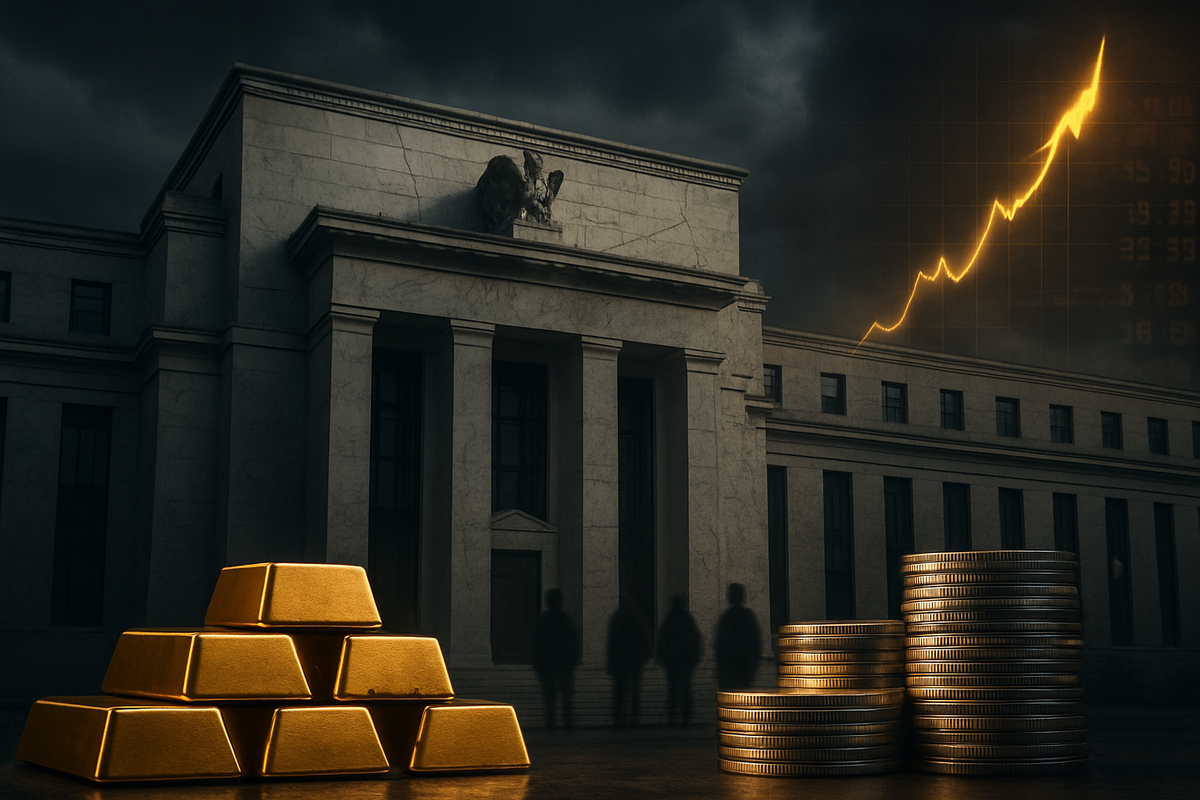
WASHINGTON D.C. / NEW YORK — In a historic convergence of political turmoil and financial upheaval, gold and silver prices have surged to unprecedented all-time highs as of January 12, 2026. The rally comes as investors scramble for safe-haven assets following the Department of Justice's escalation of a criminal investigation into Federal Reserve Chair Jerome Powell. The move has plunged the U.S. central bank into a constitutional crisis, raising existential questions about its independence and the long-term stability of the U.S. dollar.
As of this morning, spot gold reached a staggering $4,612 per ounce, while silver—long considered the "restless" sibling of gold—shattered nominal records to trade at $78.79 per ounce, after peaking near $86 late last month. Market participants are increasingly viewing precious metals not just as a hedge against inflation, but as the only viable insurance against a potential collapse of the institutional framework that has governed the American economy for over a century.
The Subpoena and the Squeeze: A Timeline of the Fed's Legal Crisis
The current market frenzy was ignited on Friday, January 9, 2026, when the Department of Justice (DOJ) served the Federal Reserve with grand jury subpoenas. The investigation centers on the Fed's $2.5 billion renovation of its historic Eccles Building headquarters in Washington, D.C. Prosecutors are reportedly examining whether Powell and other senior officials misled Congress regarding cost overruns and the scope of the project. However, the timing of the probe has led to widespread allegations of political weaponization.
The investigation follows months of escalating tension between the White House and the central bank. In late 2025, President Trump repeatedly attacked the Fed’s "incompetence" for maintaining higher interest rates than the administration desired. By September 2025, a separate criminal inquiry had already been launched into Fed Governor Lisa Cook. Powell, in a defiant statement on January 11, characterized the DOJ's actions as a "pretext" for intimidation, suggesting the legal pressure is a direct consequence of the Fed’s refusal to enact rapid, politically motivated rate cuts. This perceived erosion of central bank independence has sent shockwaves through global markets, triggering a "regime change" in how investors value the dollar versus hard assets.
Initial market reactions were swift and severe. The U.S. Dollar Index (DXY) saw its sharpest three-day decline in years, while the yield on the 10-year Treasury note spiked as international creditors began pricing in a "political risk premium" for U.S. debt. Conversely, gold and silver experienced a "slingshot" effect. Gold broke through its primary resistance of $4,260 in late December, and silver completed a massive 45-year "Cup and Handle" technical pattern that dates back to the 1980 Hunt Brothers peak.
Winners and Losers: Mining Giants Surge While Industrial Users Reel
The stratospheric rise in metal prices has created a stark divide in the corporate world. On one side, precious metal producers are witnessing a windfall of historic proportions. Newmont Corporation (NYSE: NEM), the world’s largest gold producer, has seen its stock gain over 170% in the last 14 months, as its vast reserves are revalued at $4,600+ levels. Similarly, Barrick Gold (NYSE: GOLD) has capitalized on its high-margin Nevada operations, maintaining production costs near $1,500/oz while capturing nearly $3,000 in pure profit per ounce sold.
In the silver space, "pure-play" miners like First Majestic Silver (NYSE: AG) and Hecla Mining (NYSE: HL) have seen their valuations triple as silver supply remains in a structural deficit for the fifth consecutive year. Royalty and streaming companies, such as Wheaton Precious Metals (NYSE: WPM) and Franco-Nevada (NYSE: FNV), have also emerged as major victors. These firms avoid the rising labor and diesel costs that plague traditional miners, allowing them to capture the full upside of the price breakout without the operational risks.
However, the "silver-flation" of 2026 has been a nightmare for the green energy and automotive sectors. Tesla (NASDAQ: TSLA), which uses significant amounts of silver in its power management systems, is estimated to have seen a $2.2 billion drop in automotive gross profit due to rising raw material costs. Solar manufacturers like JinkoSolar (NYSE: JKS) are facing a "brutal margin squeeze," as silver now accounts for nearly 15% of total module production costs. Interestingly, First Solar (NASDAQ: FSLR) has emerged as a relative winner among its peers; its unique Cadmium Telluride technology uses no silver, providing it a significant competitive advantage as silicon-based competitors struggle to stay profitable.
A Wider Significance: The End of the "Inflation Anchor"?
The current crisis draws chilling parallels to the 1970s Nixon/Burns era, when President Richard Nixon famously pressured Fed Chair Arthur Burns to keep rates low ahead of the 1972 election. However, analysts warn that the 2026 situation is far more dangerous. While Nixon used verbal and political pressure, the current administration has deployed the judicial power of the DOJ. This shift from "browbeating" to "criminalizing" policy disagreements threatens to permanently destroy the Fed’s role as a credible "inflation anchor."
Beyond the political drama, the macro drivers for gold and silver are deeply structural. China’s implementation of strict export licensing on refined silver on January 1, 2026, has caused an immediate global supply squeeze. Furthermore, the U.S. government’s decision to officially add silver to the Critical Minerals list in late 2025 has highlighted the metal's indispensable role in 5G, EV, and solar infrastructure. With annual inflation remaining "sticky" at 2.7% and geopolitical tensions rising in Venezuela and Iran, the move into metals is increasingly viewed as a logical exit from a destabilizing fiat system.
Historical precedents suggest that once a central bank's independence is compromised, currency debasement often follows. The 2026 breakout in SPDR Gold Shares (NYSEARCA: GLD) and iShares Silver Trust (NYSEARCA: SLV) suggests that institutional investors are no longer waiting for a resolution—they are voting with their capital, moving into assets that cannot be printed or subpoenaed.
What Comes Next: The Supreme Court and the $5,000 Threshold
The immediate future of the markets hinges on two major developments. First is the "Trump v. Cook" case currently before the Supreme Court, which will determine if the President has the constitutional authority to fire Federal Reserve governors "at will." A ruling in favor of the administration could lead to a permanent "political discount" on the U.S. dollar, potentially pushing gold toward the psychological $5,000 per ounce threshold by mid-year.
Second, the silver market is entering a period of extreme volatility. While the metal recovered from a year-end "flash crash" to $70, veteran traders are now eyeing $101 as the next major technical target. Industrial users may be forced to seek strategic pivots, such as "thrifting" silver or accelerating the development of silver-free battery and solar technologies. For investors, the challenge will be navigating the margin hikes and liquidity crunches that typically accompany such parabolic moves in the commodities space.
Conclusion: A New Era for Hard Assets
The events of early 2026 represent a watershed moment for the global financial system. The DOJ's investigation into the Federal Reserve has stripped away the veneer of institutional stability, revealing a central bank caught in the crosshairs of a bitter political struggle. For gold and silver, this has served as the ultimate catalyst, confirming their status as the primary release valves for systemic risk.
Investors should watch for the Fed’s next policy meeting and any further legal escalations from the DOJ. If the Fed's "for-cause" removal protections are struck down, the flight to hard assets is likely to accelerate. While the volatility in mining stocks and ETFs like SLV remains high, the underlying macro-economic and political drivers suggest that the era of "cheap" precious metals is firmly in the past. In a world where the independence of the dollar's guardian is under trial, the only remaining "truth" for many is the value of the metal in their vaults.
This content is intended for informational purposes only and is not financial advice.