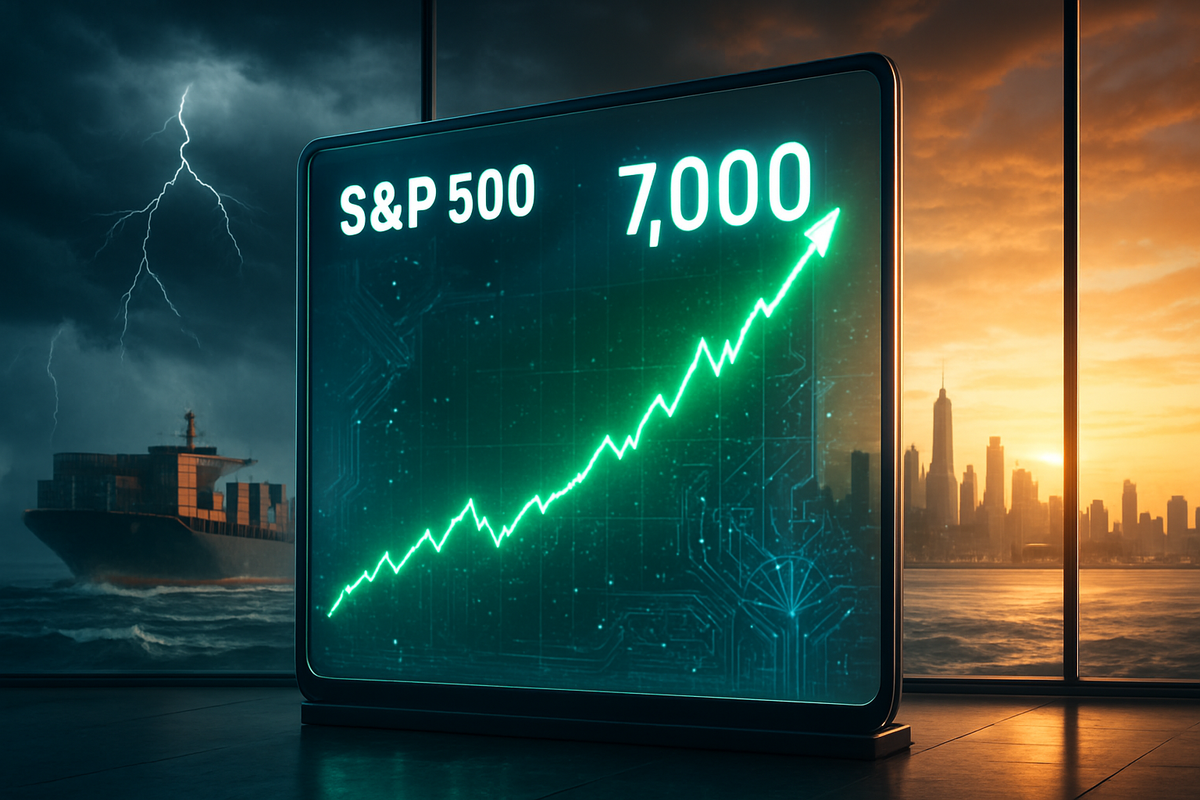
As the final opening bell of 2025 rings across the floor of the New York Stock Exchange, investors are reflecting on a year that defied almost every bearish prediction. The S&P 500 is set to close the year with a robust 17% gain, a remarkable feat considering the index weathered a historic trade policy shock in the spring and persistent anxieties regarding an artificial intelligence bubble. For the American investor, 2025 was not just a year of growth, but a masterclass in market resilience, as the benchmark index scaled new all-time highs and flirted with the psychological 7,000-point milestone.
The rally has been characterized by a "V-shaped" recovery that began in the wake of the "April Tariff Storm," which briefly threatened to derail the post-pandemic expansion. Despite the volatility, the narrative of the year shifted from speculative hype to tangible productivity. By late December, the S&P 500 reached an intraday peak of 6,952.84, driven by a combination of cooling inflation, a series of Federal Reserve rate cuts, and a corporate earnings season that finally proved AI could deliver more than just promises.
The Year of the 'V': From the April Shock to the Christmas Breakout
The journey to 17% was anything but linear. The year began with the "DeepSeek Shock" in January, a moment of reckoning for U.S. Big Tech when a highly efficient Chinese AI model sparked fears that American capital expenditure was being mismanaged. This initial tremor saw Nvidia (NASDAQ: NVDA) suffer a sharp 17% intraday drop, setting a cautious tone for the first quarter. However, this proved to be a mere prelude to the most significant event of the year: the "April Tariff Storm." On April 2, 2025, the administration’s announcement of a universal baseline tariff triggered a massive sell-off, with the S&P 500 plummeting 4.88% in a single session—wiping out over $3 trillion in market value.
The recovery from this "April Shock" was as swift as the decline. Dubbed "Liberation Day" by traders, April 9 marked the turning point when the government announced a 90-day pause on several duties to facilitate negotiations. This sparked a 9.5% recovery rally, the largest single-day gain in years. This momentum was sustained through the summer as the Federal Reserve, led by Chair Jerome Powell, successfully navigated a "soft landing." The Fed implemented three 25-basis-point interest rate cuts throughout 2025, bringing the federal funds rate down to a target range of 3.50%–3.75%. This "normalization" of monetary policy provided the necessary liquidity for the market to absorb tariff-related costs and reinvest in domestic infrastructure.
By the fourth quarter, the market had moved into a "Christmas Breakout" phase. Fueled by a Q3 GDP report showing a surprising 4.3% growth rate, the S&P 500 recorded eight consecutive months of gains leading into December. The year-end rally was further bolstered by retail trading activity, as household investors returned to the market, emboldened by a cooling labor market that remained strong enough to support consumer spending but soft enough to keep the Fed's "dovish" stance intact.
Winners and Losers: The Great Divergence of 2025
The 2025 rally was not a "rising tide lifts all boats" scenario; instead, it created a stark divergence between companies with "AI Sovereignty" and those crippled by global supply chain exposure. Nvidia (NASDAQ: NVDA) remained the undisputed champion of the year, finishing up approximately 42% and becoming the first company to reach a $5 trillion market capitalization in October. Its "Blackwell Ultra" architecture became the gold standard for data centers, silencing critics who had called for an AI bubble. Similarly, Alphabet (NASDAQ: GOOGL) saw a 65% surge as its Gemini AI integration began to dominate search and cloud revenue, further aided by a favorable antitrust ruling in September.
On the other end of the spectrum, the "Tariff-Exposed" sector faced a brutal reality. Target (NYSE: TGT) was one of the year's primary losers, with its stock plummeting nearly 27.4%. Unlike its rival Walmart (NYSE: WMT)—which finished up 23.9% by leveraging its domestic grocery supply chain—Target struggled with its reliance on imported discretionary goods. The apparel sector was hit even harder; Lululemon (NASDAQ: LULU) cratered over 53% as it faced massive margin compression from duties on Asian-sourced products. Even tech giants were not immune; Apple (NASDAQ: AAPL) underperformed the broader market with a modest 10% gain, as its heavy manufacturing footprint in China became a significant liability under the new trade regime.
Other notable winners included Palantir (NASDAQ: PLTR), which surged 140% on the back of massive U.S. Army contracts, and Boeing (NYSE: BA), which managed a 22.7% recovery after stabilizing its production lines and securing significant defense deals. Meanwhile, Amazon (NASDAQ: AMZN) lagged with a 6% return, weighed down by a staggering $125 billion capital expenditure cycle for its AI data center expansion. This "Great Divergence" highlighted a new market reality: in 2025, supply chain resilience and AI monetization were the only metrics that truly mattered.
A New Paradigm: AI Sovereignty and Trade as a Market Driver
The significance of the 2025 rally extends far beyond the numbers on the screen. It represents a fundamental shift in how the market values technology and trade. The "AI Bubble" narrative, which dominated headlines in 2024, evolved into an "Earnings Era." Investors moved away from speculative bets and began rewarding companies that could demonstrate tangible productivity gains. This shift toward "AI Sovereignty"—the ability of a company or nation to control its own AI stack and infrastructure—became a cornerstone of investment strategy, favoring domestic chipmakers and software firms over those dependent on foreign hardware.
Furthermore, 2025 proved that trade policy has replaced traditional monetary policy as the primary driver of market volatility. The "April Tariff Storm" served as a wake-up call, illustrating that the globalized "just-in-time" supply chain model is increasingly vulnerable to geopolitical shifts. This has led to an accelerated trend of "reshoring" and "friend-shoring," with companies like Caterpillar (NYSE: CAT) and Procter & Gamble (NYSE: PG) being forced to rethink their manufacturing footprints to avoid the "tariff-induced" margin erosion that plagued them mid-year.
Historically, 2025 will be compared to the late 1990s, but with a crucial difference. While the dot-com era was built on eyeballs and clicks, the 2025 rally was built on silicon and software that actually moved the needle on corporate efficiency. The S&P 500’s ability to absorb a 27% effective tariff rate while still delivering double-digit returns suggests a structural strength in the U.S. economy that many analysts had previously underestimated.
The Road to 2026: Strategizing for the 7,000 Milestone
Looking ahead to 2026, the market faces a new set of challenges and opportunities. The immediate focus for investors will be the "7,000 Milestone." Having flirted with this level in late December, the S&P 500 is expected to test it early in the new year. However, the path forward may require a strategic pivot. The "easy money" from the initial AI surge has been made, and the next phase of growth will likely come from the "application layer"—companies that successfully integrate AI into traditional industries like healthcare, logistics, and energy.
One of the most significant factors to watch in the coming months will be the leadership transition at the Federal Reserve. With Jerome Powell’s term set to expire in May 2026, the market is already beginning to price in his successor. A "hawkish" appointment could threaten the current valuation levels, while a "dovish" successor might provide the fuel needed to push the index well past 7,000. Additionally, the 90-day tariff pauses negotiated in April are set to expire, meaning trade policy will remain a central theme of market discourse well into the first half of 2026.
Final Thoughts: A Year of Resilience
The S&P 500's 17% gain in 2025 is a testament to the enduring power of the American corporate engine. By navigating the dual threats of a potential AI bubble and a trade war, the market has proven that it can adapt to a rapidly changing global landscape. For investors, the key takeaway from 2025 is that diversification is no longer just about sectors; it is about supply chain exposure and technological self-sufficiency.
As we move into 2026, the market appears to be on a sustainable, albeit more cautious, path. The "soft landing" has been achieved, inflation has been tamed, and the AI revolution has moved from the laboratory to the balance sheet. While the volatility of the past year was a reminder of the risks inherent in a globalized economy, the year-end all-time highs provide a clear signal: the bull market of the mid-2020s is far from over. Investors should keep a close eye on trade negotiations and Fed appointments, but for now, the 2025 rally stands as a landmark achievement in financial history.
This content is intended for informational purposes only and is not financial advice