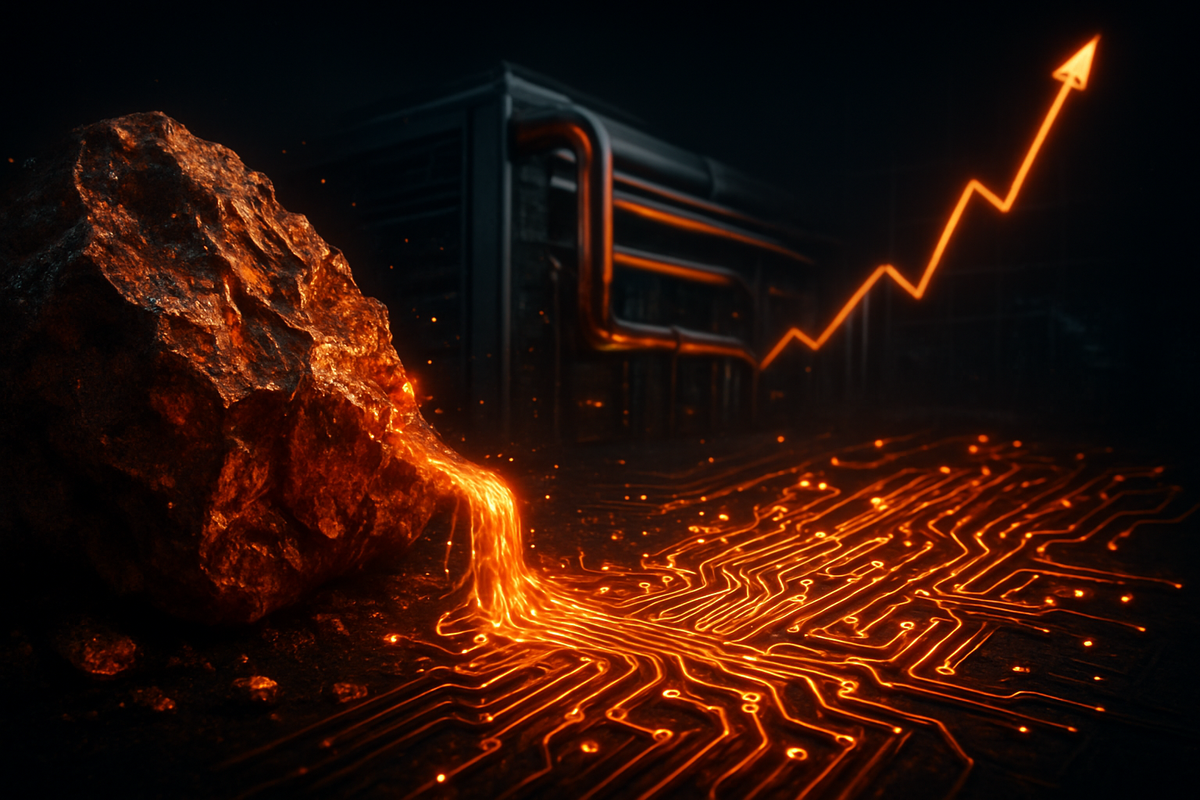
As of December 25, 2025, the global commodities market is grappling with a paradigm shift that has propelled copper prices to an unprecedented all-time high. On the London Metal Exchange (LME), copper futures surged past the psychological $12,000 barrier earlier this month, peaking at a staggering $12,220 per tonne. This rally, a 30% increase over the calendar year, marks the definitive arrival of the "AI Supercycle," where the metal once known as a simple industrial bellwether has been elevated to the status of a critical strategic asset.
The immediate implications are profound: manufacturing costs for everything from electric vehicles to high-performance computing hardware are skyrocketing. For the global economy, this "red gold" rush signals a structural deficit that could last for years. Investors are now pivoting away from traditional tech stocks and toward the miners and infrastructure plays that control the flow of the world’s most essential conductor, as the gap between supply and demand reaches a critical breaking point.
The Perfect Storm: From Data Centers to Mine Disasters
The journey to $12,220 per tonne was paved by a series of compounding events throughout 2025. The primary engine behind this demand is the "AI Supercycle." Unlike traditional IT infrastructure, hyperscale AI data centers are incredibly power-intensive, requiring specialized high-power cooling systems and massive busbars—all of which are copper-heavy. A single AI-dedicated facility can consume up to 50,000 tonnes of copper, nearly triple that of a conventional data center. By late 2025, AI workloads accounted for roughly one-third of the world’s 44 GW data center capacity, creating a demand vacuum that the market was unprepared to fill.
On the supply side, the market was rocked in September 2025 by a catastrophic mudflow at the Grasberg mine in Indonesia, operated by Freeport-McMoRan (NYSE: FCX). As the world’s second-largest copper mine, the force majeure at Grasberg removed approximately 250,000 tonnes of production from the 2025 calendar year alone. This disaster coincided with a historic "overcapacity crisis" in China. The China Smelters Purchase Team (CSPT) was forced to implement production cuts of up to 10% after benchmark treatment and refining charges (TC/RCs) plummeted to $0 per tonne, signaling that raw copper concentrate had become virtually impossible to source.
Winners and Losers in the New Copper Order
The primary beneficiaries of this price surge are the diversified mining giants with high-grade assets. BHP (NYSE: BHP) has emerged as a dominant winner, reporting record copper production of 2 million tonnes for the 2025 fiscal year. Its flagship Escondida mine and aggressive investments in the Vicuña joint venture have allowed it to capture the upside of the price spike. Similarly, Rio Tinto (NYSE: RIO) has seen its strategic pivot toward copper pay off; the company recently lifted its 2025 guidance to 875,000 tonnes as its Oyu Tolgoi mine in Mongolia ramps up toward becoming the world's fourth-largest copper operation.
Conversely, the "losers" in this scenario are the mid-stream refiners and end-product manufacturers who lack vertical integration. Chinese smelters are facing an existential margin squeeze, as the cost of concentrate outweighs the value of the refined metal. In the consumer sector, electric vehicle manufacturers and renewable energy firms are seeing their "green" premiums eroded by the rising cost of wiring and motors. Companies like Southern Copper (NYSE: SCCO) and Antofagasta (LSE:ANTO) are thriving on the extraction side, but the broader manufacturing sector is bracing for a period of "copper inflation" that may necessitate a redesign of everything from power grids to household appliances.
Copper as the "New Oil": Strategic and Policy Shifts
This price explosion has forced a global re-evaluation of copper’s role in national security. In March 2025, the U.S. government issued Executive Order 14154, officially designating copper as a "critical mineral." This reclassification under the National Energy Dominance Council (NEDC) allows for fast-tracked permitting on federal lands and invokes the Defense Production Act to subsidize domestic mining and recycling projects. Copper is no longer viewed as a mere commodity; it is now the "New Oil"—the indispensable medium for electricity in a decarbonized, AI-driven world.
This shift mirrors the lithium boom of the early 2020s but on a much larger scale. Historically, copper prices were tied to Chinese construction and global GDP. However, the decoupling of copper from traditional economic cycles is now evident. Even as global growth moderated in 2025, copper demand continued to climb, driven by the non-negotiable requirements of the energy transition and the digital arms race. This has led to a "hoarding" mentality among sovereign states, with many nations beginning to build strategic copper reserves similar to the Strategic Petroleum Reserve.
The Road Ahead: Short-Term Volatility, Long-Term Scarcity
In the short term, the market remains on edge as Freeport-McMoRan (NYSE: FCX) works toward a phased restart of the Grasberg mine, currently slated for the second quarter of 2026. Until that supply returns, the global deficit—estimated at 1.5 million tonnes for 2025—will keep a high floor under prices. We may see strategic pivots toward "copper substitution," where manufacturers attempt to use aluminum in certain applications, though aluminum’s lower conductivity makes it an inferior choice for high-performance AI hardware and compact EV motors.
Longer-term, the industry faces a "discovery gap." Most of the world’s "easy" copper has been mined, and the lead time for a new greenfield mine is now averaging 12 to 15 years due to environmental regulations and declining ore grades. This suggests that while prices may fluctuate, the era of "cheap copper" is likely over. Investors should expect a wave of consolidation as major miners use their record profits to acquire smaller juniors with proven reserves, further concentrating control over the world's most vital tech mineral.
Final Assessment: What to Watch in 2026
The surge to $12,220 per tonne is a watershed moment for the financial markets. It confirms that the dual pressures of the AI revolution and the green energy transition are fundamentally altering commodity valuations. The key takeaway for the coming months is that supply, not demand, is now the primary driver of volatility. The "AI Supercycle" is no longer a theoretical concept; it is a physical reality reflected in the price of every pound of copper traded globally.
Moving forward, investors should closely monitor Chinese smelter activity and any further disruptions in South American mining regions, particularly Chile and Peru. As we head into 2026, the ability of the industry to bring new supply online will determine whether copper stabilizes or makes another run toward $15,000. For now, the "Red Gold" remains the most critical barometer of the 21st-century economy, and its record-breaking ascent is far from over.
This content is intended for informational purposes only and is not financial advice.