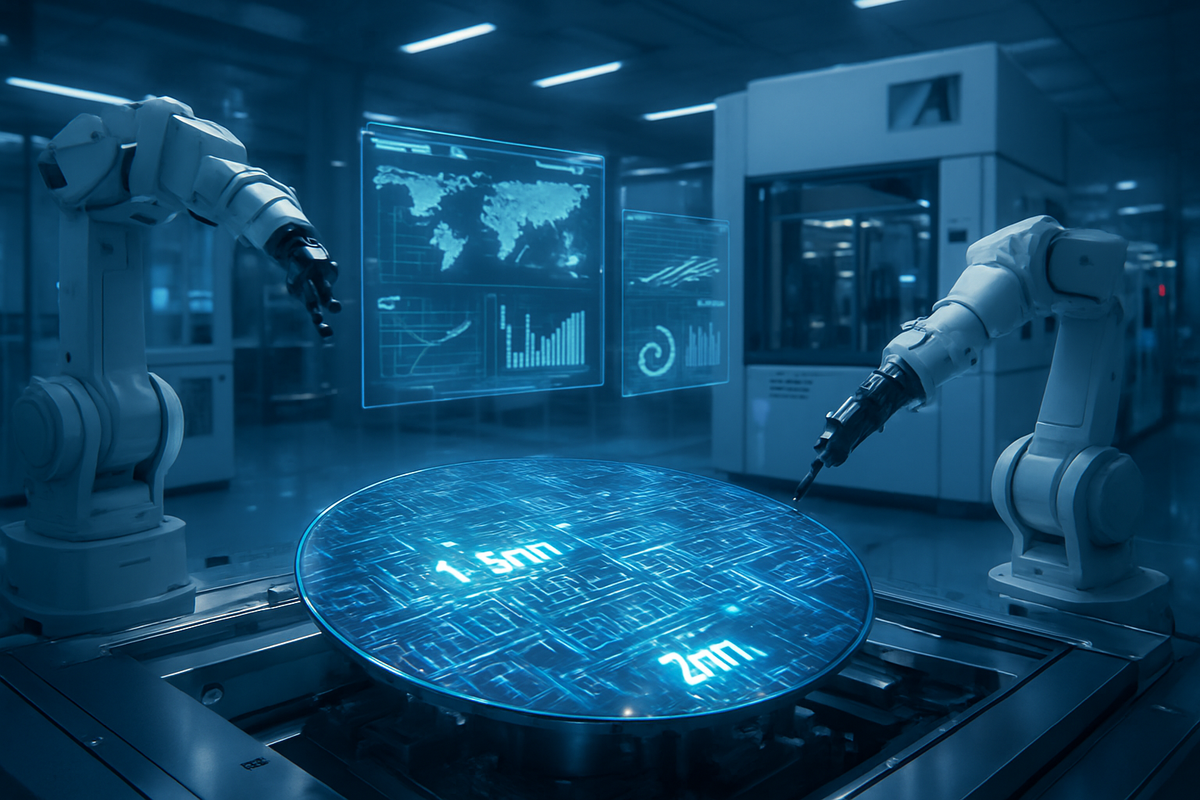
As 2025 draws to a close, the global semiconductor landscape stands at a precarious crossroads. Intel Corp. (NASDAQ: INTC), once the undisputed king of silicon, is currently navigating the final stages of its most ambitious transformation in history. After years of bleeding market share and technical prestige, the company has officially entered high-volume manufacturing (HVM) for its "18A" (1.8nm-class) process node. This milestone represents the culmination of CEO Pat Gelsinger’s "five nodes in four years" strategy, a roadmap many analysts initially dismissed as a pipe dream.
However, the immediate implications are a mix of technical triumph and financial fragility. While Intel has successfully booted up its first 18A-powered products—the "Panther Lake" client CPUs and "Clearwater Forest" server chips—the foundry business remains a deep well of red ink. With a reported operating loss of $9.5 billion for the 2025 fiscal year, the market is left asking a critical question: Can Intel transition from a self-serving manufacturer to a world-class foundry capable of luring the industry’s biggest players away from Taiwan Semiconductor Manufacturing Co. (NYSE: TSM)?
The Road to 18A: A Timeline of Restructuring and Resilience
The journey to this moment has been defined by a series of radical pivots and government interventions. Throughout 2024 and early 2025, Intel underwent a massive corporate restructuring, which included spinning off its foundry business into a wholly-owned independent subsidiary and cutting its global workforce by 20%. A significant leadership shift also occurred in early 2025 when board member Lip-Bu Tan took a more prominent role in overseeing the foundry’s operational efficiency, aiming to instill a "customer-first" culture that had long been missing at the Santa Clara giant.
The technical timeline reached its peak in the second half of 2025, as Intel 18A achieved HVM. This node is the first to successfully integrate two revolutionary technologies: RibbonFET (Gate-All-Around transistors) and PowerVia (backside power delivery). By implementing PowerVia ahead of its rivals, Intel has gained a temporary "first-mover" advantage in power efficiency—a critical metric for the power-hungry AI accelerators that now dominate data center spending. Initial industry reactions have been cautiously optimistic; while early yields for 18A are hovering in the 60% range—trailing TSMC’s typical 70%+ gold standard—the fact that the chips are functional and shipping is a major credibility boost.
The federal government has also become a permanent stakeholder in Intel’s success. In August 2025, the U.S. Department of Commerce converted $8.9 billion of pledged CHIPS Act grants into a 9.9% federal equity stake in the company. This "National Champion" model was designed to ensure that Intel’s leading-edge manufacturing remains domestically owned and operated, effectively making Intel "too big to fail" in the eyes of Washington. This move was further solidified by a $3 billion "Secure Enclave" contract from the U.S. Department of Defense, positioning Intel as the primary manufacturer for sensitive military-grade hardware.
Winners, Losers, and the Battle for the "Big Three"
The battle for foundry supremacy has created a clear divide between winners and losers. TSMC (NYSE: TSM) remains the primary winner, maintaining a dominant 75% market share of the leading-edge foundry business. Despite Intel’s progress, TSMC’s N2 (2nm) node is expected to have a much larger volume of mass-market products by mid-2026, including the next generation of iPhones and Nvidia Corp. (NASDAQ: NVDA) AI accelerators. Nvidia, in particular, has emerged as a cautious observer; reports indicate the AI giant "paused" testing on Intel’s 18A in late 2025 due to yield concerns, choosing to remain with TSMC for its 2026 "Blackwell" successor cycle.
On the winning side of the Intel ledger are the "anchor customers" who have committed to the 18A node to reduce their reliance on TSMC. Microsoft Corp. (NASDAQ: MSFT) has signed on for custom AI accelerators (Maia 2), and Amazon.com Inc. (NASDAQ: AMZN) through its AWS division is partnering for custom Xeon 6 chips and a new AI fabric chip. These partnerships are vital, as they provide Intel with the high-volume "pipe-cleaning" orders necessary to improve yields. For these hyperscalers, Intel represents a strategic hedge against the geopolitical risks associated with Taiwan.
The primary loser in this shift appears to be Samsung Electronics (KRX: 005930), which has struggled to stabilize yields on its SF2 (2nm) node. While Samsung was the first to adopt Gate-All-Around architecture, its inability to secure major external clients like Qualcomm Inc. (NASDAQ: QCOM) for its 2nm process has allowed Intel to leapfrog it in the race for the #2 foundry spot. Meanwhile, smaller players like GlobalFoundries (NASDAQ: GFS) have largely exited the leading-edge race, focusing instead on specialized, mature nodes, leaving the "Angstrom-era" battle to the big three.
The Trillion-Dollar AI Inflection Point
The significance of Intel’s 18A launch extends far beyond its own balance sheet; it is a bellwether for the entire semiconductor industry’s move into the $1 trillion era. As the market approaches this revenue milestone in 2026, the shift from traditional CPUs to specialized AI silicon has become the primary driver of growth. Intel’s positioning as a "Systems Foundry"—offering not just chip fabrication but also advanced packaging services like CoWoS-equivalent technologies—reflects a broader industry trend where the package is becoming as important as the silicon itself.
Geopolitically, the "Silicon Shield" of Taiwan remains a central concern. The diversification of manufacturing to U.S. soil is no longer just a luxury but a strategic necessity. Analysts estimate that by 2026, the "geographic premium" for chips made in the U.S. could become a reality, as potential tariffs and trade restrictions on Asian-made silicon could raise costs for domestic tech companies. Intel’s success or failure with 18A will determine whether the U.S. can truly reclaim its manufacturing sovereignty or if it will remain dependent on a single island for its most critical technology.
Historically, this moment echoes the "Copy Exactly!" era of the 1990s when Intel first established its manufacturing dominance. However, the stakes are now much higher. Unlike the PC era, the AI era requires massive capital expenditures—upwards of $30 billion per fab—meaning that a single failed node can threaten the existence of the company. Intel’s reliance on government equity marks a departure from traditional free-market dynamics, signaling a new era of "industrial policy" where the state and private enterprise are inextricably linked in the pursuit of technological leadership.
Looking Forward: The 2026 Horizon
Looking ahead to 2026, the focus will shift from "can they build it?" to "can they make it profitable?" The short-term challenge for Intel will be the ramp-up of its 18A-P (the enhanced version) and the initial risk production of its 14A (1.4nm) node. The 14A node will be the industry’s first to utilize High-NA EUV lithography tools commercially, a move that could finally give Intel a density advantage over TSMC. However, the costs of these machines—exceeding $350 million each—will put even more pressure on Intel’s margins.
Investors should watch for two potential scenarios. In the bull case, Intel’s yields on 18A stabilize above 70% by mid-2026, leading to a "stampede" of second-tier customers who are currently wait-listed at TSMC. This would allow Intel’s foundry unit to reach break-even by 2027. In the bear case, continued yield struggles and the high cost of High-NA EUV tools could force Intel to seek further government bailouts or reconsider a full divestiture of its manufacturing arm. The 2026 launch of TSMC’s A16 (1.6nm) node, which will finally introduce their version of backside power, will be the ultimate test of whether Intel’s "first-mover" advantage was enough to gain permanent ground.
Conclusion: A Fragile Resurrection
As we enter 2026, the narrative surrounding Intel is one of "fragile resurrection." The company has proven its critics wrong by delivering on its technical roadmap, but the financial and operational hurdles remain immense. The successful high-volume manufacturing of 18A is a historic achievement, yet it is only the first step in a marathon that TSMC has been winning for decades. For Intel, the goal is no longer just to be a chipmaker, but to become the bedrock of the global AI infrastructure.
For the market, the key takeaways are clear: the era of "easy" semiconductor gains is over, replaced by a period of intense capital competition and geopolitical maneuvering. Intel’s transformation into a national champion has provided it with a safety net, but its long-term viability depends on its ability to win over the "big three" of AI—Nvidia, Apple, and AMD. As 2026 unfolds, the industry will be watching the yield charts and order books with unprecedented scrutiny.
Investors should keep a close eye on the Q1 2026 earnings reports, specifically looking for updates on 18A yield improvements and any new "whale" customer announcements. The transition to the 14A node and the integration of High-NA EUV will be the next major technical hurdles. In the world of 1.8nm silicon, there is no room for error, and for Intel, the year 2026 will be the ultimate judge of whether its multi-billion dollar gamble has finally paid off.
This content is intended for informational purposes only and is not financial advice.