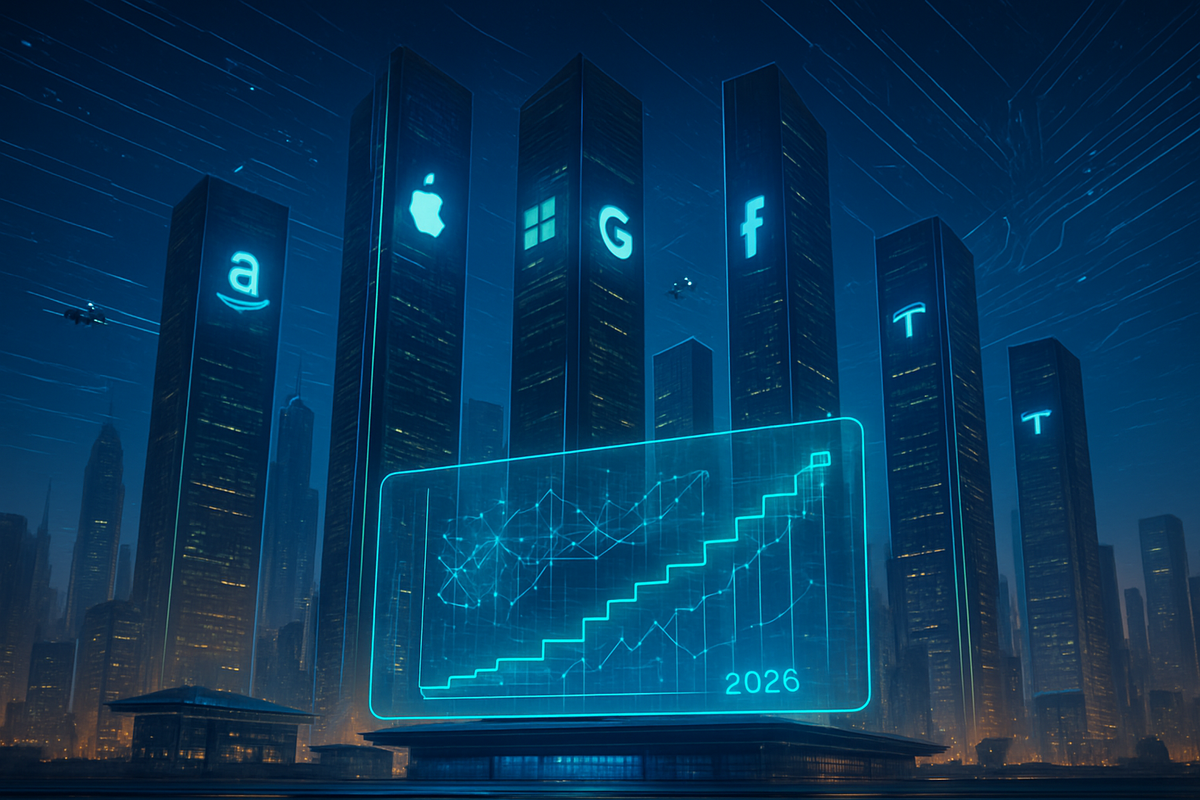
As the sun sets on 2025, the financial world is no longer asking if Artificial Intelligence is a bubble, but rather how much of the global economy it can successfully digest. On this Christmas Day, December 25, 2025, the "Magnificent Seven" tech giants stand at a critical threshold. After two years of unprecedented capital expenditure—exceeding an estimated $200 billion in 2025 alone—investors are demanding that the "experimental" era of AI give way to a "validation phase" in 2026. The coming fiscal year is projected to be the moment when these tech titans must prove that their massive bets on silicon and software can translate into a "stair-step" acceleration of earnings.
The immediate implications are stark: Wall Street forecasts suggest that by the end of 2026, these seven companies will account for nearly half of the total earnings growth for the entire S&P 500. With an aggregate profit margin expected to hover around 28%, the market is pricing in a reality where AI is no longer a peripheral feature but the central engine of corporate profitability. As we enter 2026, the focus shifts from building the "brains" of AI to deploying "agents" that can act, reason, and operate autonomously within the global economy.
The Dawn of the 'Rubin' Era and Agentic Workflows
The transition into 2026 is marked by a significant shift in hardware and software roadmaps. NVIDIA Corp. (NASDAQ: NVDA) is preparing to move beyond its dominant Blackwell architecture to the newly unveiled "Rubin" platform. This next-generation system, featuring the Vera CPU and Rubin GPU, is designed for "massive-context" inference—allowing AI to process millions of tokens of data, such as an entire hour of high-definition video or 100,000 lines of code, in seconds. This hardware leap is intended to support the 2026 shift toward "Physical AI," where NVIDIA’s chips move from data centers into the brains of autonomous robots and industrial systems.
This hardware evolution coincides with a fundamental change in how software giants like Microsoft Corp. (NASDAQ: MSFT) approach the market. Throughout 2024 and 2025, AI was largely seen as a "Copilot"—a digital assistant that helped users write emails or summarize meetings. In 2026, Microsoft is pivoting toward "Agentic AI." Through its Copilot Studio, the company is enabling enterprises to build autonomous agents that can manage entire supply chains or process complex insurance claims without human intervention. This shift is backed by a new "Work IQ" data layer, which allows AI to maintain "memory" across sessions, transforming it from a reactive tool into a proactive business partner.
The timeline leading to this moment has been defined by a relentless arms race. In early 2025, the market saw a brief "AI fatigue" as investors questioned the ROI of massive data center builds. However, a series of breakthrough earnings reports in the second half of 2025, coupled with the successful deployment of early autonomous agents, re-ignited the rally. Now, as we enter the 2026 fiscal year, the "Magnificent Seven" are no longer just tech companies; they have become the essential utility providers for the AI-driven world.
Identifying the 2026 Winners: Hardware Kings vs. Software Alchemists
In the race for 2026 dominance, NVIDIA Corp. (NASDAQ: NVDA) remains the primary beneficiary of the infrastructure build-out, with analysts projecting a consensus EPS of $4.69 for the fiscal year ending January 2026, potentially climbing toward $7.50 by 2027. However, the "winner" circle is expanding. Apple Inc. (NASDAQ: AAPL) is positioned for what many call the "AI Supercycle" with the upcoming iPhone 17 and 18. By late 2026, Apple is expected to launch a fully redesigned "Smarter Siri" capable of multi-step task handling across third-party apps, alongside a new "Health AI" subscription service that acts as a personalized wellness coach, potentially driving Apple's EPS to new heights near $8.24.
Alphabet Inc. (NASDAQ: GOOGL) and Amazon.com Inc. (NASDAQ: AMZN) are finding their stride by leveraging their custom silicon. Alphabet’s 7th-Gen "Ironwood" TPUs are now being commercialized, with a landmark deal to provide chips to Meta Platforms Inc. (NASDAQ: META) expected to add billions in incremental revenue by 2026. Meanwhile, Amazon’s AWS enters the new year with a backlog exceeding $200 billion, driven by the integration of its "Trainium" and "Inferentia" chips. These custom chips allow Amazon and Alphabet to bypass the high costs of third-party hardware, giving them a significant margin advantage over smaller cloud competitors.
Conversely, the "losers" in this environment may be companies that fail to solve the looming energy crisis. Tesla Inc. (NASDAQ: TSLA) faces a high-stakes year as it attempts to scale its "Unsupervised Robotaxi" fleet and Optimus robot production. While the potential for a $2.25 EPS exists, the company remains the most volatile of the group, dependent on regulatory breakthroughs and the successful execution of its "Physical AI" vision. Similarly, any firm that cannot secure stable, high-capacity power for its data centers will likely see its growth throttled, as energy availability becomes a more significant bottleneck than chip supply.
The Great Energy Bottleneck and the Sovereign AI Trend
The broader significance of the 2026 outlook lies in the physical constraints of the digital revolution. Global data center energy consumption is forecast to top 1 Petawatt-hour (1,000 TWh) in 2026—a figure equivalent to the entire electricity consumption of Japan. This massive demand has created a "binding constraint" on the grid, with interconnection delays stretching up to 36 months. In response, the Magnificent Seven are increasingly becoming energy companies. Microsoft’s deal to restart the Three Mile Island nuclear plant and Google’s investments in Small Modular Reactors (SMRs) represent a historic shift toward "Sovereign Energy," where tech companies own and operate their own power generation to ensure 2026 capacity targets.
This trend mirrors the "Sovereign AI" movement, where nations are building their own domestic AI infrastructure to avoid dependence on foreign technology. For the Magnificent Seven, this provides a dual opportunity and a regulatory challenge. While they can sell the underlying hardware and cloud services to these nations, they also face increasing scrutiny from regulators in the EU and North America. Meta, for instance, is launching a "consent-first" AI architecture in 2026 specifically to navigate European privacy laws, a move that could set the standard for how AI companies operate in a fragmented global regulatory landscape.
Historically, this era resembles the build-out of the railroad or the electrical grid in the 19th and 20th centuries. The initial phase was defined by frantic construction and speculation, but the second phase—the one we are entering in 2026—is defined by the utility of the network. The ripple effects will be felt across every sector, from healthcare to finance, as these seven companies provide the "intelligence utility" that powers the global economy.
The Road Ahead: 2026 Scenarios and Strategic Pivots
Looking toward the short-term, the market will be hyper-focused on the first-quarter earnings calls of 2026. Investors will be looking for "Agentic Revenue"—specific line items showing how much companies are making from autonomous AI workflows. If Microsoft and Amazon can demonstrate that these agents are reducing operational costs for their clients, it will validate the current valuations. If not, we may see a strategic pivot where companies focus more on hardware efficiency and "Edge AI"—running models locally on devices like the rumored "A-series MacBook" from Apple—to reduce the reliance on expensive, energy-hungry data centers.
In the long term, the possibility of "Physical AI" becoming a reality could lead to a massive market expansion. If Tesla’s Optimus or NVIDIA’s robotics platforms begin meaningful deployment in 2026, the total addressable market for these companies could move from the digital realm into the physical labor market. This would require a significant adaptation in business models, shifting from software-as-a-service (SaaS) to "labor-as-a-service." However, challenges remain, particularly in the form of potential "AI hallucinations" in critical infrastructure and the ongoing threat of a "compute ceiling" if energy solutions do not scale as fast as model complexity.
Wrapping Up: What to Watch in the Coming Months
As we move into 2026, the key takeaway is that the "Magnificent Seven" are no longer just riding a wave of hype; they are building the foundational infrastructure of a new era. The market is moving from a "growth at any cost" mindset to one of "profitable scaling." The success of the Rubin chip launch, the adoption of agentic workflows in the enterprise, and the resolution of energy constraints will be the three pillars that determine market performance in the coming year.
Investors should keep a close eye on the "Energy-to-Compute" ratio of these companies and watch for any signs of a slowdown in AWS or Azure's AI-related backlogs. While the 2026 forecasts are optimistic, the margin for error has narrowed. The "Magnificent Seven" have promised a world transformed by AI; 2026 is the year they must begin to deliver the receipts.
This content is intended for informational purposes only and is not financial advice.