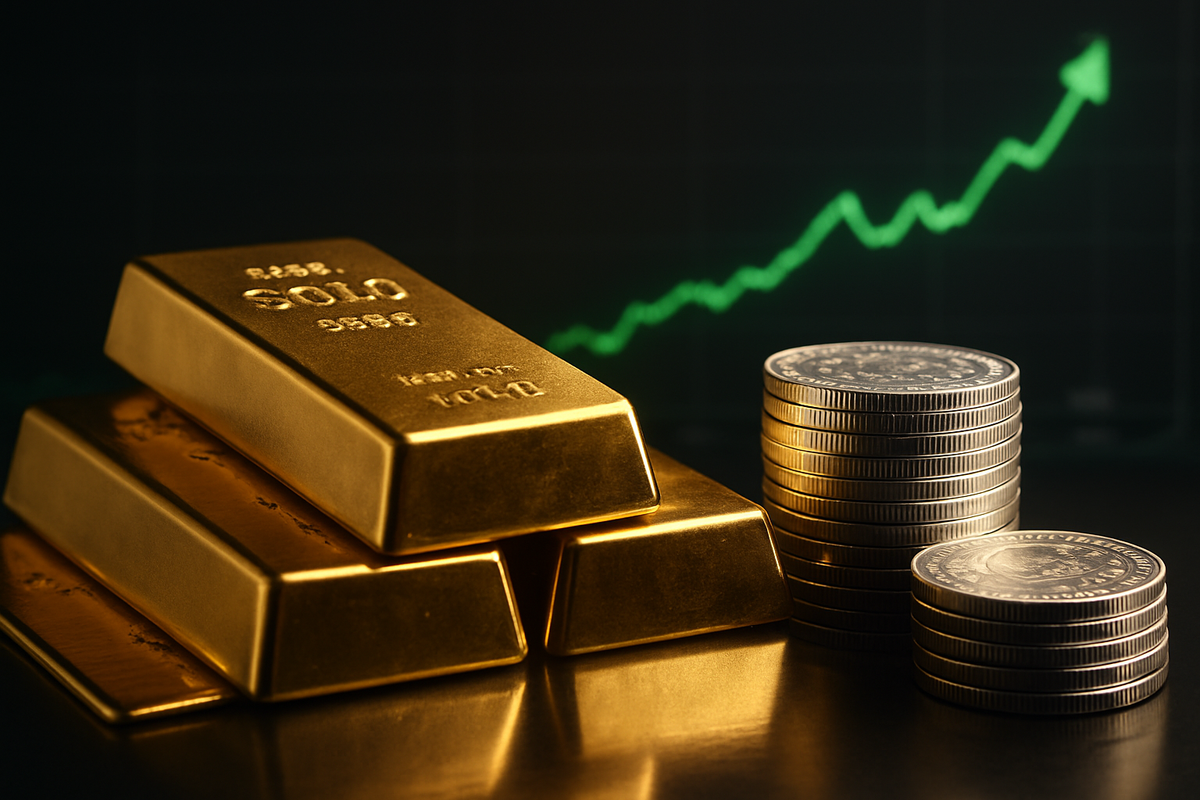
NEW YORK — On this Christmas Eve, December 24, 2025, the financial world is witnessing a historic realignment of the global commodities market. Gold and silver have surged to unprecedented all-time highs, fueled by a decisive dovish pivot from the Federal Reserve and a growing consensus that the era of restrictive monetary policy has come to a definitive end. As of midday trading, spot gold has breached the psychological fortress of $4,500 per ounce, while silver has vaulted past $70, a level many analysts considered impossible just two years ago.
The rally is the culmination of a turbulent fourth quarter, defined by cooling inflation data, a 43-day U.S. government shutdown that blinded regulators to key economic indicators, and a series of interest rate cuts that have sent the U.S. dollar into its steepest decline in nearly a decade. For investors, the message is clear: the "Hard Asset Super-cycle" has arrived, driven not just by speculative fervor, but by a structural shift in how the world values industrial and monetary metals in an age of fiscal expansion.
The path to today’s record-breaking prices began in earnest during the Federal Reserve's September 2025 meeting. After eighteen months of holding rates at restrictive levels to combat post-pandemic echoes of inflation, Chair Jerome Powell and the Federal Open Market Committee (FOMC) executed the first of three consecutive 25-basis-point rate cuts. This initial move brought the federal funds target range down to 4.00%–4.25%, signaling to markets that the central bank was more concerned about a cooling labor market—which saw unemployment tick up to 4.6% in November—than the lingering embers of price growth.
The momentum accelerated in October and November when a protracted 43-day government shutdown halted the release of official Bureau of Labor Statistics (BLS) data. This "data void" forced the Fed to rely on private payroll reports and anecdotal evidence, which painted a picture of an economy nearing a stall. By the time the government reopened and released the November Consumer Price Index (CPI) on December 18, showing inflation had cooled to a manageable 2.7%, the Fed was already committed to its path. On December 10, the central bank not only cut rates for a third time to 3.50%–3.75% but also announced a restart of Quantitative Easing (QE) to ensure "ample reserves" in the banking system, effectively ending the largest quantitative tightening cycle in history.
Market participants reacted with a massive rotation out of Treasuries and into non-yielding assets. The U.S. Dollar Index (DXY) plummeted nearly 10% over the course of the year, providing the necessary tailwind for gold to climb from $4,200 at the start of December to its current peak of $4,525.19. Silver, meanwhile, benefited from a unique supply-demand squeeze, as industrial demand for AI infrastructure and solar energy collided with a fifth consecutive year of silver production deficits, pushing the metal to an intraday high of $72.70 on December 24.
The primary beneficiaries of this rally have been the major mining and streaming houses, which are now generating record-breaking free cash flow. Newmont (NYSE: NEM), the world’s largest gold producer, has seen its stock surge over 130% year-to-date, hitting all-time highs near $102. Similarly, Barrick Gold (NYSE: GOLD) has leveraged the price surge to fund a massive $1.5 billion share buyback program, reporting its highest adjusted earnings per share in a decade. In the silver space, Pan American Silver (NYSE: PAAS) has emerged as a dominant winner, with its shares rising 90% this year following the successful ramp-up of its high-grade Juanicipio mine.
However, the fixed-cost model of "streaming" companies has perhaps provided the cleanest play on the rally. Wheaton Precious Metals (NYSE: WPM) reached an all-time high of $122.81, maintaining a staggering 84% gross profit margin because its costs are largely decoupled from the inflationary pressures of diesel and labor that affect traditional miners. Hecla Mining (NYSE: HL) also reported record milling volumes, proving that domestic producers are capturing significant premiums as supply chains tighten.
Conversely, the surge in silver prices has created a punishing "margin squeeze" for industrial consumers. Solar manufacturers like JinkoSolar (NYSE: JKS) and First Solar (NASDAQ: FSLR) have seen silver rise to nearly 15% of their total module production costs. First Solar, despite a broader renewable energy boom, faced significant stock pullbacks in late December as investors worried that the high cost of silver paste would erode profitability. Tech giants like Apple (NASDAQ: AAPL) and Tesla (NASDAQ: TSLA) are also feeling the heat; Tesla’s electric vehicles require roughly double the silver of traditional internal combustion engines, leading to concerns that the company may have to raise vehicle prices or accelerate "thrifting" efforts to replace silver with less conductive copper.
This 2025 surge is fundamentally different from the speculative peaks of 2011 or the pandemic-induced flight to safety in 2020. Analysts are increasingly pointing to the "structural" nature of the current rally. In August 2025, the U.S. government officially designated silver as a "Critical Mineral," a move that acknowledged its indispensable role in the green energy transition and the burgeoning AI sector. This designation has provided a permanent valuation reset, moving silver away from being viewed merely as "poor man’s gold" and toward being treated as a vital industrial staple.
Furthermore, the trend of "de-dollarization" has reached a fever pitch. Global central banks, led by those in the Asia-Pacific and Middle East regions, purchased an estimated 850 tonnes of gold in 2025. This diversification away from dollar-denominated assets has created a floor for precious metals that did not exist during previous cycles. Historically, when the Fed cuts rates, gold rallies, but the current combination of a weakening dollar, geopolitical instability—including the December naval blockade of Venezuelan oil tankers—and industrial scarcity has created a "perfect storm" for hard assets.
The ripple effects are extending into the broader commodities complex. As gold and silver break out, they are dragging other critical materials higher, complicating the Fed’s mission to keep inflation at its 2% target. The precedent set by the 1970s "stagflationary" environment is being whispered in the halls of Wall Street, as investors wonder if the Fed’s pivot has come too early, potentially reigniting a second wave of inflation driven by raw material costs.
Looking ahead to 2026, the market faces a period of strategic adaptation. For high-tech manufacturers and automakers, the priority will be "material substitution." We can expect a surge in R&D spending from companies like Apple and Samsung as they attempt to reduce the silver content in their circuitry. In the short term, however, these companies have little choice but to pay the market price, which could lead to "pass-through" inflation for consumers in the form of more expensive electronics and EVs.
For the Federal Reserve, the challenge will be navigating a "Goldilocks" scenario where they can continue to ease policy without causing the commodities market to overheat. While the December Summary of Economic Projections (SEP) signaled at least one more rate cut in early 2026, any sign of rebounding inflation could force a sudden and painful policy reversal. Investors should also watch for a potential "supply response" from miners; while it takes years to bring new mines online, the current price environment makes previously uneconomical deposits highly attractive, likely triggering a wave of M&A activity in the junior mining sector.
The takeaway from this historic Christmas Eve rally is that the fundamental relationship between the U.S. dollar and hard assets has entered a new chapter. The Federal Reserve's pivot to a dovish stance, combined with a structural deficit in silver and a global trend toward de-dollarization, has created a robust environment for precious metals that shows no immediate signs of exhausting itself. Gold at $4,500 and silver at $70 are no longer just milestones; they are the new benchmarks for a world re-evaluating the definition of value.
As we move into 2026, the market will be defined by the tension between industrial necessity and monetary policy. Investors should keep a close eye on the Fed’s January meeting and the subsequent labor data releases to see if the economic cooling that justified these rate cuts continues. While the current highs are cause for celebration among gold bugs and mining executives, the long-term impact on industrial margins and consumer prices remains the great unknown of the coming year.
This content is intended for informational purposes only and is not financial advice.