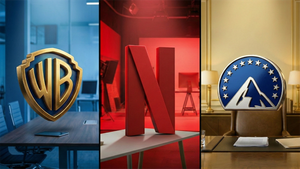
On this February 26, 2026, the media landscape stands at a definitive crossroads. Warner Bros. Discovery (Nasdaq: WBD), a company born from a debt-heavy $43 billion merger in 2022, is no longer just a content powerhouse—it has become the ultimate prize in a high-stakes consolidation endgame. Following its Q4 2025 earnings report, WBD finds itself the subject of an intense bidding war between the streaming titan Netflix (Nasdaq: NFLX) and the newly consolidated Paramount-Skydance (Nasdaq: PSKY). With a narrowed quarterly loss and a streaming segment finally in the black, the company is proving that David Zaslav’s "lean and mean" strategy may have been the necessary, if painful, prelude to a massive exit.
Historical Background
The DNA of Warner Bros. Discovery is a complex tapestry of Hollywood royalty and cable television grit. The "Warner Bros." side dates back to 1923, a studio that defined the Golden Age of cinema. After decades as part of Time Warner, it was famously acquired by AT&T in 2018 for $85 billion—a vertical integration experiment that ultimately failed.
Discovery, led by David Zaslav, emerged as the white knight in 2022, merging with WarnerMedia to form the current entity. The early years of WBD were defined by drastic cost-cutting, the controversial shelving of nearly-finished films like Batgirl, and a relentless focus on paying down the massive debt inherited from the AT&T era. By 2024, the company had pivoted from survival mode to "Max" global expansion, setting the stage for the structural split and acquisition talks dominating headlines today.
Business Model
WBD operates as a diversified media and entertainment conglomerate across three primary pillars:
- Studios: Consisting of Warner Bros. Pictures, New Line Cinema, and DC Studios, this segment produces theatrical and television content. It remains the "crown jewel" sought by acquirers for its deep IP library (Harry Potter, DC Universe, Lord of the Rings).
- Direct-to-Consumer (DTC): Centered on the Max streaming service, this segment monetizes content through subscriptions and advertising.
- Networks: The legacy "cash cow," including CNN, TNT, TBS, and Discovery Channel. While facing secular headwinds from cord-cutting, it still generates significant, albeit declining, cash flows.
The 2026 strategy involves a "structural separation" of the Studios/DTC side from the legacy Networks, allowing the higher-growth assets to be sold at a premium valuation.
Stock Performance Overview
The journey for WBD shareholders has been a volatile "U-shaped" recovery:
- 1-Year Performance: Shares have surged over 120% since early 2025, driven almost entirely by M&A speculation and the realization of streaming profitability.
- 5-Year Performance: Looking back to 2021 (pre-merger), the stock remains down from its initial highs, reflecting the massive "valuation reset" the entire media sector underwent during the 2022-2023 "streaming recession."
- 10-Year Performance: Long-term holders of Discovery or the spin-off shares have faced significant underperformance compared to the S&P 500, largely due to the structural decline of linear television which previously anchored the business.
As of today, WBD trades near $29.00, buoyed by the $31.00 hostile bid from Paramount-Skydance.
Financial Performance
In its latest Q4 2025 report (released today), WBD showcased a company that has finally turned the corner:
- Revenue: Q4 revenue hit $9.46 billion, exceeding analyst consensus.
- Net Income: The company reported a Q4 net loss of $252 million, a significant improvement from the $494 million loss in the prior-year period. More importantly, WBD posted its first full-year net profit ($727 million) since the merger.
- Debt Management: Net debt has been slashed to $29.0 billion, down from a peak of over $40 billion. The leverage ratio now sits at 3.3x, making the company a much more attractive acquisition target.
- Free Cash Flow (FCF): 2025 FCF was $3.09 billion. While lower than 2024 due to one-time "separation costs," the underlying cash generation remains the envy of its peers.
Leadership and Management
CEO David Zaslav has transitioned from a maligned cost-cutter to a "transactional architect." His reputation in 2026 is that of a leader who made the hard choices—canceling projects and restructuring debt—to maximize shareholder value in a sale. Supporting him is CFO Gunnar Wiedenfels, known for his disciplined "financial guardrails" approach.
The board's current focus is navigating the competing bids. While Zaslav initially favored a deal with Netflix to ensure the Warner Bros. brand became the prestige arm of the world’s largest streamer, the higher cash offer from Paramount-Skydance has forced a pivot toward a potential "merger of equals" among the remaining legacy giants.
Products, Services, and Innovations
The core product today is Max, which ended 2025 with 131.6 million global subscribers. Innovation at WBD has shifted toward "content windowing" and AI-driven personalization.
- DC Studios: Under James Gunn, the revamped DC Universe (DCU) has begun its theatrical rollout, providing a renewed competitive edge against Disney's Marvel.
- Gaming: Warner Bros. Games remains a hidden gem, with titles like Hogwarts Legacy demonstrating the power of cross-media IP monetization.
- Ad-Lite Tiers: WBD has successfully pioneered hybrid subscription models that maximize Average Revenue Per User (ARPU) through high-value ad placements.
Competitive Landscape
WBD competes in an arena of giants:
- Netflix (Nasdaq: NFLX): The incumbent leader. Its bid for WBD is an attempt to secure "Must-Have" IP to prevent churn.
- The Walt Disney Company (NYSE: DIS): WBD's primary rival in prestige content and franchises.
- Amazon (Nasdaq: AMZN) & Apple (Nasdaq: AAPL): Deep-pocketed tech competitors that use content as a loss leader for broader ecosystems.
- Paramount-Skydance (Nasdaq: PSKY): The "new" challenger. By merging with WBD, PSKY would create a "Big Three" player capable of standing toe-to-toe with Disney and Netflix.
Industry and Market Trends
The "Streaming Wars" have officially entered the Consolidation Phase.
- Profitability over Growth: Investors no longer reward "subs at any cost." WBD’s move to profitability in DTC has been the catalyst for its 2025 stock rally.
- Linear Sunset: The decline of cable TV is accelerating, forcing companies to "ring-fence" their legacy assets (as WBD is doing with Discovery Global) to protect their studio and streaming brands.
- Bundling 2.0: We are seeing the return of the "cable bundle" through digital partnerships (e.g., the Max/Disney+/Hulu bundle), which has stabilized churn rates across the industry.
Risks and Challenges
Despite the M&A optimism, significant risks remain:
- Regulatory Scrutiny: Any deal with Netflix or Paramount-Skydance will face intense DOJ and FTC oversight. A "blocked" deal could cause WBD shares to crater back to fundamental valuations ($15-$18 range).
- Linear Collapse: If the "Discovery Global" networks decline faster than expected, they could become a "toxic" drag on the parent company's balance sheet before a split is finalized.
- Creative Exodus: Continued cost-cutting and the uncertainty of a sale have strained relationships with top-tier Hollywood talent.
Opportunities and Catalysts
- The Bidding War: With PSKY offering $31.00 and Netflix holding matching rights, a "bidding floor" has been established.
- Global Expansion: Max’s 2026 launch in the UK and Ireland represents a massive untapped market for subscriber growth.
- DCU Success: If James Gunn’s Superman and subsequent films reach "Avengers-level" box office, the valuation of the Studio segment could skyrocket independently of M&A.
Investor Sentiment and Analyst Coverage
Wall Street is currently "Overweight" on WBD. Analysts view the company as a "heads you win, tails you win" play: either it gets bought at a 15-20% premium to current prices, or it remains a highly profitable, de-leveraged standalone leader in content.
- Institutional Moves: Goldman Sachs and Vanguard have increased their stakes in late 2025, signaling confidence in the "separation" strategy.
- Retail Sentiment: Small-scale investors remain wary after the 2022-2024 slump, but the recent price action has brought back "momentum" traders.
Regulatory, Policy, and Geopolitical Factors
The primary hurdle is the U.S. Department of Justice (DOJ). A Netflix-WBD merger would combine the #1 and #3 players in streaming, potentially triggering antitrust concerns regarding market share and data dominance. Conversely, a Paramount-Skydance/WBD merger would be viewed as "defensive consolidation" to survive the tech onslaught, which might receive a more favorable regulatory hearing.
Geopolitically, WBD’s heavy reliance on international markets for Max expansion makes it sensitive to digital services taxes and content localization laws in the EU and India.
Conclusion
Warner Bros. Discovery enters 2026 as a leaner, more disciplined, and ultimately more desirable version of its former self. By prioritizing debt reduction and streaming profitability, David Zaslav has successfully "dressed the bride" for a high-value wedding. Whether the groom is Netflix or the Skydance-led Paramount remains the $100 billion question. For investors, the current Q4 loss is a footnote to the much larger story of a legacy media titan successfully navigating the most turbulent transition in entertainment history. The coming months will determine if WBD remains the master of its own destiny or the foundation of a new global media hegemon.
This content is intended for informational purposes only and is not financial advice.