AI-Driven Manufacturing, Edge Computing Integration, and Hardware-Agnostic Control Platforms Accelerate the Global Shift Toward Software-Defined Industrial Automation
NEWARK, DE / ACCESS Newswire / March 11, 2026 / The global Software Defined Automation (SDA) Market is entering a transformative phase as manufacturers increasingly decouple industrial control software from proprietary hardware. According to the latest analysis by Future Market Insights (FMI), the market-valued at USD 46.63 billion in 2025-is expected to reach USD 54.09 billion in 2026 and surge to USD 112.5 billion by 2036, registering a strong CAGR of 16.0% during the forecast period.
The rapid acceleration reflects a structural shift across global manufacturing, where plant operators are transitioning from rigid, hardware-centric automation architectures toward flexible, software-driven control environments capable of integrating AI, digital twins, and real-time analytics.
Get Access of Report Sample: https://www.futuremarketinsights.com/reports/sample/rep-gb-32159
Industrial Automation Enters the Software-First Era
Traditional industrial automation systems were tightly bound to proprietary hardware controllers such as PLCs and distributed control systems. Today, this model is rapidly evolving.
Manufacturers are adopting software-defined automation architectures that virtualize control logic and allow automation workloads to run on commercial off-the-shelf IT infrastructure using containerization and edge computing technologies.
Industry analysts note that plant managers are increasingly restructuring procurement models to prioritize hardware-agnostic runtime environments capable of integrating IT and operational technology (OT). This transition enables faster system upgrades, scalable analytics, and improved interoperability across production networks.
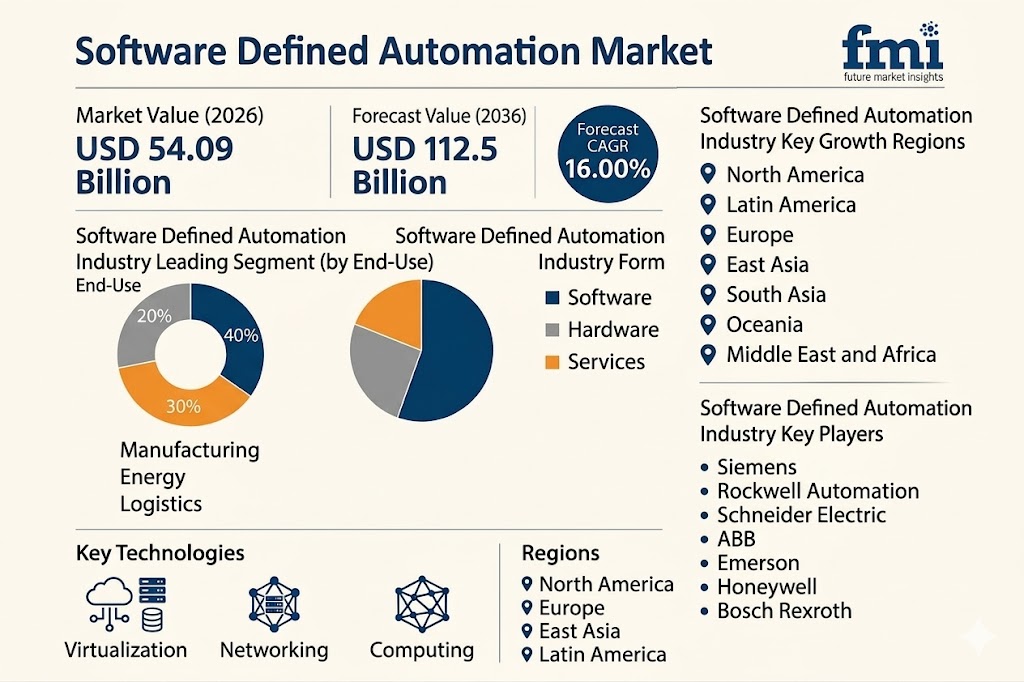
Key Market Highlights (2026-2036)
Metric |
Details |
|---|---|
Market Value (2025) |
USD 46.63 Billion |
Market Value (2026) |
USD 54.09 Billion |
Forecast Value (2036) |
USD 112.5 Billion |
Projected CAGR |
16.0% |
Leading Offering |
Software Platforms (48% Share) |
Dominant End Use |
Manufacturing (46% Share) |
Fastest Growth Region |
Asia Pacific |
Software Platforms Lead the Automation Transformation
Among the various offerings within the software defined automation ecosystem, software platforms dominate the market with a 48% share. These platforms act as centralized orchestration layers that allow manufacturers to manage automation workloads across multiple production sites.
Several factors are accelerating the adoption of software-based automation platforms:
Virtualization of legacy PLC environments into containerized runtime applications
Increased IT budgets for manufacturing digitization
Rising demand for integrated analytics and digital twin simulations
Lifecycle cost reductions through software updates instead of hardware replacements
As factory networks expand and robotic installations surge globally, software orchestration systems are becoming essential for maintaining operational efficiency.
Hybrid Deployment Models Become the Industry Standard
Deployment patterns also reflect the evolving complexity of industrial control systems. Hybrid architectures currently hold a 44% market share, combining on-premise edge computing with cloud-based analytics.
This model allows manufacturers to maintain real-time deterministic control at the factory floor while leveraging cloud infrastructure for data processing and predictive analytics.
Hybrid deployments are favored due to:
Data sovereignty and cybersecurity regulations
Low-latency requirements for industrial control loops
Increasing reliance on AI-based predictive maintenance tools
Seamless integration of distributed robotic systems
As a result, vendors offering purely cloud-based automation models risk disqualification in mission-critical sectors such as automotive, semiconductor manufacturing, and energy.
Manufacturing Industry Drives Market Demand
The manufacturing sector accounts for 46% of global SDA adoption, making it the largest end-use segment.
Production environments are becoming more complex due to increasing product customization, shorter product cycles, and growing automation density. Traditional machine-specific control systems are unable to support such dynamic environments.
Software-defined automation addresses this challenge by enabling:
Dynamic reprogramming of production lines
Digital twin simulations before physical commissioning
Centralized management of robotic fleets
Rapid production changeovers without hardware modifications
With more than 500,000 industrial robots installed globally each year, scalable software orchestration has become critical for managing modern automated factories.
Regional Outlook: Asia Pacific Leads Global Growth
Demand for software-defined automation varies significantly across regions depending on industrial maturity and digital infrastructure.
Asia Pacific
Asia Pacific has emerged as the fastest-growing region, driven by massive manufacturing expansion and government-backed digitalization initiatives.
India: Expected to record the fastest growth with a 19.0% CAGR, supported by strong government incentives and national manufacturing expansion programs.
China: Projected to grow at 18.0% CAGR, driven by large-scale smart factory deployments and rising labor costs.
Japan: Growth of 12.0% CAGR as manufacturers automate operations to offset workforce shortages.
North America
The United States is projected to expand at a 16.0% CAGR, supported by reshoring initiatives and the adoption of smart manufacturing technologies.
Europe
Europe remains a major innovation hub as industrial operators replace closed automation ecosystems with open and interoperable software-defined architectures, aligned with the region's Industry 4.0 initiatives.
Market Challenges: Legacy Infrastructure and Security Concerns
Despite strong momentum, several factors could slow adoption in certain sectors.
Key challenges include:
Resistance from plant operators relying on proven hardware systems
Cybersecurity concerns associated with connected control systems
Complex migration processes for legacy industrial infrastructure
Initial capital investment required for digital transformation
However, government incentives and industry standardization efforts are gradually reducing these barriers and encouraging pilot deployments across mid-sized manufacturing facilities.
Competitive Landscape: Technology Innovation Intensifies
The software defined automation ecosystem is highly competitive and rapidly evolving. Market leaders are focusing on open architecture platforms, AI integration, and cloud-edge orchestration capabilities.
Key companies operating in the market include:
Siemens
Rockwell Automation
Schneider Electric
ABB
Emerson
Honeywell
Bosch Rexroth
Intel
PTC
Beckhoff Automation
Strategic collaborations between automation providers, cloud companies, and semiconductor manufacturers are becoming increasingly common as the complexity of industrial software ecosystems expands.
The Road Ahead: Software Becomes the Brain of the Smart Factory
Looking ahead to 2036, industry analysts believe software-defined automation will become the foundational architecture of smart factories worldwide.
As industrial AI, robotics, and edge computing continue to evolve, the ability to orchestrate complex automation systems through flexible software platforms will determine the competitiveness of manufacturing enterprises.
With the rapid convergence of IT and operational technology, software defined automation is poised to transform industrial production-from rigid hardware-bound factories into adaptive, data-driven manufacturing ecosystems.
For an in-depth analysis of evolving formulation trends and to access the complete strategic outlook for the Composite Insulator Market through 2036, Full Report Request: https://www.futuremarketinsights.com/reports/software-defined-automation-market
Related Reports:
Agricultural Bucket Market- https://www.futuremarketinsights.com/reports/agricultural-bucket-market
Agricultural Sprayers Market Share Analysis- https://www.futuremarketinsights.com/reports/agricultural-sprayers-market-share-analysis
Composite Roller Market- https://www.futuremarketinsights.com/reports/composite-rollers-market
About Future Market Insights (FMI)
Future Market Insights (FMI) is a leading provider of market intelligence and consulting services, serving clients in over 150 countries. Headquartered in Delaware, USA, with a global delivery center in India and offices in the UK and UAE, FMI delivers actionable insights to businesses across industries including automotive, technology, consumer products, manufacturing, energy, and chemicals.
An ESOMAR-certified research organization, FMI provides custom and syndicated market reports and consulting services, supporting both Fortune 1,000 companies and SMEs. Its team of 300+ experienced analysts ensures credible, data-driven insights to help clients navigate global markets and identify growth opportunities.
For Press & Corporate Inquiries
Rahul Singh
AVP - Marketing and Growth Strategy
Future Market Insights, Inc.
+91 8600020075
For Sales - sales@futuremarketinsights.com
For Media - Rahul.singh@futuremarketinsights.com
For web - https://www.futuremarketinsights.com/
SOURCE: Future Market Insights, Inc.
View the original press release on ACCESS Newswire