TUCSON, AZ / ACCESS Newswire / February 26, 2026 / Umbrella Labs today announced an updated research catalog standard that formally presents GLP-3R as the internal research designation for retatrutide, also identified as LY-3437943, supplied as a lyophilized peptide vial for laboratory developmental research use only. This program is designed for laboratories building reproducible tri-receptor signaling studies where naming clarity, lot traceability, and documentation readiness directly impact comparability across experiments.
Laboratory procurement and method documentation programs increasingly require that a compound's catalog name, identifier set, and batch references remain stable across an entire study lifecycle, especially when projects span multiple assay platforms and multiple phases of replication. Umbrella Labs is aligning its tri-receptor peptide offering under the GLP-3R designation to minimize ambiguity in ordering language, labeling, and internal recordkeeping, while preserving established identifiers such as LY-3437943 and retatrutide for cross referencing. The GLP-3R (LY-3437943) listing that anchors this standard is integrated into the Umbrella Labs peptide vial catalog as https://umbrellalabs.is/shop/peptides/peptide-vials/retatrutide-ly-3437943/ and is formatted for research procurement workflows that depend on consistent specification fields and repeat ordering discipline. Within the same listing, documentation-ready identity markers are provided to support inventory systems and study notebooks, including CAS Number 2381089-83-2 and recognized alternate names such as GLP-3R and LY-3437943 to reduce mismatch across databases and internal tools. The program is supported by batch referenced quality documents where available, including certificates of analysis and supporting reports suitable for internal QA filing and reproducibility review.
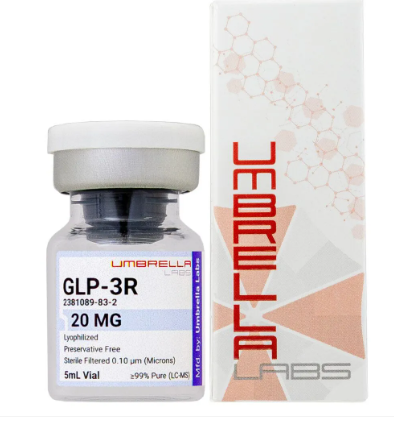
GLP-3R is positioned as a tri-receptor endocrine signaling research tool intended to support controlled bench studies that map receptor proximal activity, pathway kinetics, and downstream marker programs under consistent exposure logic. The offering includes lyophilized/freeze-dried vial options sized to match different project scales, with common selections including 2 mg, 5 mg, and 10 mg vials and additional size options presented on the product page for laboratories planning larger batching strategies. The GLP-3R program is sold strictly for laboratory developmental research use only and is not intended for clinical, diagnostic, therapeutic, medical, veterinary, or household applications, and terms of sale apply.
RESEARCH LAB DISCUSSION, WHY THE NAME CHANGE MATTERS, AND WHAT GLP-3R SIGNALS IN MODERN BENCH SCIENCE
In current endocrine signaling bench science, the fastest growing challenge is not simply measuring a response, but comparing responses across receptor families, across timepoints, and across assay technologies without losing interpretability to naming drift or documentation drift. Multi-receptor ligands often circulate under multiple common names, internal codes, and shorthand labels, which can introduce silent errors in procurement, labeling, and downstream analysis. When a laboratory runs a large assay matrix, a single inconsistent name string can fragment records across inventory systems, push an incorrect label into a protocol, or complicate method transfer between teams.
Umbrella Labs is addressing this risk by standardizing retatrutide as GLP-3R within its research catalog, making the GLP-3R name the primary procurement label while retaining retatrutide and LY-3437943 as secondary identifiers for continuity. This approach reduces the probability of ordering mismatches, improves cross linking between certificates, shipping records, and experimental logs, and provides a stable naming anchor for multi-phase studies. For laboratories purchasing materials as reference reagents, a stable catalog designation is a reproducibility feature, not a cosmetic choice.
The GLP-3R naming convention also acts as a clear signal of the ligand class within a lab's internal taxonomy. Tri-receptor endocrine signaling research is increasingly organized by receptor family coverage, pathway convergence, and downstream response signatures. By using GLP-3R as the standardized label, laboratories can more easily tag protocols, experimental designs, and analytical pipelines as "tri-receptor ligand input" without relying on an inconsistent mix of codes and synonyms.
WHAT GLP-3R MEANS AT THE BENCH, TRI-RECEPTOR PROFILING AND PATHWAY MAPPING
GLP-3R (retatrutide, LY-3437943) is commonly described in scientific literature as a triagonist at the glucagon-like peptide-1 receptor, the glucose-dependent insulinotropic polypeptide receptor, and the glucagon receptor. For bench science, that tri-receptor profile matters because it enables a single standardized input to probe three linked receptor systems under matched conditions. This is valuable for mapping receptor selectivity, relative potency patterns, pathway kinetics, and downstream marker programs across receptor contexts while holding handling variables constant.
Modern endocrine platform development increasingly uses receptor panels that include engineered cell lines, primary-like model systems, and microphysiological platforms where receptor expression can be tuned or compared across conditions. In these systems, a tri-receptor ligand is often used to evaluate how receptor density, receptor cross talk, and signaling network feedback shape the measured output. In addition, tri-receptor ligands can be used as comparators when validating assay performance, calibrating dynamic range, or stress-testing analytical pipelines against complex signaling profiles.
GLP-3R is positioned for laboratory teams that want to run structured experiments across multiple receptors without switching compounds or mixing multiple ligands that increase operational complexity. By providing a single tri-receptor reference input with stable naming, stable specification fields, and traceable documentation, the program supports large matrix studies that would otherwise be vulnerable to recordkeeping friction.
ASSAY STACKS THAT BENEFIT FROM A GLP-3R REFERENCE INPUT
Tri-receptor endocrine signaling work rarely lives in a single assay category. Current research stacks often include receptor proximal readouts, kinetic mapping, downstream transcriptional programs, and metabolic-state proxies in the same project, each with different sensitivity to preparation drift. A stable procurement and documentation framework becomes more valuable as the assay stack becomes broader and more time-resolved.
Receptor proximal activity profiling
Laboratories commonly use second messenger assays, pathway-specific reporters, and activation readouts to compare receptor engagement patterns across GLP-1R, GIPR, and GCGR contexts. These assays are sensitive to concentration accuracy, timing, and container interactions, which is why stable handling expectations and consistent documentation matter when comparing data across runs.
Kinetics and persistence mapping
Time-resolved assays are increasingly used to differentiate rapid receptor coupling from longer-lived signaling persistence, receptor internalization dynamics, and downstream pathway engagement over extended windows. For tri-receptor ligands, kinetic mapping can be particularly informative because the apparent persistence profile may vary by receptor context, cell background, or assay architecture. Repeat ordering discipline and traceable lot records are key when kinetic curves must be comparable across multiple phases of a project.
Downstream marker programs and systems-level signatures
Many endocrine signaling labs pair receptor activation with multi-omics or targeted marker panels, including transcript-level response mapping, phosphoprotein panels, and metabolic-state signatures. In these designs, the initial receptor event is used to trigger downstream cellular state transitions that are sampled across multiple timepoints. Because downstream programs integrate many inputs, controlling reagent provenance and preparation assumptions becomes critical for interpretability.
Platform validation and method transfer
A tri-receptor ligand is also useful as a platform validation tool when laboratories need to confirm that a receptor panel behaves as expected across instruments, across operators, or across sites. A stable, standardized naming convention reduces errors during method transfer and ensures that "the same input" truly means the same catalog item, the same identifier set, and the same documentation trail.
REFERENCE MATERIAL CHARACTERISTICS, SPECIFICATION FIELDS, AND HANDLING EXPECTATIONS
GLP-3R is supplied by Umbrella Labs as a lyophilized/freeze-dried material intended for laboratory preparation workflows. Lyophilized formats support structured batching strategies and allow laboratories to align preparation timing to assay schedules under internal standard operating procedures. The GLP-3R listing provides specification fields designed for internal documentation, including Molecular Formula C223H343F3N46O70 and Molecular Weight 4845.44, supporting consistent recordkeeping across inventory systems and analytical reporting.
The listing states purity at or above 99 percent by LC-MS, aligning with laboratories that require a stated purity reference for internal procurement standards and reproducibility review. Storage guidance is presented to support stability-minded inventory practices, including storing cold, keeping refrigerated, and avoiding freezing. The listing also states that the peptide arrives lyophilized/freeze-dried and must be reconstituted to become dispensable in liquid form, supporting laboratories that plan controlled reconstitution workflows under institutional procedures.
Umbrella Labs emphasizes that laboratories should follow internal safety procedures, appropriate laboratory controls, and documentation practices suitable for biochemical research materials. In reproducibility-focused projects, preparation variables are often treated as controlled parameters, including container selection, dilution strategy, mixing approach, timing between preparation and assay exposure, and tracking of handling events. A standardized procurement label supports this discipline by reducing ambiguity at the very first step, material selection and documentation.
QUALITY DOCUMENTATION, TRACEABILITY, AND REPRODUCIBILITY SUPPORT
High rigor bench science depends on traceable inputs. When results differ between runs, laboratories need the ability to confirm whether the difference is model-driven, assay-driven, or input-driven. Umbrella Labs supports this need by presenting GLP-3R with a stable SKU structure and documentation resources where available, including MSDS access and batch referenced certificates of analysis and related reporting.
The GLP-3R listing includes direct references to certificate documents intended to support internal QA filing and procurement traceability. For laboratories running sensitive assays or multi-omics stacks, documentation readiness reduces administrative friction and strengthens replication planning. When a study is repeated after a delay or transferred between teams, stable naming plus traceable documentation helps ensure that the material input is truly consistent.
The GLP-3R naming standard is designed to function as a laboratory-friendly anchor across the procurement-to-data chain. Procurement records, receiving logs, storage records, protocol documents, and assay results can all reference the same standardized label while retaining LY-3437943 and retatrutide identifiers for external cross referencing. This reduces the probability of mismatched labels, improves internal searchability, and makes audits of experimental inputs simpler.
BUYING FOR RESEARCH, PROCUREMENT CONTINUITY, AND INVENTORY PLANNING
Laboratory purchasing programs frequently prioritize continuity, because switching sources mid-project can introduce confounding variables and complicate documentation. The GLP-3R program is structured to support buying for research with stable catalog references, lyophilized vial options that match different project scales, and specification fields that can be copied directly into inventory systems. Common vial sizes presented for GLP-3R include 2 mg, 5 mg, and 10 mg options, supporting flexible batching strategies for assay development, replication campaigns, and longer multi-phase research programs.
A procurement-continuity approach is especially valuable for tri-receptor studies where the same ligand input is used across multiple assay platforms. Consistent sourcing reduces the need for repeated revalidation and helps laboratories maintain clean comparability across data sets. Umbrella Labs encourages laboratories to pair procurement records with internal preparation logs that capture timing, storage conditions, and key handling assumptions so that results remain interpretable over time.
For laboratories maintaining LIMS workflows, the GLP-3R naming standard simplifies reference mapping and improves data hygiene. A single standardized name can be used to tag protocols, sample sets, and analytical pipelines, while secondary identifiers can be maintained for external referencing and literature alignment. This reduces the chance that a study's input is fragmented into multiple name variants inside a database, which is a common issue in multi-receptor research programs.
NEW RESEARCH DIRECTION, TRI-RECEPTOR SIGNALING AND INTEGRATED METABOLIC READOUT STACKS
A notable trend in endocrine signaling bench science is the shift toward integrated readout stacks that combine receptor activity with metabolic-state proxies and cellular stress signatures in controlled experimental systems. Tri-receptor ligands are particularly useful in these designs because they offer a single input that can be applied across multiple receptor contexts, enabling laboratories to characterize convergence and divergence across signaling networks.
In integrated designs, the most frequent source of interpretability loss is uncontrolled variability in inputs and preparation. A tri-receptor ligand may be used in receptor assays, then in downstream marker experiments, and then in metabolomics or transcriptional studies, often spanning weeks. A stable naming and procurement framework helps laboratories hold one major variable constant, the input identity, while the study explores the variables that matter, model conditions, receptor context, timing, and measurement platform.
The GLP-3R program is intended to support this new lab reality where studies are broader, longer, and more data-intensive. By treating naming clarity as part of scientific rigor, Umbrella Labs aims to reduce operational friction and improve the reliability of comparisons across runs, across assay families, and across study phases.
RESEARCH USE ONLY STATEMENT
GLP-3R (retatrutide, LY-3437943) supplied by Umbrella Labs is sold strictly for laboratory developmental research use only. It is not intended for consumption or for clinical, diagnostic, therapeutic, medical, veterinary, or household applications, and terms of sale apply. Materials should be handled only in appropriate research facilities using established institutional procedures for biochemical reagents, documentation, and safety.
ABOUT UMBRELLA LABS
Umbrella Labs is a U.S.-based supplier of research grade peptides, SARMs, and biochemical reagents focused on supporting rigorous, transparent, laboratory developmental research use only applications in academic and private laboratories. The company emphasizes specification-forward listings, traceable procurement, and documentation support to help research programs maintain consistent materials across repeat experiments and multi-run bench science workflows.
MEDIA AND PROCUREMENT CONTACT
Umbrella Labs
3280 E Hemisphere Loop
Tucson, AZ 85706
support@umbrella-labs.us
1-866-289-7276
SOURCE: Umbrella Labs
View the original press release on ACCESS Newswire