Image generated by Gemini
The private aviation sector is experiencing unprecedented growth, with the market for new business jets projected to generate a record-breaking $283 billion in profit from 8,500 new deliveries over the next decade. This expansion is part of a much larger trend, as the global private aircraft market is anticipated to soar from $26.6 billion in 2024 to $80.8 billion by 2034. For investors holding these multi-million dollar assets—whether they are new business jets or valuable vintage planes—the primary driver of resale value is not market sentiment alone, but pristine physical condition. Environmental exposure and improper storage represent the most significant, yet often overlooked, financial risks to these assets, silently eroding value and leading to diminished returns and inflated maintenance costs.
The Hidden Costs Eroding Your Aircraft's Market Value
Corrosion: The Billion-Dollar Threat to Airframes and Avionics
Corrosion is a persistent and costly threat in aviation, driven by the electrochemical reaction of metals with their environment. Exposure to high humidity, salt-laden coastal air, and industrial pollutants significantly accelerates the degradation of aluminum alloys, critical engine components, and sensitive avionic systems. This process is far more than a cosmetic issue; it directly compromises the structural integrity of the airframe, leading to exorbitant repair bills and, in severe cases, rendering an aircraft unairworthy. For an investor, corrosion's impact is twofold: it drastically reduces the aircraft's valuation in the secondary market and diminishes its liquidity, as potential buyers are deterred by the high cost and downtime associated with remediation.
UV Radiation and Material Degradation
Constant exposure to the sun's ultraviolet (UV) radiation inflicts significant damage on an aircraft's exterior and interior finishes. UV rays cause expensive paint to fade, chalk, and peel, while rubber seals and gaskets become brittle and crack, compromising weatherproofing and pressurization. Inside the cabin, luxurious upholstery, leather, and wood veneers can discolor and deteriorate, detracting from the high-end appeal expected in a private aircraft. From an investor's perspective, this visible wear signals neglect to appraisers and prospective buyers. A visually worn aircraft will command a significantly lower perceived value, regardless of its mechanical condition, leading to a direct and often substantial financial loss upon resale.
Rising Maintenance Burdens Amidst Parts Scarcity
The connection between inadequate storage and increased maintenance frequency is direct and financially draining. An aircraft stored outdoors is subject to constant environmental assault, necessitating more frequent inspections, cleaning, and preventative servicing to combat accelerated wear. This problem is compounded by current market conditions. Recent data reveal that air cargo operators, MROs, and lessors are increasingly constrained by parts scarcity and aging fleets. In this environment, protecting existing components is no longer just a best practice; it has become a financial necessity to avoid long operational downtimes and the costly, time-consuming search for scarce replacement parts. Preventative care through proper storage is the most effective strategy to manage these escalating risks.
A Comparative Analysis of Aircraft Storage Solutions
Evaluating the Risks of Common Storage Methods
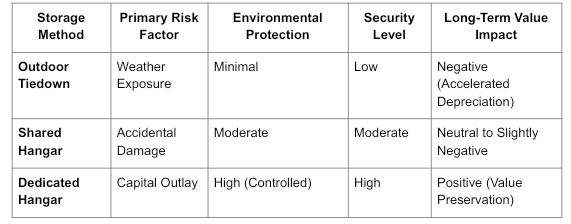
Aircraft owners often default to common storage methods without fully weighing the long-term financial consequences. Outdoor tie downs, while the least expensive option, leave an asset completely vulnerable to weather, UV radiation, pollutants, and security threats, accelerating depreciation. Communal or shared hangars offer a step up in protection but introduce a significant risk of hangar rash—accidental damage caused by the movement of other aircraft, ground equipment, or personnel. This type of damage can be costly to repair and may negatively impact the aircraft's maintenance history and subsequent valuation, making it a considerable liability in a shared, high-traffic environment.
Storage Options: A Cost-Benefit Breakdown
The Financial Case for a Controlled Environment
A dedicated, controlled-environment hangar directly mitigates the financial risks of corrosion, material degradation, and accidental damage. The ability to manage humidity and temperature is the most effective weapon against corrosion, halting its formation before it can compromise airframes and electronics. This proactive approach to preservation translates into a clear financial benefit. Furthermore, insurers recognize the drastically reduced risk profile of aircraft stored in private, secure facilities. Consequently, aircraft owners with dedicated hangars often qualify for lower insurance rates, a recurring operational saving that helps offset the initial capital investment in the structure while maximizing the asset's long-term value.
The Strategic Advantages of Custom Steel Hangars
Why Modern Steel Construction is the Industry Standard
The superiority of modern steel construction for aircraft hangars stems from its unique combination of safety, durability, and cost-efficiency. For serious aviation investors, choosing a prefabricated steel structure is a strategic decision that offers tangible returns through enhanced protection and lower lifetime costs. These advantages are critical when safeguarding a multi-million dollar asset against a range of environmental and physical threats.
Superior Fire Resistance: Steel is a non-combustible material, a critical safety feature when storing assets containing jet fuel and sensitive electronics. This property helps contain a potential fire, protecting not only the aircraft but also surrounding property and personnel, as steel's inherent fire resistance prevents it from fueling a blaze.
Structural Durability: Engineered steel hangars are designed to meet or exceed local building codes for extreme weather conditions, including heavy snow loads and high winds. This provides unparalleled structural protection against events that could destroy less resilient structures and the assets within them.
Reduced Construction Time: The use of prefabricated steel components can significantly shorten the building timeline, decreasing construction time by as much as 60% compared to traditional methods. This speed allows owners to secure their valuable aircraft in a protected environment faster, minimizing exposure to risk.
Low Long-Term Maintenance: Unlike wood or other materials, steel is resistant to pests like termites, as well as rot, mold, and warping. This resilience results in substantially lower lifetime maintenance costs, contributing to a more favorable total cost of ownership for the investor.
Tailoring the Structure to Your Aviation Portfolio
A one-size-fits-all approach to aircraft storage is both inefficient and risky, as an improperly sized hangar can lead to accidental damage or limit operational flexibility. The most effective storage solution is purpose-built for the specific needs of the aircraft and its owner. True asset protection requires precision. Ensuring the structure is built to the exact size of your aircraft, from wingspan to tail height, is a non-negotiable step in optimal asset protection. This level of customization extends far beyond the aircraft's immediate footprint. With modern steel buildings offering clear spans of up to 300 feet without interior support columns, owners can design a highly efficient space that also accommodates maintenance bays, ground support equipment, and even office or lounge facilities.
Proactive Preservation in a Growing Market
In an aviation market characterized by strong growth and accumulating operational risks, proactive asset protection is not an expense—it is a fundamental investment strategy. Aircraft lessors are navigating a landscape where geopolitical and market risks are increasingly complex, placing a higher premium on assets that are well-maintained and physically secure. The decision to invest in a dedicated, custom-built hangar directly correlates with preserving an aircraft's long-term capital value and ensuring its marketability in any cycle. The aircraft hangar market itself is projected to grow to $1.17 billion by 2034, a trend that aligns with the expanding private aircraft fleet. For savvy investors, securing the right ground infrastructure is as critical as acquiring the aircraft itself.
Disclaimer: This article is provided for general informational purposes only and does not constitute investment advice. The opinions expressed are those of the publication and are subject to change without notice. Investing in financial markets involves risk, including the possible loss of principal. Past performance is not indicative of future results. Readers should do their own due diligence and speak with a qualified financial advisor before making any investment decisions.
Media Contact
Company Name: Pulse of Strategy
Contact Person: Jay Jangid
Email: Send Email
City: New York
Country: United States
Website: https://www.pulseofstrategy.com/