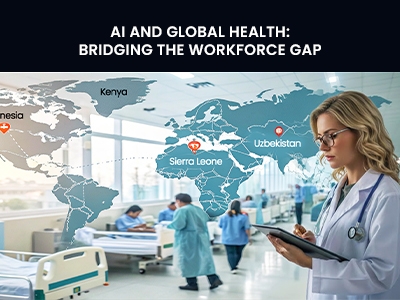
GENEVA - An ambitious new digital roadmap was unveiled by the World Health Organization (WHO) and the World Bank Group. It targets an initial 45 nations. The goal is simple: use artificial intelligence and digital monitoring to save a global health system that is currently running out of human beings.
This framework aims to provide essential care to 1.5 billion people by 2030. It is a massive undertaking. According to a December 2025 World Bank report, the reality is bleak. Right now, 4.6 billion people cannot access a basic clinic or doctor. President Ajay Banga originally committed to this 1.5 billion target in 2024, but the 2026 update makes one thing clear: technology is no longer a luxury. It is the only way forward.
The Nursing Shortage Crisis
The problem is a lack of people. The WHO’s 2026 Health Workforce Bulletin estimates a global shortfall of 11 million workers by 2030. That number keeps growing. Nurses and midwives are the most scarce. Projections suggest a 4.5 million-person gap in the nursing sector alone.
Dr. Uche Ralph-Opara, Chief Health Officer at Project HOPE, spoke to reporters in January. She described a "tipping point" where burnout and aging are hollowing out hospitals. "The human personnel holding these systems together are facing impossible demands," Ralph-Opara said. She noted that recruitment simply cannot match the speed at which the current workforce is retiring.
Why AI is Taking Over Operations
In 2026, AI is not just a buzzword. It is a survival tool. The Deloitte 2026 Global Health Care Outlook report found that 80 percent of health executives expect generative AI to keep their clinics running this year. It is about paperwork. Currently, administrative "friction" eats up 30 percent of a doctor’s day.
Administrators are fighting back. Around 64 percent of them plan to use AI to automate those logs. By early 2026, roughly 30 percent of surveyed health systems were using generative AI at scale. Take Northwestern Medicine as an example. They now use a system that drafts radiology reports instantly. These drafts are 95 percent complete when the doctor first sees them. This lets the human radiologist focus on the diagnosis, not the typing.
FDA Milestones: 1,200 Clearances
The regulatory floodgates have opened. Submission trends from the Stanford-Harvard ARISE network show that AI-enabled medical devices are projected to reach 1,200 FDA clearances by early 2026. This is a massive leap from the 950 clearances seen in late 2024.
These machines are moving into high-stakes roles. They route patients. They predict prescriptions. The ARISE "State of Clinical AI" report notes that systems now monitor patients for sepsis or respiratory failure in real-time. Often, the AI sees the danger hours before a human nurse would notice a change in the patient's vitals.
National Health Compacts: The Funding Fix
A key part of Tuesday's announcement is the "National Health Compact." These are five-year reform plans that bring together a country's finance and health ministries. In December 2025, 15 countries signed these compacts in Tokyo. They set hard targets.
Since the 1.5 billion-person goal was set, the World Bank claims it has already helped reach 375 million people. Now, they are working with 45 priority countries. These include the Philippines, Indonesia, and Kenya. The focus is on primary care. Ajay Banga, World Bank President, stated that strong health systems are about more than just medicine. They are about jobs.
Ground-Level Impact: Indonesia to Sierra Leone
The impact of these digital tools varies by region. In Indonesia, the "SatuSehat" platform has connected 600 rural clinics to major hospitals. In Uzbekistan, digitizing patient files has already slashed administrative work by 30 percent.
Sierra Leone has even bolder plans. They want every citizen to be within five kilometers of a clinic. This involves building 300 new facilities, all equipped with solar power and digital links. Ethiopia plans to have 40 percent of its health centers running on these digital tools by the end of 2026.
The 2026 Financial Tsunami
The financial side of this crisis is equally daunting. The World Bank Group is currently navigating what it calls a "double-squeeze" on global health funding. Higher interest rates in the West have made it nearly impossible for developing nations to borrow money for clinical infrastructure. This is why the AI framework is being pitched as a cost-saving measure.
World Bank Vice President for Human Development, Mamta Murthi, noted that "efficiency is the only currency we have left." Without the ability to build massive new hospitals, countries are being forced to turn their existing small clinics into "smart hubs" that use predictive algorithms to manage patient loads.
Case Study: The Philippines and the Digital Archipelago
One of the most complex implementations of the new framework is currently taking place in the Philippines. With over 7,000 islands, the logistical nightmare of providing healthcare is unparalleled. The Philippine government is deploying "AI-on-the-edge" devices. These are diagnostic kits that do not require a constant internet connection to function.
These kits use local AI models to screen for tuberculosis and malaria in remote mountain villages. When a patient is flagged as high-risk, the data is synced to a central server the next time a health worker reaches a satellite link. This "store and forward" AI model is now being studied by the WHO as a potential template for other island nations.
The Rise of the Medical "Digital Twin"
Another technical pillar of the framework is the use of digital twins. These are virtual models of a nation's health system. In countries like Vietnam, health ministries are using these twins to simulate how an outbreak of avian flu would move through the population.
By running these simulations, officials can determine exactly where to send their limited supply of human doctors. This "precision deployment" is a core part of the World Bank's strategy to maximize the output of a shrinking workforce. If you only have one doctor for 10,000 people, you need an algorithm to tell you where that doctor will save the most lives today.
Rising Costs and Economic Friction in the West
The Business Group on Health’s 2026 Strategy Survey is a reality check for the U.S. market. It predicts a 9 percent spike in healthcare costs this year. That is a heavy blow for employers. Ellen Kelsay, CEO of the group, said 70 percent of employers are turning to tech to survive these costs.
They want AI that manages chronic diseases like diabetes before they become emergency room visits. By the end of 2026, 58 percent of major employers plan to have AI-driven remote monitoring for their workers. This mirrors the global shift toward "care at the edge," where the hospital is no longer the center of the medical universe.
Geopolitical Roadblocks and the "Silicon Ceiling"
But software alone cannot fix everything. The World Economic Forum (WEF) Global Risks Report 2026 warns of "geoeconomic confrontation." Half of the experts surveyed expect a "stormy" outlook for international cooperation.
This matters because of the hardware. AI needs chips. It needs sensors. It needs 5G towers. If trade wars stop the flow of these parts, the WHO's framework fails. This "silicon ceiling" is the biggest threat to the World Bank's plan. Supply chains are fragile, and maternal mortality in conflict zones remains double the global average.
Safety, the "Black Box," and Ethical Liability
The WHO issued a warning with Tuesday's framework. They insist that machines cannot replace doctors. Every AI decision must have a "human-in-the-loop." There is a real fear of "black box" algorithms, where the doctor doesn't know why the AI gave a certain piece of advice.
The Stanford-Harvard ARISE report warns that AI can fail in the "messy reality" of a busy ER. They are pushing for "Explainable AI." The system must show its work. Without this, the risk of bias or error is too high for the World Bank to ignore. Legal experts are also questioning who is liable when an autonomous agent makes a wrong call in a country with limited medical malpractice laws.
The Infrastructure Gap: Solar and Satellites
For the WHO's vision to work, basic infrastructure must be overhauled. In Sierra Leone and parts of sub-Saharan Africa, the challenge is not just the AI; it is the electricity. The World Bank is bundling its AI framework with massive investments in solar micro-grids for clinics.
Over 1,800 facilities in Sierra Leone are being equipped with solar panels and Starlink satellite terminals. This creates a "digital oasis" in areas that previously had no way to communicate with a central hospital. Without power and data, the most advanced AI in the world is just an expensive paperweight.
The Human Toll: Burnout and the "Quiet Quitting" of Doctors
While the focus is on technology, the human element cannot be ignored. A 2026 survey by the International Council of Nurses found that nearly 40 percent of nurses in the developing world intend to leave their current jobs within two years.
The fear is that as AI takes over the administrative tasks, the remaining "human" work will become even more intense and emotionally draining. The WHO's framework includes a "Wellness Tier" designed to monitor the stress levels of the human workforce, but critics argue that more tech is not a substitute for better pay and shorter shifts.
Accountability and the Road to Tokyo
The world will look at these results in December 2026. That is when the WHO and World Bank will meet again in Tokyo. They will have to prove that these algorithms actually saved lives. They will have to show that the "National Health Compacts" translated into real, on-the-ground improvements.
The message from Geneva is clear: the human workforce is not growing fast enough to meet the demand. We have to build the machines to fill the gap. But as we do, we must ensure the machines serve the patients, rather than just the balance sheets of the funding agencies.
Final Observations on 2026
As we move into the second half of the decade, the line between "health tech" and "public health" has effectively disappeared. The World Bank is no longer just a lender; it is becoming a tech orchestrator. Whether this experiment in automated medicine succeeds or fails will likely define the survival of universal health coverage for the next generation.
The stakes could not be higher. If the AI fails to deliver, the 11 million-person gap will become a chasm that no amount of money can fill.
Media Contact
Company Name: Inceptives Digital
Contact Person: Mike Davis
Email: Send Email
Phone: +1 737-389-7170
Address:5900 Balcones Drive STE 100
City: Austin
State: TX 78731
Country: United States
Website: https://inceptivesdigital.com/